Showing posts with label nathula. Show all posts

Thursday, June 30, 2011

China Traders want to offer more goods at Nathula border marketplace

YADONG, Tibet - After a half-hour drive to the Renqinggang Border Trademarket in Yadong county of the Tibet autonomous region, 29-year-old Shi Fanlu is the first trader to arrive at about 8 am on Monday.

Although most customers, especially the Indian buyers, always come in the afternoon, the girl from East China's Zhejiang province still gets up early.

"The peak season for border trade will start next month (July), so I must get ready," Shi told China Daily.

Since its reopening in 2006, Shi and her husband, Wang Jinxing, have been in the carpet business at the border trade market, where trade through Nathu La, a pass on Tibet's border with India, is duty-free.

Indian exports are limited for now to an approved 29 commodities, mostly food products like candies and coffee, while Chinese traders are restricted to bringing in 15 types of goods, including goat and sheep skins, wool and herbs.

"The approved list was made in the 1960s, which cannot meet the increasing demand of the Chinese and Indian people near the border due to the fast economic development," Kelsang Dekyi, deputy head of Yadong county, told China Daily.

Although Shi's carpet business is included in the approved list, she still hopes the list can expand because many of her customers want to buy household appliances and daily necessities.

Li Jiying, 48, who sells china at the market, said more than 66 percent of the traders here have left since the reopening of the market because business is not easy, with too many restrictions on the goods that can be traded.

Although china is not on the list, he still has regular customers, such as Sonam Ongmu from Gangtok, Sikkim, who always appears on Monday for china in Li's shop.

Sonam likes the bowls, vases and plates with beautiful patterns and she has to carry the china she bought in the market in her large bag to avoid the border check.

Like most Chinese traders, Cham Chung, an Indian trader from Gangtok, also felt the business in the market, because the commodities restrictions, is just "okay".

The 47-year-old Indian woman has been doing business for three years in the border market.

Although the traders do not feel satisfied about their business, the yearly export and import volume is still climbing from nearly 1.5 million yuan ($232,000) in 2006 to about 20 million yuan in 2010, according to statistics from the Yadong county government.

The Renqinggang Border Trademarket opens from May to December every year, because the rest of the year experiences extreme cold weather and heavy snow, about 1 to 2 meters deep, said Kelsang Dekyi.

The market covers about 6,400 square meters with a total investment of 10 million yuan.

Xigaze prefecture in Tibet has 21 border trade markets like the Renqinggang Border Trademarket and two trading ports through roads, said Wangdu, deputy commissioner in Xigaze prefecture.

"In the coming five to 10 years, we will further improve the border trade environment to push its development," he added.

China Daily

Thursday, June 02, 2011

Nathula, the 14,140-foot-high Himalayan Cross-border trade impeded by harassment

GANGTOK: Trade between India and China through Nathula, the 14,140-foot-high Himalayan border near Sikkim, has made no significant headway five years after it opened up for commerce between the two countries, says Debaashish Bhattacharya

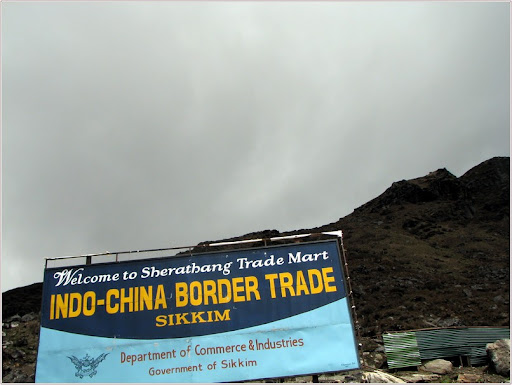
Deadlock: The snow covered trade mart at Sherathang, about 5km from Nathula. Picture by Prabin Khaling
It’s quite a distance for a Sikkimese to travel for yak’s hair and tail. But then, Tibetans have to come all the way to this remote market for their jaggery and tea. If they are lucky, they can buy some snuff, and perhaps a tin of tobacco. And buyers on the Indian side can look forward to goat or sheep skin.

It wasn’t meant to have been like this. When India and China resumed trade on July 6, 2006, through Nathula, the 14,140-foot-high Himalayan border that had stayed shut since the 1962 war between the neighbours, it was a dream come true for many. Sikkim, after all, has had a long history of trading with its neighbour Tibet, Nathula being part of the old Silk Route.

Five years down the line, traders in Sikkim rue that the vision was a mere pipe-dream. “Who’s going to go all the way there to buy yak tail or yak hair or for that matter goat or horse imported from Tibet,” asks trader Gompo Tshering Bhutia.

The border trade — which takes place four days every week between May 1 and November 30 at Sherathang in Sikkim, 5km from Nathula, and Renquingang in Tibet — got off on the wrong foot this year. Because of bad weather, the opening was delayed by one day and then trade was suspended for two days after landslides blocked the road to Sherathang.

On May 4, when some traders tried crossing into Tibet, they were stopped by Chinese customs officials, says Bhutia, who is also the Indo-China Border Trade (Sikkim) Association general secretary. This led to a week-long boycott of trade by the Sikkimese, starting May 5. East Sikkim district collector D. Anandan, who issues some 300 “trade passes” every year to enable Indian traders to visit the trade mart on the Chinese side of the border without a passport or visa, says the issue has now been resolved, and trade has resumed.

But what’s clear is that traders are unhappy. Bhutia points out that a yak tail bought for Rs 2,500 in Tibet sells for barely Rs 3,500 in Sikkim. “It is simply not worth it.”

Under a 2003 agreement between India and China, only people from Sikkim and Tibet can participate in this border trade. Indians can sell 29 specified items, which include tea, coffee, dry fruit, snuff, jaggery, spices and tobacco. And they can buy 15 items, including yak hair and tail, used for religious rituals, goat and sheep skin, goats, sheep and horse and wool.


The list, the Sikkimese traders say, would have made sense half a century ago, but has few takers now. “There is a great demand for Indian biscuits, cooking fats and incense sticks in Tibet. But these don’t figure on the list,” rues another trader. “The list of items may not be very realistic in today’s context,” admits Sikkim chief secretary N.D. Chingapa.

No wonder Motilal Lakhotia has stopped trading on the border, even though he’d waited for almost 44 years for it.

Lakhotia, who travelled on horseback regularly from 1954 to 1962 with mules carrying merchandise into Tibet, was initially full of hope. “I went all the way to Tibet from Gangtok on the opening day itself,” Lakhotia, 85, says. But he and his sons have stayed away from the border trade in the last five years, for it makes no economic sense to them.

The list needs to be revised to galvanise traders — but this is something Sikkim says it is powerless to do. “It is for India and China to make or revise the list. We cannot interfere with it,” Sikkim commerce and industries secretary M.G. Kiran says.

Union commerce minister Anand Sharma did not respond to requests for an interview. But commerce ministry sources say a request for a revision, received from the Sikkim government, has been forwarded to the ministry of external affairs, which will have to take it up with Chinese authorities.

Economic projections for Nathula trade — and the resultant expectations that it would alter not just the economic landscape of Sikkim but of the entire eastern region — painted a rosy picture.

A Sikkim government study, prepared by economists and trade experts led by Mahendra P. Lama of the Jawaharlal Nehru University in 2005, predicted goods worth Rs 206 crore flowing through Nathula by 2007, rising steadily to Rs 2,266 crore by 2010.

Even in a worst-case scenario, the study said Nathula would witness a trade volume of not less than Rs 353 crore by 2010.

According to the Sikkim commerce and industries department, goods worth only Rs 6.54 crore — both exports and imports — have flown through Nathula over the last five years.

Lama, now vice- chancellor of Sikkim University, says the projections were based on the assumption that it would be an open international trade and not a restricted border trade. For increased trade, he says there is need for basic infrastructures like roads and electricity and facilities like banking, transport and communications. “But unfortunately, that hasn’t happened,” the economist says.

The 54-km road to Nathula from state capital Gangtok is pot-holed and treacherous, with regular landslides blocking traffic. Though the Border Road Organisation is widening the road, the ensuing digging and blasting are triggering more landslides.

“The road condition on the Indian side is terrible and there is nowhere to eat or rest. We are doing this trade only because we want to see Tibet,” says merchant Sonam Bhutia, lauding the two-lane, all-weather road on the Tibet side.

What’s worse, Sikkim Chamber of Commerce president S.K. Sarda says, is that people have to go to the trading marts on either side in person for the trade. “In any international trade, you usually sit in your office, place orders and ask your bankers to pay through letter of credits. But here, you have to do everything in person, so naturally few established traders are inclined to engage in border trade,” he says.

Curiously, officers in the State Bank of India, which has a satellite office near Nathula, say hardly any traders exchange money even though all payments are to be made in US dollars.

“We stayed there for four days last year, but no traders came to us. We are short-staffed, so we locked the office and came away,” says Sonam T. Bhutia, deputy manager of SBI’s Gangtok branch, which runs the satellite office.

A Nathula trader says traders from both sides use the currencies of their respective countries for business, a practice officials call illegal.

That’s not the only illegal activity. Chinese flasks, blankets, carpets and beers — none of which figures on the list of importable items — are finding their way into Gangtok and adjoining towns, allegedly via Nathula, which is denied officially but acknowledged privately.

Intriguingly, the official import figure via Nathula for 2010 stood at “nil” while the export figure stood at a little over Rs 4 crore. “Then, the question one may ask is, what did the Chinese traders who came in droves in 2010 sell? Obviously, they sold items that were unlisted, so the official import figure for listed items stayed nil,” says Pema Wangchuk, editor of Sikkim Now, a local paper.

Sikkim’s lone Lok Sabha MP Prem Das Rai, a former entrepreneur, says the Centre has to demonstrate that it is serious about the trade. “If it is, it should build infrastructure and create a land port in Nathula and start doing trade systematically and substantively, if necessary in phases,” Rai says.

If not, octogenarian Motilal Lakhotia has a simple solution. “Seal the border and close the trade. Let me go with my memories of free and open trade.”

Sunday, May 15, 2011

BJP's Border Darshan yatra to Nathu La Pass


New Delhi, May 14 : In order to sensitise countrymen about the security problems of the border areas and people living there, BJP veteran L K Advani today flagged off a unique 'Border Darshan' pilgrimage.
"Border Darshan is an effort to focus attention on the areas which have been in the forefront of the country's defence. Border areas like Kashmir and Northeast need special care and we have to ensure our defence preparedness to face challenges emerging from various factors across the border," Mr Advani said at his residence here.

First of the 15,700 km-Border Darshan will be started from Munsiyari in Uttarakhand.

The BJP will observe 110th birth anniversary of Jana Sangh founder Shyama Prasad Mukherjee as a year of 'Border Darshan'.

It will be visiting inaccessible border areas of the country in all the four directions commencing from May 14 to April 17, 2012.

Speaking about the Darshan yatra, Mr Advani said the BJP was a product of the sacrifice of the Jana Sangh founder who laid down his life for the sake of integrating Jammu and Kashmir into the Indian Union.

Protesting against the prevailing permit system for Indians even to visit for tourism purposes, he walked into Jammu and Kahmir from Punjab but returned dead under mysterious circumstances in 1953. It was after this supreme sacrifice, things changed in J and K and the President, Supreme Court and Election Commission could get to exercise their powers in the state.

BJP Rajya Sabha MP and Dr Shyama Prasad Mukerjee Research Foundation Director Tarun Vijay said the yatra would touch border areas like Tawang in Arunachal Pradesh, Lahaul and Spiti in Himachal, Nathu La Pass in Sikkim, Bara Hoti in Uttarakhand in the areas bordering China.

In the west the yatra would touch Okha, Gujarat, Jaisalmer in Rajasthan, Uri in J and K, and Moirang in the eastern state of Manipur.

The yatra would touch Lakshadweep and Andaman Nicobar islands on the eastern and western coasts of India.

He said for the participants of the yatra the unanimous resolutions adopted by Parliament after the Chinese aggression in 1962 and on Pakistan-occupied Kashmir in February 1994 would be the guidelines and the nation would be apprised about the resolutions passed in the regimes headed by Jawaharlal Nehru and P V Narasimha Rao on two separate occasions.

During the yatra, the participants will meet the ITBP/BSF jawans, pay tributes to the martyred soldiers and understand the difficulties they face in their day to day life and their perception of the challenges from across the border.

The BJP will also prepare a Border Status Report through the Border Darshan yatra.

--UNI

Thursday, May 12, 2011

Nathula trade to re-open from May 16

Gangtok: Traders from Sikkim had earlier returned empty handed from Nathula trade due to tax imposed by China on trading. However, they will re-participate in the border from 16th May. According to sources, China has no authority to impose tax on listed items as Nathula is a free trade zone.


The Chinese Government has appealed the Indian traders to participate in trade and traders from both sides can purchase only listed items. Sources allege that Chinese custom department did not permit Indian traders to buy listed items. But during regular checking by Indian customs they found unlisted items from Chinese traders and when custom authorities’ disallowed unlisted items to be taken, Chinese customs imposed tax on Indian traders on listed items, which is illegal according to agreement between two Governments back in 2006 when the border trade was resumed after many years.

Tuesday, May 10, 2011

The border trade at Nathu-la comes to halt

Gangtok, May 9: The border trade at Nathu-la has come to a halt after Chinese customs officials threatened to impose tax on the goods brought by Sikkimese businessmen.

The Indian businessmen started boycotting the trade on Wednesday to protest the Chinese decision, which is in contravention of a bilateral agreement inked by both the countries that says that goods to be traded at Nathu-la could not be taxed.

“The mart in-charge on the Chinese side has informed us that they will impose tax per kilogram on approved items which will be exported to China from India,” said an office-bearer of the Indo-China Border Trade (Sikkim) Association.

The sixth edition of the trade between Sikkim and the Tibet Autonomous Region had been scheduled to begin on May 2. However, no business took place on the first two days because of inclement weather.

On May 4, a dozen Sikkimese traders were allegedly stopped at the border by the Chinese customs officials and disallowed from proceeding to the Donqingang Trade Mart in Tibet with the goods.

“We had taken only listed items such as copper products and canned food but the Chinese did not allow us to go further. They said tax would be imposed on our items. When we argued that we were carrying only approved items, they said that they had nothing to do with the list prepared by the Indian government. So, we came back,” said a trader, who did not want to be named.

The Sikkim traders’ association today formally informed the East district collector, D. Anandan, who issues border trade passes, on the decision of the Chinese authorities.

A member of the traders’ association said on condition of anonymity: “If we pay the customs duty when there is no provision for it in the agreement, then God knows what other kinds of taxes would be imposed on us in future. Besides, the idea behind not levying this duty is to keep our goods affordable. Once the Chinese impose the tax, our goods would become more expensive and the Chinese may not buy them. So, in the end, we will suffer losses.”

It is understood that the Sikkimese traders were also told by the Chinese that their goods would be allowed through only if the items carried by the Chinese were cleared by the Indian customs officials for sale at Sherathang trade mart on the Sikkim side.

“The Indian customs officials had not allowed Chinese traders to come with unlisted items on Wednesday,” said a source.

The trade was completely paralysed as the items brought by the Chinese were not bought by the Sikkim traders.

Only 29 items can be exported to Tibet from the Indian side, while Chinese traders can bring in 15 items, according to the agreement.

Anandan told the traders that their complaint had been forwarded to the state commerce and industries secretary. The secretary will write to the ministry of external affairs which will take up the matter with China, he told association leaders.

Friday, May 06, 2011

No tourist vehicle after 11 a.m to Tsomgo and Nathula allowed

GANGTOK, 05 May: The unreliability of the Jawaharlal Nehru Road [JNR] to Tsomgo and Nathula has proved a major setback for everyone involved in the tourism sector here. Frequent breakdowns in the connectivity status has led to stranded tourists requiring elaborate, and often dangerous, evacuation efforts. Now, the tourism stakeholders and BRO officials have agreed on a timing regime to streamline traffic on this axis to ensure better monitoring for everyone’s convenience.
Vehicles headed for Tsomgo and Nathula are now required to be on their way up by 11 a.m., after which no tourist vehicle will be allowed through the check-post above Gangtok. These vehicles will now have to start the return journey from Tsomgo latest by 3 p.m.
With JN Road blocked at two major trouble spots at 9th Mile and 13th Mile, the road has remained closed for the past three days. With 112 vehicles packed with tourists stranded on the wrong side of the slides on 2 May eventually evacuated, a meeting between all concerned authorities and stakeholders has thought it necessary to streamline responses to such situations.

Even earlier, on the night of 30 April around 90 vehicles packed with tourists had to be rescued, which explains the necessity to amend timings and let the BRO who have been entrusted the job of double- laning, expedite back-cutting works on a “faster-pace”.
At present, an average of 240 tourist vehicles ply from Gangtok to Tsomgo Baba Mandir and another 75 vehicles upto Nathula which is expected to rise to more than 500 vehicles by mid- May, when “season” sets in it is learnt.
All vehicles plying tourists to these most sort-after tourist destinations will be moving along JN Road as per a new time schedule starting tomorrow, Friday.
All tourist and private vehicles will be required to cross over to the destinations by 11am which shall be manned by the security personnel posted at 3 Mile police check-post [the first entry point towards Nathula] and will have to leave Tsomgo Lake at 3pm.
The new rule was decided today at a meeting held between various tourism stake-holders in Gangtok- the Travel Agents Association of Sikkim, JN Road Taxi drivers association, officials of the Border Roads Organisation [BRO] and officials of the police check-posts.
The meeting was attended by the outgoing tourism Secretary, SBS Bhadauria, the new Secretary N.Yethenpa, the Chief Engineer of the BRO’s Project Swastik Brigadier Rajeev Sahani and the TAAS president Lukendra Rasaily.
According to the TAAS President, the “high level” meeting, which is the first of its kind to be organized here informed that the new timings will not only streamline the movement of the tourist vehicles on this road but will also allow the BRO to deploy more manpower and machines to facilitate convenient vehicular traffic, predominantly during the monsoon season which brings landslides along JN Road.
The TAAS president added that a strict adherence to the new time schedule will prevent incidents of the tourists getting stranded due to inclement weather to a large extent.
“A rescue operation orchestrated by additional director, Tourism, Nima Choden, PI. Checkposts, Savatri Pradhan and SI.check-posts, Choley Bhutia on the night of 30 April which evacuated 90 vehicles filled with tourists was commendable and thus we needed to discuss these problems since the road is very unpredictable because of the inclement weather”, informed the TAAS president .
It may be informed that the BRO Chief Engineer after hearing the tribulations during the meeting directed that JCB Excavators will be stationed at three locations between 7th and 17th Mile along the road for immediate clearance of passage. The CE also directed that manpower/ road-gangs along the road will be increased keeping in view the change in timings for entry and exit into JN Road.
The BRO CE, assured that different areas along the road which have now become difficult, for drivers to negotiate because of the heavy slush caused by back cutting works shall also be cleared within six days.
It was also decided that all tourism stakeholders including travel and tour operators strictly adhere to the timings. Vehicles won’t be allowed passage after the specified timings. Further, it was also urged that the operators ensure sensitizing tourists about the change in timings to avoid unforeseen inconveniences.
Representatives of the Police check-posts while sharing their views on the change in timings said that the development would prove to be beneficial during evacuation times since vehicles will move while there was daylight which would help in mobilizing efficient operations. It was also decided that the check-post shall provide permits through advance bookings as well.
The meeting also emphasized on regular and enhanced coordination between all agencies involved for effective rescue operations.

Tuesday, May 03, 2011

The Indo-China Border Trade via Nathu- la begins today

Gangtok: The Nathu-la border trade with Tibet Autonomous Region of China  started on May 2, official from Government of Sikkim said here today.
The border trade through Nathu La  started on May 2 and will continue till November 30 when the pass at 14,420 ft closes down for winter, the Commerce and Industries department Deputy Secretary Sumita Pradhan said here. Under the bilateral agreement between India and China, there are 29 exportable items. Sikkim traders are allowed to export them to TAR. But the Indian business community can import only 15 items.
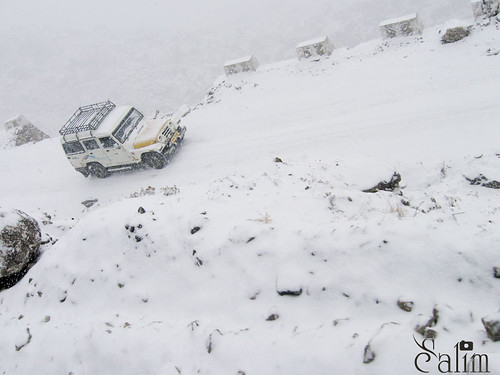
There was no trade held today as there was bad weather conditions due to heavy snowfalls.There were 30 vehicles from China entered into nathula today to open trade for this season.

 The trade though the Nathu La pass started in 2006.

Friday, April 30, 2010

BRO personnel killed in a mishap on Nathu La-Gangtok highway

Gangtok,April30 : A Border Roads Organization (BRO) personnel Lakpa Tamang was killed in a road accident on the Jawahar Lal Nehru Marg between Gangtok and Nathu La two days ago, according to a BRO release today.
Tamang, a member of Project Swastik team maintaning the strategic highway between Gangtok and Nathu La, fell down the slope alongwith the ill-fated dozer on April 26 last while he was engaged in the task of clearance of accumulated muck there due to landslides, it said.

The mishap took place due to mechanical problems in the dozer, the release said.
The 28 year-old BRO personnel had helped the dozer driver and several members of his unit to move to safe place in the nick of time, it said.
The BRO will provide necessary assistance and help to his family, the release added.

Friday, November 20, 2009

Sikkim Commerce Minister visits Nathula border


Gangtok,Nov20 : On Wednesday, November 18, a sunny day with strong wind, Miss. Neeru Sewa, Minister for Commerce and Industries and Information and Public Relations (IPR), visited Serathang trade mart, Nathula border of India and China and Baba Mandir. She was accompanied by officers of both Commerce and Industries and IPR departments in her first visit of the area as a Minister.
She enquired about success of the trade mart. At Nathula border, the Minister talked to Indian Army personnel on tourists visiting the area. She visited the conference hall at the India China border. also visit.

Tuesday, November 17, 2009

Heavy snowfall in Sikkim


Snowfall in Nathu La, Changu Lake
Gangtok, Nov 17 : Heavy snowfall took place since last night in the higher altitude areas of Sikkim with some areas receiving falls as high as 3-4 inches.
The snowfall started at around 2230 hours, said sources at the Sherathang police outpost located at 13,300 ft near Nathu La border.


Heavy snowfall of around 3-4 inches took place in Nathu La border and nearby areas of Kupup, Tsogmo and Sherathang.The snowfall continued today but the roads were clear so far enabling tourists to reach the tourism spots of snowclad Tsogmo Lake and Nathu La border.

However, if the snowfall persists for the next few days, the high altitude tourism spots may be closed down for tourists as the roads may get blocked by snow.
UNI

Nathula border trade better than last year


GANGTOK, November 17: As the fourth consecutive year of the border trade between India and China via Nathu-la border comes to an end on November 30 for the year 2009, the traders from both sides of the border are happy that the business transactions were better than last year.
Despite teething problems faced by the Indian traders in the beginning of the year, traders are of the opinion that the overall business transactions would be better than last year.
Anil Kumar Gupta, one of the Indian traders said, there has been a drastic rise in trade in the past three months covering up all the losses of the past five months. “This year too, we will have amicable closure of the trade on November 30 for which discussions will be held between the two trader groups,” Mr. Gupta added.
It has also been learnt that every day nearly 80 traders from China and 40 traders from India cross the border for their usual transaction.
According to Mr. Gupta, the items that are exported and are in demand are canned food, spices, edible oil, textile cloths, copper items, utensils, tea and coffee. He added edible oil is in very high demand as compared to other items in the list.
In context to infrastructure development, some of the traders noted that development of connectivity and infrastructure in the border are impressive. “Various developmental works are in progress like the intergraded check post for immigration and custom at Nathu-la, double lane road, parking lot facility, trade mart and cafeteria which have provided satisfaction to traders of both the countries – the reason why transactions are on the rise of late,” they added. They further informed that the business is carried out peacefully without any cases of threat or harassment.

Friday, November 13, 2009

Jawan killed in road mishap at Gangtok-Nathu La road


GANGTOK, November 13: One army havaldar was killed and two jawans were seriously injured when an army heavy vehicle slipped and crashed some 800 m down the road at 6th Mile, Jawaharlal Nehru Marg connecting Gangtok with Nathu La border.
The vehicle belonging to a signals regiment was proceeding towards Binagudi in Siliguri from a border outpost when the mishap took place around 9 am in the morning.
The vehicle slipped down the road while apparently giving pass to an oncoming vehicle.
Havaldar SK Singh (40) who was driving the vehicle was killed at the spot. Two other jawans, signalman Jitendra Kumar (23) and signalman JP Singh (25) suffered serious injuries and were rushed to the army hospital at Libing in Gangtok.
The body was released to the army authorities after post mortem formalities at STNM hospital.
It is informed that the duo will be flown to another hospital in Siliguri today. The deceased is said to be from Allahabad, Uttar Pradesh and had one year service left.
Moments after the news of the accident spread, army personnel from nearby bases along with men from 19th Engineers rushed to the spot and pulled out the two injured jawans from the spot where the vehicle had crashed.
The vehicle was shattered into pieces and its main body remained in a mangled heap. The 19th Engineers fixed ropes and deployed manpower to evacuate the injured jawans and recover the body up a steep hill.
Local police led by OC Sherthang police station Cholay Tshering Bhutia also participated in the rescue and relief operations.
This is the second such mishap along the Jawaharlal Nehru Marg in the past one week.
On November 6, an army jawan was killed and seven others injured in a similar accident at 9th Mile

Saturday, November 07, 2009

One jawan dead, seven others injured in Nathula road mishap

pic:SikkimExpress
GANGTOK, November 7: One army jawan was killed and seven others of the Rajputana Regiment were injured in various degrees today afternoon when their vehicle slipped down the road at 9th Mile along Jawarhal Nehru Marg connecting Gangtok with Nathu La border.
The mishap took place at around 3:30 pm but the reasons for the accident are not known yet.
Police sources said that the army vehicle was coming from Nathu La to Gangtok and all the eight jawans were injured in the accident.
Among the injured jawans, three are taken for treatment at STNM hospital. They are Ugan Singh, Sudhir and Prem Singh. The other five were rushed to the army hospital at Libing army cantonment here and their names have not been yet disclosed.
STNM director Dr IL Sharma said that the condition of one jawan at STNM hospital was serious while the conditions of the other two are also weak.
Later it was informed that Sudhir succumbed to his injuries at the STNM hospital while the other two were also taken to the army hospital at Libing. The deceased was from Uttar Pradesh, it is informed.
After the accident took place, Sherathang police led by the in-charge officer rushed in for rescue and relief operation. The army jawans and locals of 15th Mile and 3rd Mile also came forward in the rescue operation.
The injured were sent to Gangtok for treatment in the tourist and army vehicles.

Friday, October 16, 2009

Narendra Modi visits Nathu La pass


Gangtok, October 16: Gujarat Chief Minister Narendra Modi on second day of his Sikkim visit today reached Nathula Pass, the last Indian defense post at the height of 15,000 ft and Nathula Baba Mandir. Modi participated in Diwali celebration of Jawans and offered sweets and a gift on behalf of the people of Gujarat to the soldiers. He was highly impressed with the Jawans posted in the forward areas.

Modi visited a Shahid Smarak that has been built in memory of 27 Indian martyred soldiers who were killed in 1967 by Chinese Army in fencing dispute.

Tuesday, October 13, 2009

Traders from China alloted site at Sherathang Trade Mart in Nathula


Gangtok, October 13: A complex for Chinese traders in the Sherathang Trade Mart premises was opened from today, 3 years after the Nathu La border trade between Sikkim and Tibet Autonomous Region (TAR) resumed in June, 2006.
The complex for Chinese traders at the Sherathang mart has rooms for 12 shops and was opened for the Chinese traders from today after the infrastructure was finally completed, sources informed.
Sources informed that the Chinese traders were very happy to do business and conduct trade under a permanent roof as they have been so far running at road side in the mart at the mercy of adverse weather conditions.
The site for the Chinese traders was scheduled to be completed and opened during the starting of the border trade this year but was set back due to heavy snowfall during last winter.
The third season of the Nathu La border trade between Sikkim and TAR had commenced from May 4 for this year

Thursday, October 08, 2009

Sikkim gets first heavy snowfall of season


TheSikkimTimes is excited to announce the first snowfall of the 2009-2010 season in Sikkim. The heavy snowfall has been reported in the mountainous corridors of the Nathula border while the holy lake of Guru Dongmar is already wearing a blanket of snow. Nathula Pass and its nearby tourist spots have been receiving heavy snowfall since tuesday  night. It started to snow in nathula at around tuesday midnight, much to the delight of those in the hospitality industry.


Tourists proceeding to the Nathula border couldnot reach their destination due to heavy snowfall but they arenot complaining as they were able to touch and beautiful sight of snow all around. It was welcome sign for many as being the first heavy snowfall.and most of the roads blocked by fresh snow but cleared immediately . But army personnels have done a good and quick job, rescued the visitors, some got sickness among them.


All the high passes of Sikkim are now under snow cover. Normally snowfall occurs in the months of the November to February and therefore signs of snowfall in early October is a bit unexpected but welcome sight to tourists as well as those in travel industry.

Thursday, October 01, 2009

‘Tibet’ topples ‘China’ in Delhi


New Delhi, Sept. 30: On the eve of the 60th anniversary of the People’s Republic of China, India has played with a combustible word that could ignite fireworks of a different kind in Beijing.

A monthly report card released by home minister P. Chidambaram today mentions construction “on the Indo-Tibet border”, a departure from the official “Indo-China border”.

“On the Indo-Tibet border, work on construction of 10 roads totalling 196km is under progress. 45.27km of formation works and 4.77km of surfacing works were completed in September,” he said, reading from a written statement.

If Chinese antennae live up to their reputation and pick up the variation, it will coincide with the People’s Liberation Army’s spectacular march and other celebrations in Beijing tomorrow.

India has officially said several times that it considers Tibet an integral part of China. Beijing does not approve of India’s asylum to the Dalai Lama since 1950, and New Delhi has more or less ensured that the references to Tibet do not nettle Beijing beyond a point.

However, with the recent but vigorously denied reports of incursions by China, the Centre is also under pressure to be seen as being firm.

Until last month, the parlance was on conventional lines. “On the Indo-China border, 35.63km of formation works and 2.82km of surfacing works were completed,” the home minister had stated in his report card for August.

So was the case in July. “On the Indo-China border”, 35.63km of formation works were completed, the home ministry had said.

In official communication, the government refers to the international border as the “Indo-China” border and not “Indo-Tibet border”, a home ministry official said.

A stickler for details, Chidambaram is known to check every word of important communication. Semantics are a key feature in international relations, especially when an inscrutable customer like China is involved.

Even if the variation was an error made somewhere down the line, till late tonight there was no clarification from the home ministry. It remains to be seen what the response would be if China makes it an issue.

Sunday, September 20, 2009

Union Govt launches border development programme in Sikkim

Gangtok,Sep20: Amid reports of repeated border violations by neighbouring countries, the Centre has launched an ambitious frontier area development programme in 17 states having land border with foreign nations, including China.

The Border Area Development Programme (BADP) has been launched early this fiscal in the border blocks through the state governments.

"The objectives of BADP are to meet the special development needs of the people living in remote and inaccessible areas situated near the international border," a Home Ministry official said.

The project also aims at saturating the border areas with basic essential infrastructure through the convergence of Central or State government's schemes or BADP and through participatory approach.The guidelines of the BADP have been revised in February in consultation with the state governments. As per the revised guidelines, the state governments concerned will arrange the utilisation of the BADP funds only in those villages of the border blocks which are located "within 0-10 km" of the international border.

The villages located nearer to international border will get first priority. After saturating these villages with basic infrastructure, the next set of villages located within 0-15 km and 0-20 km would be taken up.
If the first village in a block is located at a faraway location from the international border, the first village or hamlet in the block may be taken as "0" km distance village for drawing the priority list.

The revised guidelines of the BADP have come into force with effect from 2009-10 for compliance by the state government concerned.

"The BADP emphasises the focused socio-economic development in the border areas and has brought confidence and belongingness among the border population," the official said.The convergence of BADP with other state or central plan schemes has activated the process of development

Friday, September 18, 2009

Chinese incursions to hit Sikkim tourism


Gangtok, Sep 17- Travel agents in Sikkim are a worried lot, as they fear a dip in domestic tourist arrivals in the state following the tension that prevails after reports of Chinese incursion and aggression along the international border.

From the tourist point of view the tourism movementthere seems to be lot of fear amongst the countrymen especially the domestic tourists because no body likes to go to a war zone, said Satish Bardewa, proprietor, Yak and Yeti Tour and Travel.

In January 2009 at least 27,138 domestic tourists arrived in Sikkim, while in February around 32, 038 tourists arrived in state, an increase of 7,883 as compared to the corresponding period in 2008.

However, travel agents said that the number of bookings have declined in September.

Well, to me it looks like the response has really come down, the enquiry response has really come down because by September this time we had lot of bookings for October and November and even the hotels in Sikkim are not very well booked, said Lukendra Rasaily, General Secretary, Travel Agent Association of Sikkim (TAAS).

In the recent days, there have been multiple reports of Chinese incursion along the international border, and earlier, two paramilitary personnel of the Indo-Tibetan Border Police (ITBP), the sentinel force along the Line of Actual Control (LAC) were reportedly shot from the Chinese side.

- ANI

Wednesday, September 16, 2009

ITBP denies its jawans being injured by Chinese bullets

Gangtok,September 16 - The Indo-Tibetan Border Police (ITBP) on Tuesday denied any incident of shooting that led to injury of two of its jawans in the North-Eastern region of Sikkim.

ITBP spokeperson Deepak Pandey termed the media reports which said that two jawans of the para-military force (ITBP) were injured in firing from Chinese side in Sikkim, as "factually incorrect and baseless". "No such incident of firing has taken place in north Sikkim on the India-China border," Pandey said.

The reaction comes in the wake of a front-page report carried in a leading Indian daily stating that two ITBP jawans were injured in China border firing – in a first violation of the 1996 ceasefire agreement between India and China.

A newspaper report citing quoting sources said two ITBP jawans were injured "by bullets fired from the Chinese side" about a fortnight ago but has been kept under wraps.