Showing posts with label Nathula pass. Show all posts

Friday, September 30, 2011

Red Army border posts damaged in Sikkim Earthquake


Chinese Soldiers help remove debris after the earthquake

Two residents in Yadong county in the Tibet autonomous region on Sept 19
 Gangtok: The earthquake that rattled Sikkim more than a week ago also left a trail of devastation across the border in Tibet, inflicting widespread damage on life and property. According to an assessment here, the Chinese People's Liberation Army has also suffered losses with its garrison at Yadong in Tibet, barely 40 kilometres away from Sikkim, taking the maximum hit. Reports hint that troops from the Yadong garrison were involved in a massive rescue and relief operation in the region. Independent reports suggest that at least 2,000 soldiers were taking part in the relief operation though the exact number of casualties in the area could not be ascertained. The operation was anchored by the Tibet military district with air support from the army aviation wing of the Chengdu military region. Yadong has been one of the areas worst affected by the earthquake, with communication lines in the area having snapped completely. In Sikkim, the Indian Army is spearheading the rescue operation, clearing the debris and delivering relief material to people living in remote areas. The Indian Army has a brigade-level presence in the region to guard the border with China in north Sikkim. Apart from the civilian population, even the army has suffered damages as contact to many areas in the region was cutoff because of landslides. Though the loss of life was contained, the link to forward location remains inaccessible and could take some time to rebuild. The link to Nathu La, at more than 14,000 feet, is yet to be restored. While Sikkim witnessed frantic activities with Prime Minister Manmohan Singh also visiting the state, information is not forthcoming on developments in Tibet.

Monday, June 20, 2011

Indian Army wants operational control of ITBP

NEW DELHI: With Chinese troops continuing with their aggressive "transgressions'' across the Line of Actual Control (LAC), the Army wants the Indo-Tibetan Border Police (ITBP) to be placed under its "operational control'' for better border management.

Defence ministry sources said the Army contends India's border management posture will acquire the much-needed "cohesion, coordination and synergy'' required to counter the People's Liberation Army's "offensive'' posture if ITBP is placed under its jurisdiction.

The Army feels such a step will prove operationally productive as well as ensure optimal utilisation of resources especially in eastern Ladakh where ITBP, one of the seven central police forces under the home ministry, is responsible for border management of 826 km of the LAC.

The Army is also present in depth along that stretch but it can exercise operational control over ITBP only during the outbreak of hostilities.

This is not the first time the Army has moved for getting ITBP under its operational wings along the 4,057-km LAC for "single-point control'' as well as effective "border-guarding'' rather than mere "border-policing''.

The defence ministry had six years ago taken up the Army proposal with the home ministry and the national security advisor, among others, but it all came to naught. Interestingly, one of the main objectors at that time was the external affairs ministry, which felt that it would needlessly antagonize China.

China has had no such compunctions. It continues with its policy of frequent troop incursions all along the three LAC sectors -- western (Ladakh), middle (Uttarakhand, Himachal) and eastern (Sikkim, Arunachal).

Officially, India often downplays Chinese intrusions, holding that they take place due to "differing perceptions'' of the still-unresolved LAC. The fact, however, remains that China has been indulging in aggressive border patrolling for several years now to strengthen its claim over disputed areas and put pressure on India.

India's overall border management policy has remained largely muddled over the years despite having a porous land border of 14,880-km, running through 17 states and touching six countries. Moreover, it took the 26/11 terror attacks in Mumbai for the government to rethink security of the country's 5,422-km coastline and 1,197 islands.

The large land borders with both China and Pakistan, as also Myanmar, Bangladesh and Nepal, continue to suffer from a lack of coordination among the different forces manning the border outposts, ranging from BSF, ITBP and Sashastra Seema Bal to Assam Rifles and of course the Army, which report to different bosses and ministries.

Incidentally, both the Border Management Task Force in the aftermath of the 1999 Kargil conflict, and the subsequent Group of Ministers' report on "reforming the national security system'' in 2001, had strongly recommended the principle of "one border one force''.

"Multiplicity of forces on the same borders has inevitably led to the lack of accountability as well as problems of command and control,'' held the crucial GoM report. But since then, both the previous NDA and the present UPA regimes have taken only half-hearted steps to plug the gaps.

Wednesday, May 11, 2011

China can deploy 5L troops on India border

New Delhi: Even as India struggles to match its eastern neighbour’s infrastructure along the border between the two countries, reports claimed Wednesday, that China now has the capability to deploy and maintain more than five lakh troops for over a month on the Line of Actual Control (LAC) in case of a threat scenario with India.

As per a newspaper report, Indian Army has apprised Prime Minister Manmohan Singh of the threat perception emerging out of China’s assertive stance.

The Indian military's top brass had last month given a presentation on the developing scenario in South Block to Prime Minister Manmohan Singh, Defence Minister AK Antony, National Security Adviser SS Menon, Principal Secretary TK Nair and Defence Secretary Pradeep Kumar, the report said.

Concerns about China’s plans are well founded as Beijing has been carrying out a major infrastructure upgradation in Xinjiang and Tibet bordering India. Its assertiveness over Arunachal Pradesh and active role in the Ladakh region has also been a cause of worry for New Delhi.

The report said that the PM has been informed that Chinese People’s Liberation Army, with a defence budget estimated at $150 billion, can rapidly deploy 34 troop divisions (23,000 soldiers form one division) along the LAC by pulling t troops from Chengdu and Lanzhou regions.

In comparison, India is said to only have the capability to the hold nine divisions along the northern borders.

China has been, notwithstanding the treacherous terrain, quietly but resolutely building infrastructure along its border with India

There is now 58,000 km of roads in Tibet region besides the plan to build 11 new rail lines in Tibet and Xinjiang, which will ensure rapid deployment of troops by PLA.


To the south of Tibet, the railway is being extended to Shigatse (close to Sikkim).

Moreover, China has announced plans for a rail link to link Kathmandu, Myanmar, Bhutan, Pakistan and Central Asian republics.

In terms of air power, China now has many air bases in Tibet and Xinjiang from where India is well “within the range”.

Not to forget China’s all-weather friendship with Pakistan and Beijing’s greater involvement in the Nepal and Sri Lanka.

Surely, Indian security planners have a tough job at hand

Wednesday, April 20, 2011

Nathu-la trade to re-open from 2nd May

Gangtok: 19th April: The Indo-China Border Trade via Nathu- la for this year will start from 2nd May, 2011 informs a communiqué received from Department of Commerce and Industries, Government of Sikkim. It further informs that the scheduled time period for the Indo-China Border Trade is 1st May and the closing date is 30th November annually. However, for the current year 1st May 2011 being Sunday a non trading day, the State Government has approved for the trade to resume from 2nd May, Monday being a trading day.

Wednesday, November 18, 2009

SIKKIM:Snow is here, but winter far away


Wait till December to feel the shiver, drizzle-induced chill not to stay: Met experts

Gangtok,Nov. 17: Winter this year has to race hard to catch up with Siliguri, Met experts have said. And it may be as late as the first week of December before it comes calling on the foothills of the Himalayas.

While snow drizzled in Nathu-la and its neighbouring areas today, a common phenomenon this time of the year in the higher reaches of Sikkim like the border pass at 14,400ft, there seems to be no sign of winter in north Bengal plains where the woollens are usually out in November.

A light shower or two in the past 24 hours did raise a hope for the much-awaited cold, but weathermen have dismissed any hope of winter.

According to the Met office, today was the “hottest day” of November in the past four years (see chart). Gopinath Raha, the in-charge of the Jalpaiguri flood and meteorological office, said an anti-cyclonic condition over the Bay of Bengal was the reason for the misty weather.


“There were drizzles in almost every part of north Bengal in the past 24 hours which decreased the temperature, but it should not be described as cold that brings winter to the region. Usually, the minimum temperature varies in this part of the state during the middle of November between 15 and 16 degrees Celsius. But today’s temperature is 19.5 degrees, which is the highest in the past four years in the region,” Raha said.

The Met expert said the weather would remain the same in the next few days. “The anti-cyclonic condition that developed over the Bay of Bengal in the past couple of days has advanced towards the northeastern part of the country by covering Orissa and Bihar, resulting in the cloudy weather in the region,” Raha said. “There is a possibility of the weather remaining the same in the next two days.”


The drizzle-induced morning chill prompted many Siliguri residents to bring out their woollens. Most of them were, however, not aware that today was the hottest compared to temperature on this day in the past four years.

But the damp weather is expected to have a bad impact on winter farming, feel agriculture department officials.

“As the paddy is ready for harvesting everywhere, the rainfall at this time will affect the crop. This type of moisture in the environment is ideal for blights,” said Mehfuz Alam, the assistant director of the Siliguri subdivisional agricultural department.

In Sikkim, there was heavy snowfall at Chhangu and Nathu-la from the morning, disrupting the border trade with the Tibetan Autonomous Region (TAR). Sources in the commerce department of Sikkim said no traders arrived at the trade mart at Sherathang from TAR. Traders from Sikkim, who managed to reach the spot, however, could not set up shop and returned to Gangtok. The trade through Nathu-la, located at 14,400 feet, officially closes on November 30.

The first snowfall in Sikkim this season was at Yumthang in North Sikkim at 12,000 feet in the last week of October.

Monday, September 21, 2009

Seminar on ‘Sino-Indian border relation-restoration of peace in India & Tibet’ held in Gangtok


GANGTOK, September 20: The national convener of Core Group for Tibetan Cause, Dr. Anand Kumar today said that the Indian government should take concrete steps by initiating peace talks with the Chinese government on the issue of Tibet.
He said this while presenting his papers during a national seminar on ‘Sino-Indian border relation-restoration of peace in India and Tibet’ held here today.
Mr. Kumar further said that China should now come up with conditional solution for Tibet issue rather than adopting the military solution.
The seminar was held here primarily to review the approaches of India, China and the Tibetans in exile towards the challenges creating an environment of peace and progress in the Himalayan region. Participants from major parts of Himalayan region as well as major organizations engaged in awareness building about the Tibetan cause in India attended the programme organized by Himalayan Committee for Action on Tibet, India-Tibet Friendship Society in collaboration with India Tibet Co-ordination Office (ITCO), Delhi.
The seminar participants interrogated the paradoxical position of the three nations and tried to evolve a set of recommendations for making the Himalayas as the zone of peace.
Sonam Lhundup, the convener of the seminar informed that the recommendation of the seminar will be presented to the Government of India, the Government of People’s Republic of China and the Tibetan Government in exile by the core group for the Tibetan cause. The core group also intends to approach all major political parties in the Indian parliament to draw their attention for a thorough review of the changing situation on Sino-India border and inside Tibet for revising their policy on Himalayas, he added.
Tenzin Lekshay, the co-ordinator of ITCO said, the Indian and Chinese government are diverting the topic on the border dispute and is leaving the Tibetan issues aside.
‘Time has come up to review and change the policy of the Indian government on Tibetan issues,” he said. Stating that Tibetans are becoming a minority in Tibetan Autonomous Region, Mr. Lekshay said the freedom of Tibetan is based on the principles of non-violence and the teachings of His Holiness, the Dalai Lama. “The Tibetan youth should come forward in taking the issue of Free Tibet forward as it is not only the matter of His Holiness but also of six million Tibetan population,” he added
PT Bhutia, the general secretary of India Tibet Friendship Society (ITFS), Kalimpong said that the Chinese government should justify the long demand of the Tibetans.
He accused the Chinese government of not having a proper map of Tibet till date.
Udai Chettri, General Secretary of Bharat Tibet Sayog Manch said, the freedom of Tibet is the security of India. He said, the Chinese people have been rampantly involved in destroying the natural resources of Tibet and adding more pollution with reckless deforestation and trafficking the faunas and the floras.
Dundup Dorjee, the Tibetan Welfare Officer, Gangtok in his address said there will be extensive deliberation and interaction on the middle way engagement mechanism propounded by His Holiness and endorsed by the Tibetan people inside Tibet and in Tibetan Diaspora for a mutual solution.

Sunday, September 20, 2009

Union Govt launches border development programme in Sikkim

Gangtok,Sep20: Amid reports of repeated border violations by neighbouring countries, the Centre has launched an ambitious frontier area development programme in 17 states having land border with foreign nations, including China.

The Border Area Development Programme (BADP) has been launched early this fiscal in the border blocks through the state governments.

"The objectives of BADP are to meet the special development needs of the people living in remote and inaccessible areas situated near the international border," a Home Ministry official said.

The project also aims at saturating the border areas with basic essential infrastructure through the convergence of Central or State government's schemes or BADP and through participatory approach.The guidelines of the BADP have been revised in February in consultation with the state governments. As per the revised guidelines, the state governments concerned will arrange the utilisation of the BADP funds only in those villages of the border blocks which are located "within 0-10 km" of the international border.

The villages located nearer to international border will get first priority. After saturating these villages with basic infrastructure, the next set of villages located within 0-15 km and 0-20 km would be taken up.
If the first village in a block is located at a faraway location from the international border, the first village or hamlet in the block may be taken as "0" km distance village for drawing the priority list.

The revised guidelines of the BADP have come into force with effect from 2009-10 for compliance by the state government concerned.

"The BADP emphasises the focused socio-economic development in the border areas and has brought confidence and belongingness among the border population," the official said.The convergence of BADP with other state or central plan schemes has activated the process of development

Friday, September 18, 2009

Chinese incursions to hit Sikkim tourism


Gangtok, Sep 17- Travel agents in Sikkim are a worried lot, as they fear a dip in domestic tourist arrivals in the state following the tension that prevails after reports of Chinese incursion and aggression along the international border.

From the tourist point of view the tourism movementthere seems to be lot of fear amongst the countrymen especially the domestic tourists because no body likes to go to a war zone, said Satish Bardewa, proprietor, Yak and Yeti Tour and Travel.

In January 2009 at least 27,138 domestic tourists arrived in Sikkim, while in February around 32, 038 tourists arrived in state, an increase of 7,883 as compared to the corresponding period in 2008.

However, travel agents said that the number of bookings have declined in September.

Well, to me it looks like the response has really come down, the enquiry response has really come down because by September this time we had lot of bookings for October and November and even the hotels in Sikkim are not very well booked, said Lukendra Rasaily, General Secretary, Travel Agent Association of Sikkim (TAAS).

In the recent days, there have been multiple reports of Chinese incursion along the international border, and earlier, two paramilitary personnel of the Indo-Tibetan Border Police (ITBP), the sentinel force along the Line of Actual Control (LAC) were reportedly shot from the Chinese side.

- ANI

Tuesday, September 01, 2009

Dial China via Nathu La

Gangtok, Aug. 31: Reliance Communications and China Telecom have established the first direct terrestrial telecommunication link between Chinese and domestic markets through Nathu-la in Sikkim.

The link was provided on Friday when the two telecom companies completed the laying of over 200km-long cable that passes through the inhospitable terrain of the 14,200ft high mountain pass. Bilateral trade between India and China is conducted through Nathu-la.

The cable, linking Yadong in China with Siliguri in India, will provide direct connectivity between all major Indian and Chinese locations as well as expanding high-bandwidth coverage to more rural and urban areas in both the countries, sources in Reliance Communications said.

Prior to this link, the only connectivity option between the two countries was undersea cable routes through Hong Kong or Singapore. However, the undersea networks were vulnerable to disruption from typhoons and earthquakes, the sources said.

Both international traders and consumers in the region will benefit from the link, which is expected to improve Internet connectivity and voice clarity.

Punit Garg, the president of Reliance Communications, said: “India and China represent the largest growing economies in the world and the current global economic environment requires ever increasing high-bandwidth, converged applications to be run between two domestic markets.”

Describing the cable link as a “landmark”, Han YiHu, the managing director of China Telecom, said: “This represents many years of planning and hard work. We are very pleased with the increased dedicated bandwidth availability, connection speed and security this cable will provide to Chinese based enterprises and consumers.”

Countries like Nepal, Bhutan, Sri Lanka and even Pakistan and Bangladesh will also benefit in the long term.

The Sikkim Chamber of Commerce has congratulated the telecom companies for the feat. “This is another milestone in improving the relationship between the two Asian giants,” said S.K. Sarda, its president.

Monday, August 31, 2009

Nathu La-Tsomgo Lake-Baba Mandir circuit fare revised


GANGTOK, August 30: In a bid to protect tourists from being fleeced by ‘jholey’ tour operators and streamline tourism traffic, the State Tourism department has notified the revised rates of package tours along the lucrative Nathu La-Tsomgo Lake-Baba Mandir circuit.
The revised rate of package tours to Tsomgo, Baba Mandir and Nathu La will stand enforced from Tuesday, September 1 as the tourism season for Sikkim approaches.
Most importantly, the revised rates of transportation and other expenses are chargeable by registered travel agents who are registered with the Tourism department which effectively delivers a KO to seasonal tour operators and taxi drivers fishing for tourists for the Nathu La-Tsomgo Lake-Baba Mandir circuit.
The total rate for a package tour to the above three destinations from Gangtok in a Mahindra Max or Sumo is Rs. 5,795 with provisions for 15 percent service charge for the concerned travel agent who has arranged the tour. These include environmental cess of Rs. 2000, transport fees of Rs. 2500 and remaining amount for contingencies.
Traveling in luxury vehicles of SK06 series, an extra Rs. 800 will be charged.
For tourists wishing to go only Kyangsola/Tsomgo Lake in Mahindra Max or Sumo, the travel agent can charge Rs. 2,300 as taxi fares and other expenses including 15 percent service charge on transport cost. For luxury vehicles, an extra Rs. 800 will be charged.
The rate for Baba Mandir tour has been revised to Rs. 2,737 in Mahindra Max with an additional Rs. 800 to be paid in case of luxury vehicles. For vans or cars, the total cost has been revised to Rs. 2117.
“This package rate should be followed strictly”, warns the Tourism department.
At the same time, it may be added here that the above rates are only for registered travel agents, the rates to above destinations for drivers is as per the Motor Vehicle department rates.
Expectedly, the new revised rates have greeted with kushi by local tour operators registered with the Tourism department as they are now entitled to service charges with respect. The rates will also bring discipline and streamline tourism sector, it is said.
Despite much talk about decongesting tourism traffic from Gangtok, the triumvirate of Nathu La-Tsomgo Lake-Baba Mandir still remains the ‘lifeline’ of Sikkim Tourism. Thousands of domestic tourists swarm to these tourism hotspots during peak season like salmons returning back to breed.
And the existence of grizzly bears feeding on the harvest is known when tourists complain of being fleeced or charged exorbitant rates which usually find much space in local media. Introspection of such cons reveals that the tourists had been taken for a ride by opportunistic drivers or fly by night tour operators.
Tourists used to be charged as much as Rs. 8000 for a ride to Tsomgo earlier. Even the collection by Pokheri Sangrakshan Samiti was felt as a burden for the overcharge tourists and it is not seen for what purpose the fees are being collected, it is claimed.
Now, with the much needed official rates for registered tour operators, such undesired incidents may come to a halt. The rates are expected to be displayed prominently in tourism office, tourist information centres and websites for the knowledge of tourists.
The registered tour operators and travel agents are also protected by the new rates from being dragged into unnecessary distractions, it was pointed out.

Friday, August 28, 2009

SIKKIM NATHULA PASS

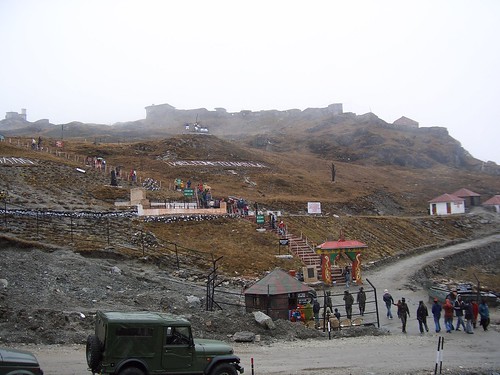
Nathula Pass - An Ancient Silk Route (also spelt Ntula, Natu La, Nathu la, Natula) is a pass on the Indo-China border connecting the Indian state of Sikkim with South Tibet. The pass, located at an elevation of 4,310 m (14,200 feet) above mean sea level, forms part of an offshoot of the ancient Silk Route.
After remaining closed for more than 40 years, the pass is due to open for trade on 2006-07-06. The pass is useful for indo-china foreign trade promotion.
The route leading up to the pass is one of the world's highest navigable roads, and is maintained by the Border Roads Organisation, a wing of the Indian Army. On the Pass the Indian army and the Chinese border guards are within touching distance of each other. To visit the Indian side of Nathula, a visitor's permit must be made one day in advance, which is done by any travel agency

The pass is 56 kilometres east of the capital Gangtok. Although just 5 km north of the Jelepla pass, the Nathula pass is not navigable in winters as it receives heavy snowfall. Temperatures in Nathula regularly dip to -25 °C in winters. The pass is open only to Indian nationals on Wednesdays,

Thursdays, Saturdays and Sundays. On other days is it in use for exclusive military use. A no man's land is absent, and the border consists of a barbed wire fence. Every Thursdays and Sunday post between the two nations are exchanged, a tradition dating back many decades