Showing posts with label karmapa. Show all posts

Thursday, August 11, 2011

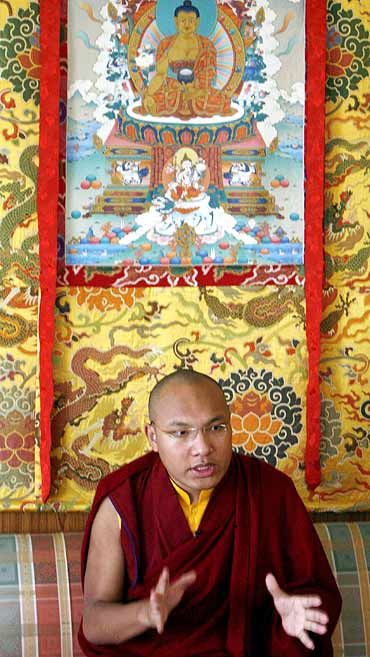
HH 17th Karmapa Prepares for a Greater Role

WOODSTOCK, N.Y. — At the age of 7, he was deemed to be the 17th reincarnation of the Karmapa — one of the most revered figures in Tibetan Buddhism — and whisked from the yak-hair tent of his nomad family in the Himalayas to be groomed in a monastery for leadership.

Now 26, his mere appearance on the stage alongside the Dalai Lama at a major ceremony in Washington this month sent a flutter of excitement through the Tibetans in the crowd. Here was more evidence to them that the Dalai Lama had taken the young Karmapa under his wing, serving as teacher and father figure in India, where both live in exile, because China claims sovereignty over Tibet.

The Karmapa and the Dalai Lama lead different Tibetan Buddhist lineages and are not equals; the Dalai Lama, who is 76, is the pre-eminent spiritual leader of Tibet. And yet, many Tibetans are looking to the Karmapa to assume the mantle of the Dalai Lama when the elder lama dies, to take on the role as shepherd of the Tibetan people and lead them home from exile.

The succession talk appears to be burdensome for the young Karmapa, a solid 6-footer with a serene gaze whose name is Ogyen Trinley Dorje. Asked about his future during an interview at the mountainside monastery here that is his North American seat, the Karmapa said that the Dalai Lama had made it clear that his hopes for the future of Tibet rested with its young leaders.

“In that regard, His Holiness has been very kind to me, and has served as a mentor and guides me greatly,” the Karmapa said in Tibetan, translated by an American lama. “But I’m only one of many.”

Then, breaking into English, he added, “I don’t need more pressure.” The Karmapa smiled, and then grew serious and added in Tibetan: “I don’t think I can do any more. It’s hard enough just to be the Karmapa.”

His Holiness the Karmapa, has just come through a trying time. Earlier this year, he was investigated by the Indian police who found more than $1 million in foreign currency in his residence, including more than $166,000 from China.

The Karmapa and his aides insisted that the money had been donated by devotees who flocked to India from around the world to see him. Although there is a rival who also claims the title, the Karmapa is regarded by the Dalai Lama and most Tibetans as the leader of the 900-year-old Karma Kagyu lineage, one of the four main schools in Tibetan Buddhism, with hundreds of monasteries and dharma centers in more than 60 countries.

The Karmapa’s aides said they planned to use the money to buy land for a monastery in India. But the Indian media fanned rumors that he was a Chinese spy.

To Tibetans and to scholars of Tibetan Buddhism, the notion is absurd. The Karmapa fled Tibet when he was 14, climbing out a window of his monastery to a waiting car, avoiding military checkpoints and riding a horse through the Nepalese outback to reach India. The escape was reminiscent of the Dalai Lama’s dash over the icy passes of the Himalayas in 1959.

But the rumors about the 17th Karmapa persisted in part because the Chinese government has recognized him as the legitimate leader of the Kagyu tradition, and avoided denouncing him even after his flight to India. That is in marked contrast to the Chinese denunciations of the Dalai Lama as a “splittist.”

This puts the Karmapa in a singular position, said Robert J. Barnett, director of the Modern Tibetan Studies Program at Columbia University.

“The Karmapa is perfectly placed to be someone who could broker a solution in the future,” Mr. Barnett said. “This is one of the rather rare issues where exiles and those in Tibet are in agreement. They have very wide respect for the Karmapa.”

Mr. Barnett likened the allegation that the Karmapa is a Chinese spy to the “birther controversy” involving President Obama, saying that to experts it has no legitimacy.

The rival Karmapa, Trinley Thaye Dorje, has the backing of one senior lama in the Kagyu tradition and some followers in the West (who managed to secure the rights to the Web address karmapa.org). But Mr. Barnett said that while Tibetans are free to choose the teachers they prefer, most recognize Ogyen Trinley Dorje as the true Karmapa. “For most people, this is a settled issue,” he said.

Tenzin Chonyi, president of the Woodstock monastery (called Karma Triyana Dharmachakra), was an aide to the 16th Karmapa, and as a child fled Tibet with him in 1959. He said the 17th Karmapa was identified by a group of lamas who were entrusted with the task of finding the child who they believe is the reincarnation of the previous Karmapa.

“This Karmapa was found based on the previous Karmapa’s instruction,” Mr. Chonyi said. “So we have no doubt.”

Saturday, July 23, 2011

Police impound luxury cars from Tai Situpa Rinpoche

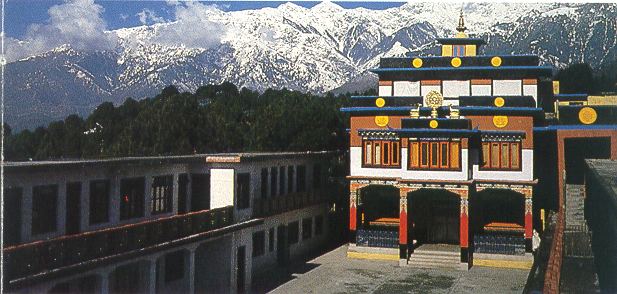
Shimla, July 22: Troubles seem to be increasing for 17th Karmapa Ogyen Trinley Dorje's mentor Tai Situpa Rinpoche, a high orderly monk in powerful Kagyu Karmapa Sect of Tibetan Buddhism. The police on Thursday sized four high-end luxury cars, with Bhutanese registration number, from Sherabling monastery in Battu village of Kangra district.


Sherab Ling Monastery in Himalchal Pradesh, India

All four cars were being used by monks residing in Sherabling monastery, that was set up by Tai Setu Rinpoche. The police had information that six vehicles with Bhutanese registration number were plying illegaly in different parts of the state. After gathering the information, cops from the police station in Baijnath visited the monastery and seized two luxury vehicles - a Toyota Land Cruiser and another sports utility vehicle. The estimated cost of the both these vehicles is said to be above Rs 1.20 crore. Interestingly, both the vehicles which were earlier being used by Tai Setupa Rinpoche had the same registration number - BHT- 27. The registration number for the Toyota Land Cruiser, that was being used by the Tai Setupa Rinpoche, is issued in the name of Royal Grand Mother of Bhutan.

Sources in the police department told media that the registration number of the Land Cruiser was earlier issued to a 1975 model Land Rover.The other tow vehicles that were impounded by the police were Isuzu's trooper - bearing number BG-2- 0179. The impounded vehicles are said to be owned by the Royal Palace of Thimpu that has also issued diplomatic visa to Tai Setupa Rinpoche.

The fourth is the white colored Mitsubishi van - BP-1-0055 - that is owned by a local monk Dzongsar Rinpoche. The police sources said that Tai Setupa Rinpoche was in meditation when the police reached the Sherabling monastery to take away the vehicles.

"We have impounded four vehicles and the further investigations are on," said Kangra suprintendent of police Daljeet Thakur. Tai Setu Rinpoche, who is said to have close connection with leaders in China, had been instrumental in selection of 17th Karmapa Ogyen Trinley Dorje -- who was coronated as the head of the Karma Kagyu Sect at Tsurphu monastery in Tibet. Tai Setupa is the spiritual mentor of Karmapa Ogyen Trinley Dorje.

Bhutanese number luxury cars came under the scanner after the sleuths recovered Rs 6.5 crore from Gyotu Tantric monastery, the transit home of 17th Karmapa Ogyen Trinley Dorje in January this year. Police had detected that about half a dozen vehicles bearing registration number from Bhutan had been plying in Rewalsar and Baijnath areas. The vehicles had not been registered anywhere in India and had been brought without paying custom duties.

Wednesday, July 06, 2011

17th Karmapa Ogyen Trinley Dorje allowed to travel to United States

Gangtok: Amidst hectic lobbying by his followers in the corridors of power, the Indian government has finally given clearance for Ogyen Trinley Dorje- the17th Karmapa, who is parallel head of powerful Kagyu karma sect of Tibetan Buddhist to travel to United States to attend Kalchakra. Under scanner of investigating agencies for huge stacks of foreign currency recovered from his monastery, Ogyen Trinley Dorje had earlier expressed his desire to visit United States along with Tibet’s exiled spiritual leader the – Dalai Lama for Kalchakra which commences from July 6th in Washington D.C.

According to Buddhist beliefs, the Kalachakra was first given by Shakyamuni Buddha, in ancient India. The Kalchakra in Washington will last for 11 days. During the first three days of the Kalachakra, from July 6 through 8, the Dalai Lama, along with the monks of Namgyal Monastery and senior lamas, will conduct rituals, which prepare and consecrate the venue. Karmapa’s administration- Tsurphu Labrang in Dharamsala had written to the ministry of home affairs seeking permission to travel abroad. It was late in the afternoon on Tuesday that Karmapa’s administration received intimation about the clearance given by home ministry. “ We have got clearance from the Indian government. We are extremely grateful to the Indian authorities” said Sonam, a Karmapa aide in Delhi.

The twenty-six year–old monk- 17th Karmapa himself had been camping in Delhi since the past one week. Karmapa’s high profile followers hectically lobbied in New Delhi to ensure that the spiritual leader is allowed to go abroad. This will be Karmapa’s second visit abroad ever since he escaped from Tsurphu in China-controlled Tibet a decade ago. Karmapa is likely to stay in United States for over two weeks and would return back to Dharamsala on July 25. Viewed with suspicion, Karmapa lives under the watchful eyes of the Indian agencies in the backside of Gyuto Tantric monastery in Dharamsala. His movements within the country remains restricted his travel schedule is cleared by the home ministry. Karmapa made his maiden trip to United States in the 2008. He had visited the seat of his predecessor – the 16th Karmapa Rangjung Rigpe Dorje, who is largely credited for introducing Tibetan Buddhism in western countries. Rigpe Dorje had escaped to Bhutan in 1959 along with 150 of his students. Later he set up a monastery in Rumtek in Sikkim. Rigpe Dorje who lived in United States died of cancer in Chicago in 1981. He was cremated at the Rumtek monastery, that remains forbidden for the two claimants- Ogyen Trinley Dorje and Shamar Rinpoche enthrone parallel Karmapa- Thaye Dorje.

Ogyen Trinley Dorje had made headlines in India in January, since police during the raid in the monastery had recovered Rs 6.5 crore from the possession of Rabjey Choesang treasurer of Karmapa headed Karmae Garchen Trust. What surprised the investigating agencies was the recovery of 12 lakh Chinese Yuan. Karmapa’s followers denied the spiritual leader had anything to do with the money, which they claimed was donated by devotees.

-HT

Tuesday, June 28, 2011

Gyalwa Karmapa inaugurates Tibetan Thangka Exhibition

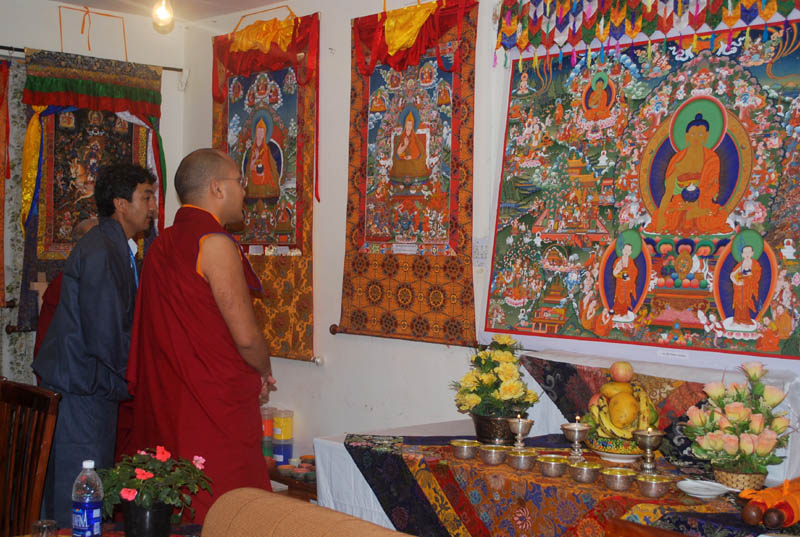
Dharamshala- His Holiness Gyalwa Karmapa formally opened an exhibition of traditional Tibetan Thangka painting Monday (27th June) at the main Tibetan Temple complex, today in Dharamshala, India. He was accompanied by the minister of the Tibetan department of religion and culture; Tsering Phuntsok, to celebrate the unique paintings by the school of Tsang Menthang - of Tibetan Traditional Arts.
To highlight the beautiful work by the 8 students that graduated from this institution, the revered spiritual leader His Holiness Gyalwa Karmapa graced the presence of the rapt audience in the Temple.

He was led around the room of around 37 beautiful, hand painted deities, with the audience of students watching intently. The Karmapa unveiled the exhibition to the public, and blessed the institute.

The Thangka teacher, Buchung Nugbya, introduced Tsang Menthang and His Holiness the Karmapa to the ancient lineage of Tsang Menthang, of Tibetan Traditional Arts.

He also offered two Thangka paintings, one to the Karmapa, and one as a gift to His Holiness the 14th Dalai Lama. Tsering Phuntsok presented certificates to the 8 students of the school, who had recently graduated. The two main guests then gave speeches.

Tsering Phuntsok stated to the audience that: "It's important to keep the good lineage of the skill of Tsang Menthang traditional arts. If we stay in one place like Dharamshala, people will come to us to buy our Thangkas. If we do this only for money, and the skill and quality deteriorates, we may find ourselves going to the market in the future attempting to sell our work, and find nobody wishes to buy this. If the skill and quality remains as good as before, we can stay in one place, and people will come to us, wishing to buy our fine art".

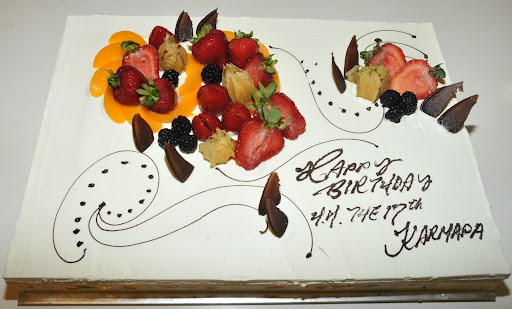
His Holiness Gyalwa Karmapa, who celebrated his birthday yesterday, drew upon the need to retain a Tibetan culture in exile, highlighting: tt"Usually in a Thanka painting, we only paint Buddha's and other deities. I usually feel that it is important to paint the life story of Tibetan people. We can keep our culture in this manner".

Monday, June 27, 2011

His Holiness the Gyalwang Karmapa's 27 birthday Celebrated in Sikkim

Gangtok,June 26: Tibetans and Buddhist followers living in Sikkim celebrated the 27th birthday of His Holiness the 17th Gyalwa Karmapa Ugyen Trinley Dorje. Thousands of devotees across Sikkim chanted hymns praying for peace and harmony while performing with traditional ritual instruments.

In Dharamshala also Dignitaries including Tibetan government officials, parliament members and heads of NGOs, monasteries, nunneries and institutions conveyed greetings to His Eminence the Gyalwa Karmapa. Earlier in the day, the programme had begun with the lighting of incense sticks by monks. This was followed by the offering of Mandalas to the 17th Gyalwa Karmapa. Led by the monks, Buddhist followers also offered prayers wishing well being and a long life to the 17th Karmapa.

Dignitaries attending the event also witnessed a presentation of Tibetan traditional dance and ritual programmes at Gyuto Tantric Monastery in Dharamshala’s neighboring town, Sidhbari and Rumtek in Sikkim.

The 17th Gyalwa Karmapa Lama, who fled from Tibet to India in January 2001 after China’s religious suppression and human rights violations, is now settled in Dharamshala, India and has been granted refugee status by the Government of India. He is the head of the Karma Kagyu sect of Buddhism, which is headquartered at the Rumtek Monastery in Sikkim. The 17th Karmapa Lama possesses the highest authority of any Tibetan Lama recognized by both Beijing and His Holiness the Dalai Lama.

Of the more than 150,000 Tibetans now living in exile in various settlements across India, Nepal and Bhutan, nearly 130,000 also celebrated the Karmapa Rinpoche’s birthday.

Friday, June 17, 2011

The Claude Arpi interviews HH Karmapa Lama in Dharamsala


While approaching the Gyuto Ramoche monastery in Sidhbari near Dharamsala in Himachal Pradesh, one is immediately struck by the pervading peace of the complex. Since 2000, the Gyuto or Upper Tantric College, has offered as temporary accommodation, a wing of its premises, to the 17th Karmapa Lama, Ugyen Thinley Dorje, who has been in the news in recent months.
The 26-year old Lama lives here, surrounded by relatively tight security, with the majestic Dhauladhar range as a background.

Till now, apart from a few statements issued by his office, the young Lama has refused to come out of his reserve and comment on the accusations levelled against him, particularly the cash donations received by his monastery but not deposited in a bank, and his relations with India.

For the first time, he agrees to speak to Rediff.com in an exclusive interview to Claude Arpi, who also interviewed the newly elected prime minister of Tibet, Lobsang Sangay, in Dharmsala.

Throughout the interview, one discovers a remarkable calm young man, deeply interested in Indian culture, in art and the environment of the Himalayas, who is able to see the deeper meaning of the controversies that have surrounded him since he fled from Tibet in 1999, under amazing circumstances.

He takes time to answer each question, knowing perfectly the importance of his words. He usually prefers to speak through his interpreter, except for the last questions where he showed his proficiency in English and his sense of humour.

Your Holiness, can you tell us about your relations with India, which is often misunderstood?

My relationship to India is not something limited to the life of a single individual. This important relationship between the Karmapa lineage and India has a long history that goes back 900 years.

This relationship cannot be separated from this context. The Buddhist lineage was introduced more than 1,200 years ago in Tibet. The beginning of my own [Karmapa] lineage started 900 years ago, and its traditions are firmly rooted in India. The entire history of our lineage goes back to India. The lineage transmitted by the Karmapa comes from India, and was passed through the great Indian Mahasiddha Tilopa and Mahapandita Naropa, whom we revere as our forefathers in this Dharma lineage. Without these Indian sages as predecessors, the history of the Karmapas lineage would have not come into existence. Thus the Karmapa lineage itself is rooted deeply in the very soil of India.

Continuing with this historical background, at the end of the 1950s, when Tibet went through a critical period, Tibetans turned to India. Not only did they turn to India, but India responded warmly and since then has truly been a generous host for the Tibetan people -- not only for His Holiness the Dalai Lama but also for the many tens of thousands who took refuge [in India] and who now form the Tibetan diaspora. India has been a great host; India extended her hospitality to the displaced Tibetan people, for whom that hospitality was not a mere formality, but a matter of life or death.

On top of this, India has provided a sanctuary for the preservation of our Buddhist religious and cultural heritage as well as our Tibetan culture in general.

When the times were so difficult, when we were in such an utterly helpless situation, to whom did we turn? To India! And India provided the refuge we so desperately needed.

Even someone like me, born after 1959, I have heard so much about the kindness and generosity of the Indian people after 1959. It is much talked about among Tibetans. In my generation, there is a general attitude of gratitude towards India to the extent that when Tibetans think of a place for refuge, a land of peace and freedom, where the meaning and purpose of our life can be fulfilled, we immediately think of India. This is why the Tibetan people, myself included, have eagerly turned to India for refuge. We have the feeling that just by reaching the holy land of India, we have accomplished something of great meaning in our lives.

Your Holiness has taken the initiative to look for some religious songs in Sanskrit (they were lost in their original forms in India). Could returning to India these parts of the Indian cultural and religious heritage, be considered as your offering to your host country?

As I mentioned, India is the source of Buddhism for the world. Buddhism originated in India, but it was unfortunately virtually destroyed in its homeland. As heirs to the Buddhist teachings from India, we feel a family connection. We think of ourselves as descendants of India. As descendants of this Buddhist inheritance, we feel responsible for preserving it. In fact, not only must we preserve it, but also whatever spread to our culture and language and is now preserved in it, I feel that we must try to offer back to India. That means we have a family obligation to bring the Dharma back home to India. We have accepted this responsibility to contribute to its revival and renaissance in India.

In this context, I have taken some initiatives. For instance, whenever we have prayer gatherings for world peace, such as the one we hold annually in Bodh Gaya the Kagyu Monlam Chenmo -- at the beginning of the function, when the Sangha [community of monks and nuns] gather together, we chant prayers in their original Sanskrit. Reviving the use of Sanskrit in our prayer gatherings is one way to acknowledge our heritage and to recollect enduring India's kindness to us.

We also have some wonderful sacred songs, also known as Dohas or songs of realisation with very profound words.

Were there Sanskrit songs?

No, they were in different ancient Indian languages. We can't single out Sanskrit; these Dohas existed in different ancient languages of India, Sanskrit is of course the best known of these languages.

These wonderful Dohas that were once sung in India are now lost here. They are virtually unknown within Indian society. I thought it was important to revive them [by having them performed again] in their ancient form. I feel that it is our responsibility to preserve them and make them available to the Indian public. We have treasured these sacred Dohas for many centuries in Tibet. India is now the second home to us Tibetans, and this is just one small effort to try to bring back home to India what India generously His Holiness the Dalai Lama says that he is a son of India, he says that he eats rice and dal like any Indian. Do you like Indian food?
Oh yes, I like Indian food.

Do you like cricket?

Cricket is not played in every country of the world. For example, when I lived in Tibet, I never heard about this game. Frankly, even now, I do not fully understand cricket! But when you live in India, how can you not be influenced by it? Cricket is one of the most important or prevalent games in India -- some might even call it one of the 'religions' of India -- so one way or another, one gets influenced by the game.

Since the time you arrived in India, some Indian officials raised some doubts about you. What can be done or what can you do to dissipate the doubts?

Recently, I have personally approached and communicated directly with some prominent Indian leaders and have also communicated indirectly through some of my representatives. [A delegation of eminent Indian disciples of Karmapa met Prime Minister Dr Manmohan Singh, Congress President Sonia Gandhi and other senior leaders in Delhi].

Your Holiness has personally met Indian leaders?

Yes, some senior officials. I would like to say that if people in the government or people in positions of responsibility have any doubts or suspicions about me, I hope that they might ask me. Please ask me!

You will clarify if there is any doubt.

Yes, I am ready and willing to do whatever is needed to clarify any doubts anyone may have. In fact, I am eager to have the opportunity to answer questions, because allowing such doubts to linger is not helpful for anybody, neither for me of course, but nor for the Indian government. Therefore the best is, if there is still any doubt or suspicion, I would welcome the chance to answer them directly.

You are ready at any time to clarify?

Yes, I will clarify.

Any restriction from the Government of India on your tours in India?

According to the information made available to me, I am restricted from visiting Sikkim [where there is a court injunction] and the monastery of Sherabling [in Himachal Pradesh, the seat of Situ Rinpoche who recognised the present Karmapa]. But I can visit all other places in India, though of course I must seek permission to travel anywhere.

Does His Holiness the Dalai Lama follow the same procedure when he informs the liaison office of the ministry of external affairs of his intended trips?

It is not exactly the same. In the case of His Holiness the Dalai Lama, it is a matter of formality. He just has to inform of his intention he wants to go tomorrow to such and such places; in my case, it is a bit different. I have to apply through various channels, well in advance, and then wait for the clearance.

Have the issues that made the headlines in the Indian press a couple of months ago, been sorted out, mainly the issues cash donations/offerings and benami purchase of land?

It is better if you ask the general secretary of the trust. He knows better the details of these things.
offered to us Tibetans many centuries ago.

Do you still have contacts with your Tsurphu monastery in Tibet? Of course, I have no direct contact with Tsurphu monastery. But sometimes when people are able to come from there, I am able to hear some news second-hand from them.

Do you have many Chinese disciples from mainland and Taiwan?
Yes, they come here [to Himachal] or to Bodh Gaya [in winter].

Apparently, the Chinese government never criticises you, is it true?
I am not sure that it is correct. Criticism need not to be always public [in the press]. For example, I heard that some time back it was forbidden to display my picture in monasteries in Tibet.

In Tsurphu?
No, in other monasteries, not in Tsurphu.

My point is that criticism is sometimes not made public. Just because the Chinese government does not single someone out for public criticism, can this justify accusing this person of being a Chinese spy? I think that it is ridiculous.

It is equally ridiculous to equate anybody with His Holiness the Dalai Lama. He is the unquestionable temporal and religious leader of the Tibetan people. He is the symbol of the Tibetan cause; he is its supreme torchbearer. It is not justified to compare me with His Holiness the Dalai Lama. Obviously, the Dalai Lama is specifically targeted for criticism by the Chinese government because he has this prominent leadership role and he leads the cause so very well.

It would be very naive to believe that there is something suspect about me, simply because the Chinese government does not criticise me. They are more clever than that. If they calculate that it is in their interest to criticise somebody publicly, they will criticise them. If it better serves their interests not to criticise them openly, they will not do so openly.

Furthermore, we have different traditions in Tibetan Buddhism and there are leaders for each of these different traditions. The leaders of these traditions are not criticised by the Chinese government either. Why? Because they have no political role, just like me. Why should it be normal that other religious leaders are not criticised, while not criticising me is wrong?

You said the Dalai Lama is the Light of Tibet. He has now announced his political retirement, will he remain the Light of Tibet?
Yes, His Holiness the Dalai Lama has made clear that he is devolving all his political and administrative responsibilities, but this does not diminish the spiritual authority of the Dalai Lama. It does not and cannot diminish the deep faith and respect that the Tibetan people place in him. This will not change. His authority in that sense will remain unquestionable.

There was another Karmapa 'candidate', Thaye Dorje (sponsored by Shamar Rinpoche, one of the regents of the 16th Karmapa). In the past, this issue has created some bitterness. Would you be ready to meet Thaye Dorje and sort out this issue, which is used by your enemies?

To make it very simple, meeting him is not a problem. Of course we can meet. I have even met with Shamar Rinpoche, so a meeting with Thaye Dorje is not an issue. But what would be the purpose and the result? It is unclear whether it would have a positive outcome. The result of such meeting might be positive or might not.

Further, Thaye Dorje is only the person in front. One needs to ask, who is behind him? For this reason, just meeting him personally is not the answer; in fact it could create more rumours or confusion, with no substantial result at the end. It is not that easy. Thaye Dorjee would have other people advising him as to whether we should meet. I too would take others' views into consideration as to the wisdom of such a meeting.

In the end, it is not simply meeting that matters. What matters is what would be the immediate and longer term benefits of such meeting. That it is the big question.

Someone in your monastery of Rumtek in Sikkim told me that the dispute with Shamar Rinpoche (and Thagye Dorjee) is a 'karmic' issue; a time factor is involved and therefore it may take some time to be solved. Would you like to comment?
You can try to reason it through in such way, but this issue is difficult to reason through. In fact, it is inconceivable for this to have happened. For those who know the history of the Shamar Rinpoche reincarnation lineage and the long history of the Karmapa reincarnation lineage, it seems simply impossible that a situation like this could occur. It is utterly unprecedented in the Karma Kagyu lineage. There was nothing indicating that something like this could happen. As far as the sanctity and integrity of the Karmapa lineage is concerned, it is impossible. Yet it has happened.

From this point of view, one could say that it is a karmic situation. In all fairness, it can't be blamed on one side or one situation exclusively. This could be opened for discussion, but I do not think all the fault lies entirely on one side. By this, I mean that if all people involved had proceeded with integrity, in accordance with the truth of karma, if they had remained harmonious in their vision, this would not have happened. But it has not been so, and thus this has happened.

As far as solving the issue, it cannot be solved as a technical problem by employing some [outer] techniques. The solution must come from "taming of the mind" or proper training of the mind. If one has the ability, one should recall the integrity of our predecessors, the highest standard of their spiritual ethics, and the spiritual vision that they have set for us. To recall this and bring it back into ourselves [His Holiness shows the gesture to bring down the wisdom of the lineage] is the solution. We have to reinstate this integrity [of the lineage] in our minds.

It is a spiritual practice?
Yes. It cannot be solved technically. Ultimately, only spiritual transformation will work

The author Claude Arpi


[General Secretary Karma Chungyalpa says that, as a measure to bring its house in order, the Karmapa Office of Administration has engaged an Indian chartered accountant. Approval under the Foreign Contribution Regulation Act to accept donations in foreign currency is still under consideration by the ministry of home affairs. A delegation that met Home Minister P Chidambaram and Home Secretary G K Pillai was assured that the application was being processed. Regarding the purchase of land on which to construct a permanent home for His Holiness the Karmapa, necessary applications had been made to the relevant government departments, including the local town planning authorities of the Himachal government, well before the issue made the headlines of the Indian press. This request is still being processed.]

Article Courtsey:Rediff

Monday, June 06, 2011

Bring 17th Karmapa Ugyen Trinley Dorjee to Sikkim

Gangtok: June 5th:Welcoming the statement made by the Chief Minister during his village tour on 2nd June at South Sikkim where he had announced the support of the State Government towards the 17th Karmapa claimant Ugyen Trinlay Dorjee., the members of the Joint Action Committee are planning to meet the CM to further discuss about this demand. During a press conference held in the capital on 4th June the spokesperson of JAC Mr Thukchuk Lachungpa said that the members of the JAC will go to Delhi under the leadership of the CM to bring the 17th Karmapa to Phudong Monastery, Sikkim on 17th November on the occasion of Lhabab Dhuechen . He further mentioned that the said committee will take further initiative to bring 17th Karmapa to his rightful throne at Rumtek Monastery permanently.
Followers of the 17th Karmapa were still confused about the stand of the Government but Chief Minister Pawan Chamling cleared all doubts on 2nd June during his village tour, and the followers are very happy after hearing the statement of Chief Minister. The statement also cleared that the original Karmapa is recognized in Ugyen Trinley Dorjee. Added Mr Lachungpa. He further mentioned that central Government has also given a clean chit to the Karmapa
of the recent allegations about him being a Chinese spy, hence now the Central Government may give the permission to the Karmapa to visit Sikkim, as this demand is from the Sikkimese followers and not from the Tibetans. Mr. Lachungpa further informed that due to on going case of Rumtek Monastery it is impossible to bring him here at Rumtek Monastery at present so that committee has decided to bring him to Phudong Monastery because of short time.
He also expressed his hopes that the Central Government will understand the right of worship and this will be granted. Mr. Lachungpa further appealed to all the people to help them to bring 17th Karmapa to Rumtek Monastery.

Monday, May 30, 2011

900th birth anniversary of Dusum Khyenpa, the First Karmapa

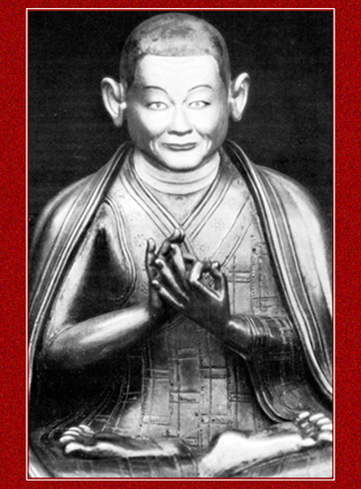
1st Karmapa
Nine hundred years ago, amidst the snow-capped peaks of eastern Tibet, there was born a spiritual master whose compassion for beings would shape the future of Buddhism in Tibet. This great being was the First Karmapa, Dusum Khyenpa, who instituted the practice of intentionally reincarnating in a way that disciples could recognize—a practice that forms the backbone of Tibetan Buddhism as we know it today. His Holiness the Seventeenth Karmapa, Ogyen Trinley Dorje, will lead the international Karma Kagyu community in Karmapa 900—a grand yearlong celebration to commemorate the 900th anniversary of the First Karmapa’s birth
The First Karmapa, Dusum Khyenpa (1110-1193), was an individual whose commitment to caring for others was so intense and unswerving that it literally changed history. Born in 1110 CE in eastern Tibet, Dusum Khyenpa became the first master in Buddhist history to leave indications where he would be reborn so that his disciples could search for his reincarnation, allowing him to continue caring for them life after life. As the first Buddhist master to identify himself to his followers after he was reborn, Dusum Khyenpa became the founder not only of Tibet’s oldest reincarnation line—the Gyalwang Karmapas—but also of the very institution of reincarnation in Tibetan Buddhism. The 900-year old Karmapa reincarnation line initiated by Dusum Khyenpa, today in its seventeenth incarnation, serves as the driving force and spiritual head of the entire Karma Kagyu school of Tibetan Buddhism.
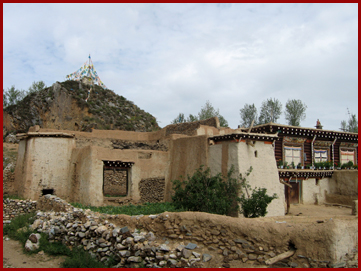
Birthplace of 1st Karmapa

The totality with which Dusum Khyenpa embraced his responsibility to others was evident both in his deeds and his speech. On one occasion, Dusum Khyenpa and his fellow students had received a teaching by their lama Lord Gampopa, in which Gampopa had identified great compassion as one of the indispensable qualities of a spiritual teacher. As the Dharma friends sat discussing this statement, Dusum Khyenpa offered his understanding of what this implied. As a spiritual teacher, Dusum Khyenpa commented, even if one had to go to a hell realm oneself for the sake of a disciple, one would do so willingly, but under no circumstances would one abandon one’s disciples.

For the past 900 years, Dusum Khyenpa has fully lived up to his own definition of a spiritual guide to beings. Indeed, he has proven himself unwilling to abandon his students, even at the moment of death. After he passed away in 1193, Dusum Khyenpa intentionally returned as the Second Karmapa, Karma Pakshi, and made it utterly clear that he was, in fact, the reincarnation of the First Karmapa. Since then, he has taken an uninterrupted series of rebirths as the Karmapa, returning again and again for 900 years to engage in a vast array of activities to benefit beings and the Buddhadharma. In his 17th reincarnation as the Seventeenth Karmapa, Ogyen Trinley Dorje, His Holiness carries on the Karmapa tradition of skilful action for the welfare of others, and has extended the range of Karmapa activities
range of Karmapa activities to include such 21st-century issues as environmental activism and the use of Internet technology to reach disciples worldwide.

Friday, May 27, 2011

No role for the 17th Karmapa, Ogyen Trinley Dorje

The Dalai Lama has acted shrewdly in giving up his political position and removing the need for a regency

 
M ore than 400 delegates from 20 countries met this week in the Indian Himalayas to implement changes that will have a profound effect on the worldwide Tibetan diaspora. If ratified by the parliament-in-exile, the withdrawal of five clauses in the Tibetan constitution will abolish the Council of Regency that has been in place for 370 years.

Recently, the Dalai Lama announced that he was giving up his political position and would in future concentrate on his spiritual and humanitarian responsibilities. This decision prompted the meeting in India – which aims to complete the transition from theocratic rule to democracy. With the Dalai Lama no longer a temporal leader, the need for a regency is eliminated.

It also means that the 26-year-old 17th Karmapa, Ogyen Trinley Dorje, will not now be become a regent – despite the fact that he has been groomed for this role since his dramatic escape from Tibet in 2000. Ogyen Trinley was confirmed as the 17th Karmapa by both the Chinese authorities and the Dalai Lama. On his arrival in India he went straight to the Dalai Lama's headquarters and has been living close by ever since. In 2008 the Dalai Lama was filmed telling the Karmapa and Ling Rinpoche, another young senior lama, that they would inherit his responsibilities when he died. "You will be the ones to continue my work," he said.

It now seems that this work will be confined to spiritual matters connected with the stewardship of Tibetan Buddhism, which has attracted tens of thousands of converts around the world during the past 30 years. According to Arnaud Dotezac – a visiting professor at Geneva University – the abolition of the regency takes the sting out of a controversial issue. The Karmapa is the head of the Kagyupas – a sect of Tibetan Buddhism that was in power until violently suppressed in the 17th century and replaced by the Gelugpa Dalai Lamas.

"It was a bloodbath," Dotezac says. "Thousands of people were killed, Kagyu monasteries were forced to convert into Gelugpas and the idea of Kagyus being friends with Gelugs was unthinkable."

Dotezac also believes that a financial scandal that erupted in the Karmapa's monastery in January tarnished his reputation to a degree that he was no longer seen as acceptable as a regent.

"Everything changed after that," he says. "The process of decoupling religion from politics accelerated. I think by renouncing his political role the Dalai Lama is preparing the ground for his return to Tibet. He has stated his wish to go back and to die there."

In pre-Chinese Tibet, regents took control after the death of a Dalai Lama and ostensibly for an interim period during the childhood of his reincarnation. In reality, regents were immensely powerful at all times and several young Dalai Lamas died in suspicious circumstances. The present (14th) Dalai Lama may have escaped the possibility of this fate because he was forced into exile in 1959.

Establishing Ogyen Trinley Dorje as a purely spiritual leader sidelines the political ramifications of more than one controversial issue that has emerged since he was recognised as the 17th Karmapa in 1992.

Two years later Trinley Thaye Dorje escaped from Tibet with his family and was formally enthroned as the 17th Karmapa, after being recognised by the senior Kagyu lama Shamar Rinpoche. This means that there are two Karmapas. Some senior lamas accept this status quo, other factions insist that their Karmapa is the only genuine one.

There are also persistent claims that Ogyen Trinley is a Chinese plant and that his escape could not have happened without agreement from the Chinese authorities in Tibet.

"This is a conspiracy theory" says Robbie Barnett, director of modern tibetan studies at Columbia University. "There is no credible explanation for the suggestion that it was in China's interests for the Karmapa to escape. Everything points in the opposite direction – it was a huge diplomatic blow and a big humiliation for the Chinese to see their Karmapa flee to India."

Robbie Barnett points out that Ogyen Trinley could have escaped without help from Chinese officials. "At that time," he says, "thousands of Tibetans were escaping to Nepal every year without being caught. In addition, Ogyen Trinley had resources and a support team to help him. They took a remote route not often used by refugees escaping on foot and his driver knew where he should get out of the car and walk to avoid check points."

To most of us born and brought up in western democracies Tibetan politics seem like a hangover from the Dark Ages. But now the Dalai Lama is launching his people into the 21st century, moving towards a future Dalai Lama being approved by an elected government, headed by an elected prime minister. He has neutralised controversies and in giving up his political status he has demonstrated a high level of political skill


(Mary Finnigan guardian.co.uk,)

Tuesday, May 03, 2011

The 17th Karmapa, Ogyen Trinley Dorje denies Chinese 'spy' tag

NEW DELHI — The 17th Karmapa Lama, one of Tibet's top Buddhist monks and widely seen as a potential spiritual successor to the Dalai Lama, spoke out Monday against allegations that he was a Chinese spy.

"Let me categorically state that I am not a Chinese spy, agent or plant in India," the 26-year-old Karmapa, who fled Tibet in 1999 at the age of 14, told reporters in New Delhi in his first comments on the issue.

Earlier this year, the Indian media, quoting unnamed security sources, reported concerns the Karmapa Lama could be a Chinese stooge sent to India to set up pro-Chinese monasteries.

The allegations surfaced after authorities found more than $1 million in foreign cash, including Chinese yuan, stashed at the Gyuto monastery where the Karmapa lives.

His staff said the rare press conference was organised to try and clear the air.

Indian officials were reported to have suspected Beijing might have links with the Karmapa ever since his flight from Tibet, believing his winter escape over the Himalayan mountains -- an eight-day journey by foot and horseback -- at such a young age would have required Chinese connivance.

"It has been very saddening to have faced such allegations," the Karmapa told reporters. "There cannot be a greater blasphemy than these false, very hurtful allegations."

There is longstanding suspicion in India about Chinese interference in Indian affairs amid friction over a disputed frontier. The two countries fought a brief but bitter border war in 1962.

The Karmapa lives in Dharamshala, the northern Indian hill town that is the base of the Tibetan government-in-exile and home to the Dalai Lama.

The Karmapa said he fled Tibet because he was concerned Beijing would force him to turn against the charismatic Dalai Lama, who has acted as a father-like figure for him in Dharamshala.

The Tibetan is one of the most revered religious figures in his homeland and is seen as as having the highest profile of a cast of young lamas who might fill the void when the charismatic Dalai Lama, now 75, dies.

The Karmapa's general secretary Karma Chungyalpa told the news conference the money found by police totalled 60 million rupees ($1.4 million) and were "offerings by devotees" from around the world and had been accumulated.

Police raided the monastery in January after two men were stopped carrying a large sum of money they said belonged to one of its trustees.

The Karmapa conceded there had been "financial mismanagement" but said he had trusted the administration of the funds to "lay workers."

"I have my hands full in fulfilling my religious duties," he said

Sunday, May 01, 2011

Karmapa Charitable Trust (KCT) terms Any Claim of Control over Rumtek Monastery as Unfounded and Misleading


New Delhi, 2011: Karmapa Charitable Trust (KCT), the legal administrative body established during the time of 16th Gyalwa Karmapa which supports the 17th Gyalwa Karmapa, Trinley Thaye Dorje, does not approve the statement made by the spokesperson of Uygen Trinley Dorje which trickled in media regarding the control of Uygen Trinley Dorje’s camp on the Rumtek Monastery. As there is a court case pending on the real claimant of the Rumtek Monastery since 1993 so any claims made in this regard do not hold ground.

Lodreu Rabsel Rinpoche, General Secretary to His Holiness the 17th Gyalwa Karmapa, Trinley Thaye Dorje, says, “The statement from the spokesperson of Uygen Trinley Dorje is totally unfounded and misleading as the court case concerning the eviction of the unlawful occupants of Rumtek Monastery and recovery of the valuable sacred objects of the late 16th Karmapa which was filed in 1997 is still pending before the Court. Hence, Ugyen Trinley Dorje’s administration cannot make any such statement, as they have no legal control over the monastery. KCT has full faith in the legal system and we are confident concerning its positive outcome and KCT does not approve of commenting on the subject that is pending before the highest judiciary in India.”

Rumtek, the seat of the Karmapa lamas since the 1960s, has been the subject of dispute for more than a decade. At the death of the 16th Karmapa in 1981, the KCT assumed management of Rumtek, following the late Karmapa’s stated wishes. This body which supported 17th Gyalwa Karmapa, Trinley Thaye Dorje. But on 2nd August 1993, Situ Rinpoche and Gyaltsap Rinpoche with the help of their followers, including Dekila Chungyalpa and a few hundred armed troops supported by then the State Government of Sikkim attacked Rumtek Monastery and physically evicted all the residents, Trustees, as well as Rinpoches and Monks from there and confiscated the Monastery. The court case was filed by the KCT against Gyaltsab Rinpoche and the Sikkim State officials who were involved in this illegal act so that Rumtek Monastery could be returned to its rightful administration. Situ Rinpoche was not named in the suit because he had been banned to enter India at that point of time.
“The High Court of Sikkim in 2003 ruled that KCT is the legal administration established by the 16th Karmapa has full legal authority over Karmapa’s estate, belongings, including Rumtek Monastery. In 2004, the Supreme Court of India dismissed a Special Leave to Appeal filed by Gyaltsab Rinpoche and his secretary Tenzin Namgyal of the opponent camp, thus confirming the earlier decision of the High Court of Sikkim. The court denied the appeal on the grounds of significant contradictions in Tenzin’s petition that Tenzin could not explain, and also on the grounds that Tenzin’s group could produce no documents to show its management of Rumtek,” confirms Lodreu Rabsel Rinpoche, General Secretary of 17th Karmapa Trinley Thaye Dorje.

(Through Press Release)

Monday, September 27, 2010

Cry for Karmapa return - followers meet in gangtok


courtsey:VoS
 Gangtok, Sept. 26: Thousands of followers of Orgyen Trinley Dorji congregated here today, demanding that the Centre allow the 17th Gyalwa Karmapa to take over his throne at the Rumtek Monastery in Sikkim.

People from all corners of the state started pouring in to Gangtok about 9am in taxis, private vehicles and buses to gather at the Guards Ground. Among them were about 3,000 monks from the 65 registered monasteries in the state.

The procession taken out by the Karmapa’s followers in Gangtok on Sunday.
Around 11am, the followers, led by the monks, began their 1.5km trek to Paljor Stadium that took almost 90 minutes. The rallyists, carrying placards highlighting their demands, chanted mantras and sang traditional songs. According to police estimates, the crowd at the stadium was around 25,000.

The reverence for the Karmapa was evident among the rallyists when photographers and onlookers were cleared from a flyover near the STNM Hospital by the police as the followers refused to allow a vehicle carrying a huge portrait of the Karmapa to pass beneath their feet.

In a memorandum to chief minister Pawan Chamling, the organisers — the Karmapa Reception Committee and the Joint Action Committee — urged him to lead a delegation to New Delhi to meet the Prime Minister to pressure the Centre into allowing the Karmapa to come to Rumtek in 2011.

Joint Action Committee general secretary Karma Sonam Topden said Chamling had promised to instruct the two MPs from the state to raise the issue in Parliament. “He said he had been raising the issue in Delhi and told the central leaders that 99 per cent of Sikkimese wanted the Karmapa in Rumtek.”

K.N. Topden, the spokesperson for the reception committee, said the Karmapa was allowed to visit nearby Mirik, but could not enter Sikkim. “We are approaching the Centre with folded hands to allow him to sit on his rightful throne, as endorsed by the Dalai Lama. Many poor people cannot go all the way to Dharamsala and seek his blessings there.”

Monday, September 20, 2010

Sikkim rally for Ogyen Trinley Dorje enthronement at Rumtek Monastery as HH 17th Karmapa

Dharamsala, September 20 - Representatives of around 65 monasteries and thousands of supporters of the 17th Karmapa Ogyen Trinley Dorje will congregate in Gangtok on September 26 for a massive rally. The rally will be held to ask the Indian government to allow Karmapa Ogyen Trinley Dorje to visit Rumtek Monastery, which they say is rightfully his home monastery in exile.

The followers of Karmapa Ogyen Trinley Dorje demand that New Delhi must lift the ban on the young Lama to travel to Rumtek, and allow him to take his throne at the monastery.

Karmapa Reception Committee which is organizing the rally said as many as fifty thousand people are expected to gather in Sikkim’s capital.

“The government of India must repose trust and confidence in the people of Sikkim. It has been 10 years since the Karmapa fled Tibet and took refuge in Dharamsala in Himachal Pradesh. We have waited long enough,” the KRC said in a leaflet distributed to followers.

“It has been 10 years since the 17th Gyalwang Karmapa had come to India from Tibet, but still he is not allowed to enter Sikkim even though he was allowed to visit Bokar monastery in Mirik, which is very close to Sikkim. We want to know from the Centre whether we are part of India. If we are a part of India, he should be allowed to come and sit on his throne,” said K.N. Topden, a spokesperson for the Karmapa Reception Committee.

The rally will begin at 10.30 am from the Guards Ground in Gangtok and proceed to chief minister’s Dr. Pawan Kumar Chamling’s official residence where a memorandum will be submitted to him. “The Sikkim government has been very supportive to our cause, the chief minister has also written to the Centre on this issue,” Topden said.

The 17th Gyalwang Karmapa Ogyen Trinley Dorje, who escaped to India on January 5 in 2000, was put forward by Tai Situ Rinpoche, a close disciple of the previous Karmapa, and recognized by His Holiness the Dalai Lama. Another claimant to the throne, Trinlay Thaye Dorjee, was put forward by Shamar Rinpoche, another close disciple of the late 16th Karmapa. The Indian government has placed a ban on Gyalwang Karmapa Ogyen Trinley Dorje's travel to Rumtek. The Indian government also denied permission twice to Gyalwang Karmapa Orgyen Trinley Dorjee to travel to Europe and USA earlier this year.

Gyalwang Karmapa Orgyen Trinley Dorjee has been living at Gyuto monastery near here since his escape to India in 2000. He made his first foreign visit to USA in 2008. The young head of Kagyu tradition of Tibetan Buddhism is the only Tibetan religious personality enjoying approval both of the Tibetan government headed by the Dalai Lama and China which has been making attempts to expand its influence on Tibetan religious heads through a law requiring Tibetan lamas to seek Beijing’s approval. Tibetans and supporters say China will use the law to install its own Dalai Lama just as it did with the Panchen Lama.

Saturday, September 18, 2010

"Bring His Holiness the 17th Gyalwang Karmapa to Sikkim "rally on Sept. 26 in Gangtok

Gangtok, Sept. 17: Thousands of supporters of Orygen Trinley Dorjee will congregate here on September 26, demanding that the Centre allow him to take over his throne as the 17th Karmapa at Rumtek monastery.

Dorjee has the backing of the Dalai Lama who endorses him as the 17th Karmapa of the Dharma Chakra Centre.

“It has been 10 years since the 17th Gyalwang Karmapa had come to India from Tibet, but still he is not allowed to enter Sikkim even though he was allowed to visit Bokar monastery in Mirik, which is very close to Sikkim. We want to know from the Centre whether we are part of India. If we are a part of India, he should be allowed to come and sit on his throne,” said K.N. Topden, a spokesperson for the Karmapa Reception Committee.

He said a number of memorandums had been sent to the Union home ministry and the Prime Minister’s Office with the request to bring back the Karmapa, but no response had come. “We do not know the reason for the Centre’s stand.”

A pamphlet issued by the committee to the people asking them to join the rally read: “The government of India must repose trust and confidence in the people of Sikkim. It has been 10 years since the Karmapa fled Tibet and took refuge in Dharamsala in Himachal Pradesh. We have waited long enough.”

According to Topden, representatives of all 65 monasteries registered with the state government, monks and preachers from all faiths will join the congregation that could swell to over 50,000.

“The rally will be silent and the people will carry placards. We want to send a message to the Centre that the demand is not from a handful of people writing memorandums but the entire population of Sikkim, whose patience is running out,” said Topden.

On the controversy over who is the rightful claimant to the throne of the Kagyug sect of Tibetan Buddhism, Topden said the chapter was closed. “The Dalai Lama has endorsed Dorjee as the head of the sect.”

On September 26, the rally will begin at 10.30am from the Guards Ground here and proceed to Mintokgang (the chief minister’s official residence) where a memorandum will be submitted to Pawan Chamling. “The Sikkim government has been very supportive to our cause, the chief minister has also written to the Centre on this issue,” Topden said.

Friday, September 03, 2010

Gangtok Rally for 17th Karmapa on Sept 26

MANGAN, September 2: Meetings are currently progressing in a positive direction with the organisers aiming to mobilise maximum attendance for the upcoming rally in Gangtok to press ahead their demand for Ogyen Trinley Dorjee, widely accepted as the 17th Gyalwa Karmapa, to take his seat of power at Rumtek Dharma Chakra Centre in East Sikkim.


In a meeting held at Phodong monastery today, the Karmapa Reception Committee and Phodong monastery management committee reiterated their appeal to the people to come out in large numbers to participate in the proposed rally and show support for the demand.

The rally will be held on September 26 at Gangtok and is scheduled to start from 10:30 am from Guards Ground, said the organisers.

“Through this rally, we want to bring focus to the long pending demand of Sikkim before the Centre to allow the 17th Gyalwa Karmapa, Ogyen Trinley Dorjee to take his seat at Rumtek Dharma Chakra Centre”, said the two organisations in the meeting.

The organizers maintained that the demand is purely religious. “We appeal people from all sections of the society like government employees, students, NGOs, religious institutions and devotees to join the rally on September 26 so that our demand is heard by the authorities,” they said.

The meeting at Mangan was attended by former deputy Speaker Palden Lachungpa as the chief guest. Karmapa Reception Committee (Phodong) Gaching Bhutia, Panchayats, members of Phodong monastery committee, NGOs, senior citizens, representatives of Phodong Welfare Association, Kabi Welfare Association, Sikkim Sherpa Association, monks from various monasteries in North Sikkim and representatives from Lachen, Lachung and Chunthang had also attended the meeting.

In his address, the chief guest stressed that the movement was purely a political one. All communities should unite and contribute to make the movement successful, he said.

During the meeting, the organizers reminded the gathering about the long pending demand before the Centre to allow the 17th Karmapa to visit Sikkim and take his throne at Rumtek monastery.

Members from both the organisations requested the Centre to have faith on people of Sikkim. “It has been over 10 years since the Karmapa took refuge in India and the people of Sikkim have waited long enough for him to come here,” they said.

Welcoming the gathering, Phodong monastery Omzed, Chewang Lama highlighted that several memorandums have been sent by various organisations to the Centre on the issue.

“Our submissions have gone unheeded for the last several years. This is why we are organising a huge peace rally and everyone should support us”, said Lama.

During the meeting, the Zilla Panchayat members from Tingchim-Mangshila, Singhik and Panchayats from Romom-Tumlong, Lingdok, Ramthang-Tanek, Paney-Phensong along with Mangat Nagar Panchayat Z Bhutia and other NGOs expressed their full support on the issue.

All gave their assurances to mobilise people for the proposed rally on their own expenditure.

The Phodong meeting follows a series of preliminary meetings conducted jointly by various organisations and three major monasteries under Kagyu school of Tibetan Buddhism monasteries in Sikkim-Phodong monastery in North, Ralong monastery in South and Old Rumtek monastery in East.

The three major monasteries had joined hands together with Karmapa Reception Committee to throw life in the dormant demand pending with the Centre to allow the 17th Karmapa to take his rightful throne at Rumtek Dharma Chakra Centre.

Tuesday, November 10, 2009

17th Karmapa on heart-centred designs


GANGTOK, November 10: There could be no better way to end the TED (Technology, Entertainment, Design) Talks than with the ‘moving’ words coming from the world’s youngest spiritual Buddhist leader – the 17th Gyalwang Karmapa, Ogyen Trinley Dorje, making the four-day long programme the first of its kind experience in TED history.
Speaking at the TED Talks in Mysore, India as the closing speaker on November 7, the Tibetan spiritual master implored the international audience not only to work on design and technology but proposed that the worldwide acceleration of technological connectivity should be accompanied by heart-to-heart connections. “Heart to heart connections are very important”, he said reminding that people should never forget this aspect in the pursuit of development.
The 22-year-old highly revered spiritual leader while sharing the storing of his early childhood in Tibet, including the process of his recognition as the Karmapa and what that change signified for him urged the people to shift their motivation to be more sincere and genuinely positive and should aspire to this even ‘when we leave the conference’.
India hosted TED for the first time in Mysore from November 4 to 7 and had invited the Karmapa to also be one of the speakers among a roster of amazing speakers and attendees. “His Holiness received a standing ovation at the conclusion of his talk as did many of the TED speakers,” said Karma Chungyalpa, Deputy Secretary to the Karmapa. Mr. Chungyalpa, who is also escorting the Karmapa said: “The TED audience, which rose unprompted for His Holiness when he walked into the stage, were deeply moved and gave him a standing ovation. Admirers thronged to greet him afterwards and requested heart to heart connections with him, in response to his speech. Some of them were in tears and some said that they felt there could be no better way to end the TED conference, especially one which is the first of its kind.”
The four-day long TED Talks, a fast-paced three-day stage show aimed to gather the world's leading thinkers and doers, offer them four days of rapid-fire stimulation and expect ‘unexpected connections, extraordinary insights and powerful inspiration’.
The Karmapa also took a break from the afternoon the TED session on November 6 to participate in a public prayer session at the NIE stadium in Mysore for the victims of the recent floods in Karnataka. This was organized by the South Zone Kagyu Buddhist Council.
On November 8, he gave teachings to the Tibetan community and students at Tibetan Youth Hostel in Bangalore city. On November 10, the Karmapa will give teachings in New Delhi and return to Gyuto, Dharamsala on the next day.
TED, it is informed is a small non profit organisation devoted to ‘Ideas Worth Spreading’. It started out in 1984 as a conference bringing together people from three worlds: Technology, Entertainment, Design. Since then its scope has become ever broader. Along with the annual TED Conference in Long Beach, California, and the TEDGlobal conference in Oxford UK, TED includes the award-winning TEDTalks video site, the Open Translation Program, the new TEDx community program, this year's TEDIndia Conference and the annual TED Prize, it is further informed.
TED Talks, which originally focused on technology, entertainment and design, but have now expanded in scope to a broad set of topics including science, arts, politics, education, culture, business, global issues, technology and development have been taken part by such people as former U.S. President Bill Clinton, U.K. Prime Minister Gordon Brown, molecular biologist James D. Watson, physicist Murray Gell-Mann, former Vice President of the United States Al Gore, political scientist Bruce Bueno de Mesquita, Microsoft co-founder Bill Gates, Google co-founders Sergey Brin and Larry Page, Zoologist Jane Goodall, and Evangelist Billy Graham among others.

Sunday, November 01, 2009

The High Court dismiss petition challenging the Tibetan origin of the 17th Karmapa


Bookmark and Share


New Delhi: The Delhi High Court has dismissed a petition challenging the Tibetan origin of the 17th Karmapa, head of Kagyu sect of Buddhism and alleging that he has been sent by China to “annex” Sikkim and Arunachal Pradesh.

Justice Manmohan Singh has dismissed the petition filed by Shree Narayan Singh, a Buddhist, and said, “I am of the considered opinion that this court has no jurisdiction to intervene in the present matter as the same is a matter of policy as it is not against any statute or constitution”.

Filing the petition through counsel Surat Singh, the petitioner alleged that Urgyen Trinlay Dorje, the 17th Karmapa, is not of Tibetan origin and “he allegedly escaped to India from China and claimed to be the 17th Karmapa of the Kagyu school of Tibetan Buddhism”.

The Court also rejected Singh’s argument that the Karmapa is in India to collect the Black Vajra Crown and other religious objects from the Rumtak Monastery to carry them back to the Tibetan Autonomous Region in China.

The court rejected the petitioner’s claim that he has the proof that “Karmapa has been intentionally placed by the People’s Republic of China in keeping with China’s larger scheme of secession of Sikkim and Arunachal Pradesh and eventually, annexation of the entire Himalayas region”.

Dorje was officially recognised as 17th Karmapa, head of the sect, by Tibetan spiritual leader the Dalai Lama in 1992 and in 2001, the Government of India had granted refugee status to him. He is presently based in Dharamshala in Himachal Pradesh.

Source: DNA India

Saturday, October 31, 2009

Is Karmapa the next Dalai Lama?

Someone young, intelligent and charismatic," said the Dalai Lama at a press conference in Delhi in 2008, when asked about his successor. And tongues

Is Karmapa the next Dalai?

began to wag. Everyone was certain that Tenzin Gyatso, the 14th Dalai Lama, was talking about Ugyen Thinley Dorjee, the 17th Karmapa.

This guessing game has been on since 2000, when the 15-year-old boy-monk suddenly appeared in Dharamsala after escaping from his monastery in Tsurphu and trekking through Tibet's icy mountains for 15 days. The Chinese made the confusion worse when they claimed that the Karmapa had gone to India to collect his Black Hat and some books. The Karmapa's hat has been locked in a vault at Rumtek, in the monastery built by his 16th reincarnation . Dorjee has not been able to visit the gompa in Sikkim till now.
Holed up on the top floor of the Gyuto Tantri Monastery, near Dharamsala, for seven long years, the Karmapa was allowed by the Indian government to travel abroad for the first time in June 2008. Amid global protests against the Beijing Olympics, as the Karmapa followed the Dalai Lama to the US, observers couldn't help claiming that the Karmapa was being groomed for a future role. The 22-yearold monk himself was quite modest. "I am still young. I have to complete my education before assuming any role," he told TOI-Crest , a day before boarding a flight to the US.

Technically, the Karmapa can't assume the role of the Dalai Lama. They belong to two different schools. But the Karmapas have ruled Tibet in the past. They lost power in a bloody struggle with the 5th Dalai Lama. Is Tibet's past coming full circle in India now? The answer probably lies in the heads of two lamas living in Dharamsala.