Showing posts with label dalai lama. Show all posts

Saturday, September 24, 2011

Dalai Lama reincarnation details but not until he’s 90

DHARMSALA, India — The Dalai Lama said Saturday if he is to be reincarnated he will leave clear written instructions about the process, but that the matter is unlikely to come up for a number of years.

The Tibetan spiritual leader said in a statement that when he is “about 90” he will consult Buddhist scholars to evaluate whether the institution of the Dalai Lama should continue at all. He is 76.

The statement came after a meeting between the Dalai Lama and the leaders of the four Tibetan Buddhist sects, the first since he transferred his political role earlier this year to an elected prime minister.

China reviles the Dalai Lama as a separatist, although the Nobel Peace Prize laureate insists he is only seeking increased autonomy for Tibet. Beijing has left little doubt that it intends to be deeply involved in choosing the next Dalai Lama. That concern has led the current Dalai Lama to contemplate ideas that break with the ancient system in which each dead Dalai Lama is reincarnated in the body of a male child.

In May, the Dalai Lama formally stepped down as head of the Tibetan government-in-exile, giving up the political power that he and his predecessors have wielded over Tibetans for hundreds of years. Though he remains the spiritual leader of Tibetan Buddhism, his decision to abdicate is one of the biggest upheavals in the community since a Chinese crackdown led him to flee Tibet in 1959 into exile in India.

China insists that religious law requires that the Dalai Lama’s reincarnation be born in a Tibetan area under Chinese control. However, the Dalai Lama has said his successor will be born in exile and has even floated the idea of choosing his own successor while still alive — perhaps even a woman.

In his statement Saturday, he said if the institution of the Dalai Lama were to continue, then he would leave behind “clear written instructions about it.”

“Bear in mind that, apart from the reincarnation recognized through such legitimate methods, no recognition or acceptance should be given to a candidate chosen for political ends by anyone, including those in the People’s Republic of China,” he said.

The Dalai Lama has lived in the Indian hill town of Dharmsala since fleeing Tibet. China says Tibet has always been part of its territory, but many Tibetans say the region was virtually independent for centuries.

Copyright 2011 The Associated Press

Tuesday, September 20, 2011

Dalai Lama express sympathy for Sikkim quake affected

Tibetan Spiritual, the Dalai Lama on Tuesday expressed his concern for the devastation caused by the recent earthquake in the state of Sikkim. In a letter written to the chief minister of Sikkim, Pawan Chamling, the Dalai Lama said he was saddened to learn about the loss of life and damage to property that the recent earthquake has cause across isolated Himalayan regions, particularly in Sikkim.

"I offer my sympathy and condolences to all those families who have been directly affected by what I understood is one of the worst earthquakes in recent Memory," said the Dalai Lama.

The Dalai Lama also offered prayers for those affected by this tragic natural calamity and donated Rs 5,00,000 from the Dalai Lama Trust towards relief work in the affected areas of the state

Sunday, July 17, 2011

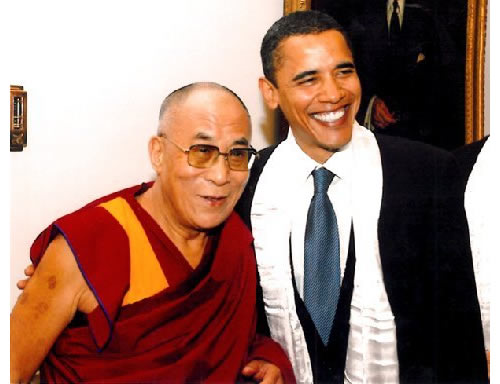
US President Obama welcome the Dalai Lama to the White House


US President Barack Obama has defied warnings from China and welcomed the Dalai Lama to the White House, urging respect for human rights and cultural traditions in Tibet. China immediately lodged a protest and accused Obama of undermining relations between the world's two largest economies by meeting with the Tibetan spiritual leader, who has spent more than half a century in exile.

The White House choreographed the visit to be low key, holding it on a weekend in the mansion's private residence. "The President reiterated his strong support for the preservation of the unique religious, cultural and linguistic traditions of Tibet and the Tibetan people throughout the world," the White House said in a statement.

"He underscored the importance of the protection of human rights of Tibetans in China."

The two leaders met for 44 minutes in the mansion's private Map Room.

The White House did not allow reporters to enter the meeting and announced it just hours before the Dalai Lama was set to close an 11-day trip to Washington by leading thousands in a Buddhist ritual.

Obama's daughters, Malia and Sasha, briefly came to the room to meet the Dalai Lama, a person with knowledge of the talks said. The Dalai Lama voiced happiness about the meeting and said he felt close to Obama at a "human level".

Obama is "president of the greatest democratic country, so naturally he is showing concern about basic human values, human rights, religious freedom", the Dalai Lama said after the meeting.

"So naturally he shows genuine concern about the suffering in Tibet and also some other places," he said.

The White House stressed that both the United States and Dalai Lama accepted Tibet to be a part of China. But Beijing insists that the Dalai Lama is a "splittist" and has sought to dent his popularity around the world.

China summoned the number two at the US embassy, Robert Wang.

The foreign ministry urged the United States to "cease to connive and support anti-China separatist forces that seek 'Tibet independence"'.

"Such an act has grossly interfered in China's internal affairs, hurt the feelings of Chinese people and damaged the Sino-American relations," foreign ministry spokesman Ma Zhaoxu said.

Chinese state television made no mention of the Dalai Lama's talks in Washington but gave prominent coverage to a rare reception by President Hu Jintao for young people from the United States.

The White House statement supported dialogue between China and the Dalai Lama's representatives and said the Tibetan leader hoped that talks would resume soon.

China has held nine rounds of talks with the Dalai Lama's envoys, the last in January 2010. But the dialogue has yielded no tangible progress, leading many Tibetans to believe Beijing is trying to wait out the 76-year-old monk's death in hopes that his calls for greater rights will wither away without him.

The meeting is Obama's second in office with the Dalai Lama; his first, in February 2010, was also closed to press in the Map Room.

Previous president George W Bush met the Dalai Lama openly to award him a Congressional Gold Medal.

US politicians and human rights groups had pressed Obama to see the Dalai Lama and some voiced disappointment that he waited so long to confirm the meeting.

AFP

Thursday, July 07, 2011

Video- Washington felicitates Dalai Lama on his Birthday‎

Hundreds of people flocked to a Washington arena Wednesday to celebrate the 76th birthday of Tibet's spiritual leader the Dalai Lama, who urged followers to mark the occasion by practicing compassion.

Sikkim celebrates 76th Birthday of His Holiness the Dalai Lama

GANGTOK, July 7.The celebrations marking the 76th Birth Anniversary of His Holiness the Dalai Lama at Sara Jhe Dophenling Gumpa saw the assembly of devotees from all over capital to pay their tributes along with offering of prayers. The dignitaries who joined the two day long birthday celebrations of His Holiness were Minister HRDD Mr. N K Pradhan along with Minister for Power Mr. Sonam Gyatso, Area MLA Mr. Dorjee Namgyal and Deputy Mayor (GMC) Mr. Shakti Singh Choudhary.
The cheerful scenario was reverberating with traditional Tibetan folklore presented by school students and students from performing arts Kalimpong. Apart from lot of dancing enjoyed by the gathered devotees, there was musical burlesque of modern Tibetan songs by the band of 7 Vikas Regiment from Rabongla.

The struggle of Tibetans was captured in the frames in the Monastery under the title, “Journey in Exile” and “Long Look Home Ward”. A Photo Exhibition was inaugurated by the chief guest Minister HRDD Mr. N K Pradhan on the occasion of the birth day celebration of HH the Dalai Lama. Mr. Pradhan on the auspicious occasion said that words are less when speaking about a person of the stature of His Holiness. Adding more Mr. Pradhan stated that The Dalai Lama’s teachings are an ocean of wisdom and everyone should make an endeavor to assimilate them in their daily lives in order to make this land worth living.

Monday, July 04, 2011

China has no right to choose my successor - Dalai Lama

Dharamshala: The spiritual leader of Tibet, His Holiness the Dalai Lama told the Associated Press on Friday that the Chinese government has no right to choose his successor upon his death. He claims that the next Dalai Lama will be born in exile somewhere outside of Chinese-ruled Tibet, and stated on Friday that he has the last say on the subject of his rebirth.
Authorities in Beijing, however, counter by arguing that he will be born in Tibet, just as his predecessors were.

"It's a disgrace they want to control that," he told the Associated Press. "As far as my own rebirth is concerned, the final authority is myself and no one else, and obviously not China's communists."

His Holiness also made the point that since the Chinese Communist government is anti-religion, they can't possibly have a say in the very religious matter of choosing his reincarnation.

The choice of the successor of the now 76-year old His Holiness the 14th Dalai Lama will be a very significant political event in the future of Tibet. Because their loyalty to the current Dalai Lama unites Tibetans in exile all over the world, Chinese authorities hope that with his death will also come the death of the Tibetan movement.

The process of identifying successors of His Holiness the Dalai Lama has been going on for over six centuries. Traditionally, a group of Buddhist high teachers (lamas) and Tibetan government officials has taken on the responsibility of finding the Dalai Lama's reincarnation. The process usually takes a few years; for the current Dalai Lama it took four.

In accordance with Buddhist belief, visions and omens are used to point the search party in the right direction. For example, visions of three Tibetan letters, a monastery with a specific roof, and a house with turquoise roof tiles were used to direct the search party of the current Dalai Lama. When they find the boy who could possibly be the reincarnation, they put him through certain tests. He is presented with certain items, some of which belonged to the previous Dalai Lama. If he identifies which objects are "his" correctly, he is proclaimed to be the next Dalai Lama.

With the unprecedented problem of selecting a Dalai Lama under a Chinese-ruled Tibet, there is much speculation as to the future of the position of Dalai Lama. There will most likely be two Dalai Lamas: one sanctioned by the Beijing government and one chosen in exile by Tibetan Buddhist high lamas.

This problem is foreshadowed by the current situation with two Panchan Lamas, one chosen by Tibetan Buddhist teachers and subsequently kidnapped by Chinese authorities, and one selected by the Chinese government itself.

According to His Holiness the Dalai Lama himself and to Tibetan Buddhist tradition, he has control over where he will reincarnate, and has even discussed the possibility of reincarnating within his lifetime.

On the subject of returning to Tibet, His Holiness has claimed that his concerns are not for Tibet's independence from China, but for the basic rights of the Tibetan people. "As soon as China's government is showing their courage to face the reality, then I am ready to go there to help them to promote genuine reconciliation," he claimed.

Chinese authorities say he can return to Tibet with conditions: he must give up separatist activities, accept Tibet as part of China and accept Taiwan as a province of China. His Holiness does not plan to return to Tibet.

Friday, May 27, 2011

No role for the 17th Karmapa, Ogyen Trinley Dorje

The Dalai Lama has acted shrewdly in giving up his political position and removing the need for a regency

 
M ore than 400 delegates from 20 countries met this week in the Indian Himalayas to implement changes that will have a profound effect on the worldwide Tibetan diaspora. If ratified by the parliament-in-exile, the withdrawal of five clauses in the Tibetan constitution will abolish the Council of Regency that has been in place for 370 years.

Recently, the Dalai Lama announced that he was giving up his political position and would in future concentrate on his spiritual and humanitarian responsibilities. This decision prompted the meeting in India – which aims to complete the transition from theocratic rule to democracy. With the Dalai Lama no longer a temporal leader, the need for a regency is eliminated.

It also means that the 26-year-old 17th Karmapa, Ogyen Trinley Dorje, will not now be become a regent – despite the fact that he has been groomed for this role since his dramatic escape from Tibet in 2000. Ogyen Trinley was confirmed as the 17th Karmapa by both the Chinese authorities and the Dalai Lama. On his arrival in India he went straight to the Dalai Lama's headquarters and has been living close by ever since. In 2008 the Dalai Lama was filmed telling the Karmapa and Ling Rinpoche, another young senior lama, that they would inherit his responsibilities when he died. "You will be the ones to continue my work," he said.

It now seems that this work will be confined to spiritual matters connected with the stewardship of Tibetan Buddhism, which has attracted tens of thousands of converts around the world during the past 30 years. According to Arnaud Dotezac – a visiting professor at Geneva University – the abolition of the regency takes the sting out of a controversial issue. The Karmapa is the head of the Kagyupas – a sect of Tibetan Buddhism that was in power until violently suppressed in the 17th century and replaced by the Gelugpa Dalai Lamas.

"It was a bloodbath," Dotezac says. "Thousands of people were killed, Kagyu monasteries were forced to convert into Gelugpas and the idea of Kagyus being friends with Gelugs was unthinkable."

Dotezac also believes that a financial scandal that erupted in the Karmapa's monastery in January tarnished his reputation to a degree that he was no longer seen as acceptable as a regent.

"Everything changed after that," he says. "The process of decoupling religion from politics accelerated. I think by renouncing his political role the Dalai Lama is preparing the ground for his return to Tibet. He has stated his wish to go back and to die there."

In pre-Chinese Tibet, regents took control after the death of a Dalai Lama and ostensibly for an interim period during the childhood of his reincarnation. In reality, regents were immensely powerful at all times and several young Dalai Lamas died in suspicious circumstances. The present (14th) Dalai Lama may have escaped the possibility of this fate because he was forced into exile in 1959.

Establishing Ogyen Trinley Dorje as a purely spiritual leader sidelines the political ramifications of more than one controversial issue that has emerged since he was recognised as the 17th Karmapa in 1992.

Two years later Trinley Thaye Dorje escaped from Tibet with his family and was formally enthroned as the 17th Karmapa, after being recognised by the senior Kagyu lama Shamar Rinpoche. This means that there are two Karmapas. Some senior lamas accept this status quo, other factions insist that their Karmapa is the only genuine one.

There are also persistent claims that Ogyen Trinley is a Chinese plant and that his escape could not have happened without agreement from the Chinese authorities in Tibet.

"This is a conspiracy theory" says Robbie Barnett, director of modern tibetan studies at Columbia University. "There is no credible explanation for the suggestion that it was in China's interests for the Karmapa to escape. Everything points in the opposite direction – it was a huge diplomatic blow and a big humiliation for the Chinese to see their Karmapa flee to India."

Robbie Barnett points out that Ogyen Trinley could have escaped without help from Chinese officials. "At that time," he says, "thousands of Tibetans were escaping to Nepal every year without being caught. In addition, Ogyen Trinley had resources and a support team to help him. They took a remote route not often used by refugees escaping on foot and his driver knew where he should get out of the car and walk to avoid check points."

To most of us born and brought up in western democracies Tibetan politics seem like a hangover from the Dark Ages. But now the Dalai Lama is launching his people into the 21st century, moving towards a future Dalai Lama being approved by an elected government, headed by an elected prime minister. He has neutralised controversies and in giving up his political status he has demonstrated a high level of political skill


(Mary Finnigan guardian.co.uk,)

Thursday, May 12, 2011

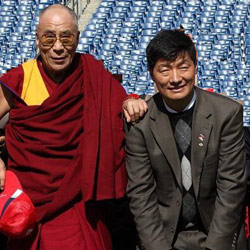
Ready to negotiate with China "anytime - Lobsang Sangay

NEW DELHI (AP) — The newly elected head of the Tibetan government in exile said Thursday that his administration is ready to negotiate with China "anytime, anywhere."

Lobsang Sangay also told reporters in New Delhi that his priorities as political leader of Tibetan exiles include bringing more freedom to Tibet and seeing the Dalai Lama return to his homeland.

"From our side we are willing to negotiate with the Chinese government anytime, anywhere," the 43-year-old Harvard legal scholar said.

The Tibetan government in exile has attempted dialogue with the Chinese government but nine previous rounds of talks between Beijing and the Dalai Lama's envoys have made no headway.

Sangay was elected last month by tens of thousands of Tibetans around the world after the 75-year-old Dalai Lama said he wanted to shift his political authority to an elected leader.

Sangay said his government would seek genuine autonomy for Tibet under Chinese rule by following "the middle path," the Dalai Lama's policy of measured compromise.

"When I take over I will implement that policy," Sangay said.

There was no immediate reaction from Beijing, which accuses the self-proclaimed exile government of seeking to separate Tibet from China, despite the Dalai Lama's claim to be working only for a high degree of autonomy under Chinese rule.

Sangay is on his way to the northern Indian hill town of Dharmsala, the seat of the Tibetan government in exile, where the parliament is slated to meet later this month to discuss amendments to its constitution.

Sangay is to be sworn in on May 30 in Dharmsala but will only assume office in August when the term of the current prime minister ends.

He was in the Indian capital to meet three activists from the Tibetan Youth Congress who are on a hunger strike to protest a clampdown by Chinese armed forces on the Kirti monastery in Sichuan province.

The monastery has been completely surrounded since March 16 after a 21-year-old monk set himself on fire to protest Chinese rule.

Soldiers at one point prevented food and other supplies from entering the compound.

"We feel the pain of Tibetans inside Tibet," Sangay said after meeting the hunger strikers.

China occupied Tibet in 1950 and claims the region has been part of its territory for centuries, although many Tibetans, who are linguistically and ethnically distinct, say they were effectively independent.

The Dalai Lama fled into exile in northern India in 1959

Tuesday, September 14, 2010

Sikkim gets ready for HH Dalai Lama 9-day Visit

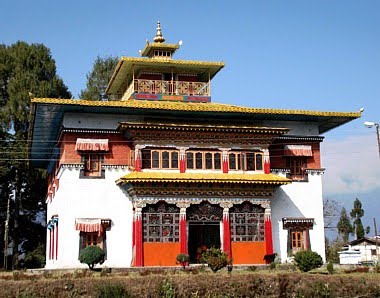
Tashiding monastery : exclusive retreat for Dalai Lama meditation


Gangtok, Sept. 14: The Sikkim government is constructing an exclusive retreat for the Dalai Lama at Tashiding monastery for his stay during the nine-day tour of the state.

The Tibetan spiritual leader will visit several parts of Sikkim and will attend a host of programmes during the tour from December 15 to 23.
“The Dalai Lama will meditate at a retreat in Tashiding monastery (West Sikkim) on December 16 and 17. The retreat, Tsam Khang (meditation centre), is being constructed and should be ready by November. The retreat will be exclusively for His Holiness and the government may later declare it a museum,” said state ecclesiastical secretary Tenzing Gelek.
He was briefing a gathering of monks, Tibetan organisations and Tibetan settlement welfare officials in Gangtok on Friday on the proposed visit of the Dalai Lama. State human resource development minister N.K. Pradhan was also present at the meeting and he invited suggestions from the public on the kind of pujas needed to be performed during the visit for the welfare of the state.
The Tashiding monastery in West Sikkim belongs to the Nyingmapa order and is about 145km from Gangtok.
Before his arrival, the Dalai Lama will be staying in Kalimpong on December 13 and 14. His programme schedule during the two-day stay in the hill town has not been disclosed as yet.
According to a tentative itinerary, the Dalai Lama will be flying to Pelling in West Sikkim on a chopper on December 15. He is scheduled to make a brief visit to the Pemayangste monastery and then reach Tashiding monastery the same day, said Gelek.
On December 18, the Dalai Lama is scheduled to depart for Palchen Choling monastery at Ralang in South Sikkim district. He will also visit a settlement of the Tibetan community there later. The next day, he will take part in a blessing ceremony at the under-construction Buddha Park at Rabong before flying back to Gangtok.
The government is erecting a 135 feet statue of Lord Buddha in the park, which is scheduled to be completed next year. The statue will be the largest of the Buddha in India and the project is aimed at boosting Buddhist pilgrimage tourism in Sikkim.
On December 20, the Dalai Lama will inaugurate a three-day seminar at Chintan Bhavan here on “brain and mind, our potential for change: modern cognitive sciences and eastern contemplative traditions”.
The seminar will be organised by the Namgyal Institute of Tibetology (NIT). The Dalai Lama was invited by the Sikkim government to inaugurate the seminar, which is expected to lay the foundation of the state’s efforts to formally introduce concepts of morality and ethics in school curriculum.

A public teaching from the Dalai Lama is also slated be held at Paljor Stadium here on December 21. The Dalai Lama will attend the closing ceremony of the NIT conference on December 22 before leaving Sikkim the next day.

Monday, September 06, 2010

Dalai Lama in Gangtok to inaugurate conference in December‎

The Tibetan Spiritual leader Dalai Lama will inaugurate a four-day conference to be held here in December.

The four-day conference "Brain and mind, our potential for change: Modern cognitive sciences and eastern contemplative traditions" is being organised by the Namgyal Institute of Tibetology(NIT).

Sikkim chief minister Pawan Chamling in a letter to the Tibetan spiritual leader thanking him for accepting the invitation to attend the conference conveyed to him that the Sikkim government intends to follow up the conference proceedings by introducing moral ethics in Sikkim's schools and colleges, NIT sources said.

The conference is expected to lay the foundations for Sikkim’s efforts to formally introduce concepts of morals and ethics to its school curriculum, they said.

The proposed conference will be attended by leading academics, scientists, thinkers and religious leaders.

Saturday, November 21, 2009

Dalai Lama appeals to China for protecting Tibet’s Glaciers


21.11.2009


At a press conference in Rome, the Tibetan leader raised concerns about climate change and its devastating effects on Tibet’s landscape.

[Dalai Lama, Tibetan Spiritual Leader]:

"Some of the rivers which come from Tibetan glaciers or snow mountains, some within 15, 20 years may dry. So it is as we mentioned a very, very serious matter. .. So with full cooperation of Chinese experts, that we organize some experts to go to Tibet and study how much damage (has been) already done and what is the best way to protect (the environment), the best way to reduce the damage. I think that China is also in need, so (I think we should do it) with full cooperation with Chinese experts. I think that's one thing we can do."

The Dalai Lama said that it is important to cooperate with China over global warming.

He said that a political solution between Tibet and China may take time but the environment cannot wait.

[Dalai Lama, Tibetan Spiritual Leader]:

"I also think that the political solution (for Tibet) may take time - but that's ok, we can wait. But damaging the ecology, year by year, is happening. So we really need serious studies and to make a plan to protect (the environment). That's I think very, very important."

Global warming has a serious impact on Tibetan glaciers.

Friday, November 13, 2009

Dalai's Arunachal visit reopens old wounds


TEZPUR (ASSAM): Much water has flown down the Brahmaputra — or Tsangpo (the purifier) in Tibetan — since the Dalai Lama first set foot in Tezpur as
a fugitive head-of-state 50 years ago. Although the foothill town has grown into a prosperous commercial centre, mainly because of huge military installations built after the 1962 conflict, nothing seems to have changed in the embittered terms between the Tibetan leader and Communist China.

The Dalai Lama's ongoing visit to Arunachal Pradesh has revived the "wounding of the monk with words" by Beijing — an exercise that began right after he made his first statement against the annexation of Tibet on reaching Tezpur in the spring of 1959. China had angrily dismissed his first reaction from foreign soil as "a crude document full of lies and loopholes".

Ever since the 75-year-old leader spoke about touring Tawang — the birthplace of the sixth Dalai Lama — Beijing has upped the ante against him and India. It has not only challenged New Delhi's authority over Tawang by describing the frontier district as its own but has also repeatedly warned him against indulging in "anti-China" activities.


On his part, the Tibetan leader, quite symbolically, chose Tawang, barely 40 km from the MacMahon Line, to answer China's sharp retorts. On the very first day of his weeklong tour on November 8, he described Beijing's opposition to his visit as "baseless". He also made it clear that Tawang belongs to India, not China. Besides, he blamed Beijing for the failure of previous talks on the Tibetan question.

While at Tawang, the Dalai Lama turned nostalgic and gave details of his flight from Lhasa. He also wondered why the Chinese did not pursue him as he fled. Faced with such embarrassing questions, Beijing accused India of ignoring its request to stop the Tibetan leader from visiting the "disputed area".

What this tour, just like his other visits, has proved, is the Dalai Lama's immense popularity across the Himalayas, a fact that may never allow New Delhi to completely distance itself from the Tibetan cause. This despite India's recognition of Tibet as an integral part of China.

People who follow Tibetan Buddhism and support the free-Tibet movement dominate the Himalayas — from Ladakh to Nepal, Darjeeling, Sikkim, Bhutan and Arunachal Pradesh. The Monpas, in an overwhelming majority in Tawang, not only follow Tibetan Buddhism but also have close historic ties to Tibet. Keeping this in view, Beijing describes Tawang as "southern Tibet".


Like elsewhere in the world, the Dalai Lama has been drawing thousands of Buddhists from within and outside India during his tour. Be it Tawang, Bomdi-la or Dirang, people have turned up with their entire families to hear his discourses. "We'll follow him wherever he goes. We'll go to Tibet only if he goes there," said Yeshe Jamyang (77), who had fled Lhasa along with the Dalai Lama in 1959 and later served in a special force of Tibetans raised by India that saw action in the Bangladesh War. The Dalai Lama had spent 10 days at Bomdi-la during his escape from Tibet.

At Tawang and Dirang, a number of Nepalese and Bhutanese Buddhists were present at his congregations. "The Dalai Lama is our supreme god," remarked Nima Tamang, a Nepalese Buddhist, as she rushed to listen to the Tibetan leader with her husband and children.

Many Buddhists fear that the hostility between Dharamshala and Beijing may further complicate the dispute over the reincarnation of the 11th Panchen Lama, the second most important leader after the Dalai Lama. Tibetans allege that China has imprisoned the Panchen Lama recognized by the Dalai Lama and propped up its own Panchen Lama to divide the Tibetans. "We can't rule out the possibility of such interference by Beijing in the selection of future Dalai Lamas," said a monk from Tawang.

Thursday, November 12, 2009

The Last Time: Tawang’s dreaded phrase for Dalai Lama


The Dalai Lama in Tawang. (Reuters)
Tawang, Nov.12: She had been there at the ground the last two days, too. But today was different for the 80-year-old mother of Lobsang Nima.

Frail and barely able to walk on her own, she cried and pleaded with her son to take her to the ground again so that she could listen to the last public teaching session of the Dalai Lama here this morning.

This was the last time, she thought, she would see and listen to her “God” because he might not come here again in her lifetime.

Lobsang, who worked in a hotel here, took her to the “teaching” but he had a different reason from his mother’s. He has heard people say this could be the last Dalai Lama. He didn’t have the heart to tell his mother so. She wouldn’t believe it even if he did.

“Everybody says China can put up a fake one. You know what it did with the Panchen Lama chosen by the Dalai Lama,” he said in broken Hindi.
As the Dalai Lama wound up the last day of his stay in this monastery town — he leaves for other places in Arunachal Pradesh tomorrow — the question if he was the last Dalai Lama seemed to have gripped the minds of many here.
Not that ordinary people would really believe it. They simply can’t imagine a world and their own life without a Dalai Lama. But even the humblest of his flock had heard of the Chinese plan to end the institution of the Dalai Lama.

As a monk at the monastery explained it, the Dalai Lama wasn’t just their spiritual leader. “He is their God as much as the Buddha is. He is the Bodhisatta.”
For the monastic community here, too, the question about the end of the institution, as Tibetans have known it for several hundred years, could no longer be avoided. Apart from the fact that the Dalai Lama is 75 years old, his own assertions on the issue are known to have introduced many uncertain elements in a hitherto unassailable tradition.

The Dalai Lama, who is known to have a scientific and democratic mind, is known to have said many different things on the issue on different occasions. He has himself said he may be the last Dalai Lama. He has also said that his successor can be chosen in a democratic way. On another occasion, he has said his successor could be a woman, an unprecedented thing in the history of the institution.

Then there is always the question what happens if his successor — the reincarnation of his soul — is born within Tibet and the Chinese lay their hands on the child. On at least one occasion, the Dalai Lama has said that his successor could be born in India, which would again be an unprecedented happening.

A monk who lived in Dharamsala and knew about the functioning of the Dalai Lama’s government-in-exile there said: “Everybody in the government and the religious hierarchy will abide by whatever His Holiness decides. But for the common people, a democratically elected Dalai Lama would be such an impossible thing. You can have an elected Prime Minister of this government, but it would be hard to make Tibetan Buddhists accept an elected Dalai Lama.”

One possibility, he said, is that the Dalai Lama himself can select a “board of regents” in his lifetime to oversee the selection of his successor.

But he was confident that the Dalai Lama knew about the impossibility of letting the line die and thereby plunge the Tibetan people and their future in a worse tragedy than they are facing now.

For the 45 lakh Tibetans within Tibet and another lakh or so outside it, the end of the Dalai Lama lineage would mean a crisis not only of their religion but also of their culture.

During his visit here, the 14th Dalai Lama repeatedly emphasised the importance of keeping Tibetan culture alive. But he himself is the ultimate symbol of the hope for the continuity of Tibetan culture.

No one knows better how difficult the challenge is. In China’s Tibet, despite all the recent moves to make the promotion of Tibetan culture a tourism tool, the government and the communist party try everything to “sinicise” Tibetan culture. In India, for all the efforts of Dharamsala and Tibetan activists, the younger generation of Tibetans find it hard to survive economically without imbibing Indian mores.

Like Lobsang Nima, most people of his generation here speaks Hindi. “It came with the Indian Army. We have always been so dependent on the army for so many things. Hindi has given us much advantage. And now English-medium schools are sprouting here.”

Tibetan culture, like Tibetan Buddhism, survived unscathed for generations as long as outsiders had not climbed the mountain passes and ridges to penetrate that forbidden world.

The Dalai Lama faces a daunting task that none of his predecessors faced — to take Tibet to the world and also keep it Tibetan.

Monday, November 09, 2009

The 5th Dalai Lama unified Tibet in mid-16th century


What are the different schools of Tibetan Buddhism?
Though there are several distinct schools, Tibetan Buddhism can be primarily divided into four main traditions: Nyingma, Kagyu, Gelug, and Sakya.


Nyingma is the oldest order formed by Indian sage Padmasambhava, who is often credited with spreading Buddhism to Tibet and Bhutan. In the Kagyu sect, the most famous subsect is Karma Kagyu headed by the Karmapa, whose principal seat, in exile, is the Dharma Chakra Centre at Rumtek Monastery in Sikkim. The third important school is Sakya, whose leaders are descendants of the royal Khon family.

The fourth major school is Gelug, whose spiritual head is the Ganden Tripa — an appointed office with the Dalai Lama as temporal head — who is selected on the basis of a reincarnation lineage. Successive Dalai Lamas ruled Tibet since the mid-16th century after the fifth Dalai Lama unified the country by defeating the rival sects. Tenzin Gyatso, the 14th Dalai Lama, is the head of the Tibetan government in exile in Dharamsala, India.

Who is a tulku?


Traditionally, a tulku, also known as rinpoche, is considered to be a reincarnation of a Buddhist master who has vowed to take rebirth to help all living beings attain enlightenment. However, some scholars oppose the use of the word rebirth as it is believed that there is a mindstream (moment-to-moment continuity of consciousness) emanation of the first master, which is based on the idea that exemplary figures might remain within the human world as institutional teachers, manifesting from one lifetime to the next. The most famous example is the lineage of Dalai Lamas, while the oldest lineage of tulkus is that of the karmapas.


Tibet experts estimate that at present there are around 500 tulku lineages found across Tibet, Bhutan, northern India, Nepal, Mongolia, and the southwest provinces of China.

In December 1988, the Dalai Lama, the Council for Religious and Cultural Affairs in Dharamsala and the Central Institute for Higher Tibetan Studies in Sarnath, organized a conference attended by more than 300 tulkus. While most tulkus were ethnic Tibetans with a few having Mongol ethnicity, in modern times, westerners are also identified as tulkus. The most famous of them are Tenzin Osel, who was born to Spanish parents, and Hollywood actor Steven Seagal, who has been recognized by Tibetan lama Penor Rinpoche as a reincarnation of 17th century tulku Chungdrag Dorje.

How are the tulkus identified?


In the case of the Dalai Lama, the tulku lineage is interlinked with the panchen lama (panchen lama traditionally recognizes the new incarnation of a Dalai Lama and vice versa). However in other cases, the potential candidates are evaluated by other respected lamas. The evaluation process often involves tests like checking whether the child can recognize acquaintances or possessions of his previous reincarnation or answer questions only known to his former-life experience.

Sunday, November 08, 2009

Dalai Lama arrives in Arunachal to rousing reception by Tibetans

I am hurt by China's claim over Tawang: Dalai Lama


Tawang, Nov 8 (PTI) Braving the winter chill, thousands of Tibetans and locals today lined up along the roads leading to the Tawang Monastery and gave a rousing reception to the Tibetan spiritual leader the Dalai Lama, who arrived here on a four-day visit.

After his arrival here by a helicopter from Guwahati, the 74-year-old Dalai Lama, accompanied by Arunachal Pradesh Chief Minister Dorjee Kandu, was welcomed by cheering Tibetans as he drove along the 10-km stretch from the helipad to the 400-year-old Tawang Monastery.


The Dalai Lama's cavalcade stopped at three places -- old market, Manjusree Vidyapeeth and new market -- as the spiritual leader blessed the people who greeted him.

Nestled in the snow-capped mountains and perched at a height of 10,000 feet, this town wears a festive look with colourful posters with the Dalai Lama's pictures and Tibetan and Indian flags flying everywhere.

Saturday, November 07, 2009

Dalai Lama sends greetings to “Tibet Festival” in Sikkim


Gangtok, Sikkim, 6 November - His Holiness the Dalai Lama sent his greetings to the first ever Tibet Festival today in the northeastern Indian state of Sikkim that has strong cultural and religious ties with Tibet. The 1989 Nobel peace laureate said it is befitting that the festival was being held to coincide with the 50 years of the Tibetan people’s life in exile.

“I too have fond memories of my several visits of Sikkim. In particular, I have been deeply moved when undertaking pilgrimage to sacred sites like Tashiding and Pemayangtse,” read the message from the Tibetan leader who is currently touring Japan. Mr. Dhondup Dorjee, Tibetan Settlement Officer of Gangtok, read out the message at the opening function of the festival today at Kanchenjunga Complex in Gangtok.

His Holiness further writes, “I am therefore pleased to send my greeting on the occasion of a Tibet Festival that is being held in Gangtok from November 6 to 10, 2009 by the Tibetan Community in Sikkim to express their gratitude to the state government and the people of Sikkim. It is befitting that this festival is being held to coincide with the 50 years of the Tibetan people’s life in exile.”

The Tibetan Community of Sikkim in association with three Tibetan NGOs from Dharamsala are hosting the event to express the Tibetan people’s gratitude to the government of India and its people for 50 years of hospitality.

T.T. Bhutia, the Minister of Transport & Public Health Engineering, presided over as the chief guest for the inaugural function, and appreciated the impressive work put up by the Tibetan community of Sikkim, and stressed on the importance of preserving Tibet’s rich cultural heritage. He also spoke on possible joint venture between the Tibetan and Sikkimese religious groups. Since Sikkimese people and Tibetans share a common religion, he urged, “the young Sikkimese lamas have much to learn and seek guidance from Tibetan lamas on the intricacies of Buddhist rituals”.

Mr. Karma Yougyal, Organising Secretary of the Tibet Festival, said, “The festival showcases the rich cultural identity of Tibet that has been conserved for the past 50 years in exile with kind assistance from the Indian government and its people. It will exhibit the spirit of Tibet in its original form.”

Mrs. Kirti Dolkar Lhamo, President of the Tibetan Women’s Association said, “We take this opportunity to convey our sincere gratitude to His Holiness the XIV Dalai Lama has provided an unwavering and visionary leadership for all Tibetan people everywhere in the world.”

“Sikkim has a special place in the hearts of Tibetan people. The hospitality extended to us is invaluable,” added Mrs. Lhamo.

Lectures and exhibits on Tibet’s environment, Buddhism, Tibetan medicine, astrology, traditional music and dance, costumes, crafts, and cuisine will be showcased at the festival.

Tibetan Women’s Association, Gu-Chu-Sum Movement for Tibet, Students for a free Tibet – India, U-Tsang Association Gangtok, Dotoe Association Gangtok, Domey Association Gangtok, Tibetan Youth Club Gangtok, Tibetan Women’s Association Gangtok and Regional Tibetan Freedom Movement Gangtok have jointly arranged the festival that is expected to draw several thousand people

Tibet Festival Starts @Gangtok


Gangtok,Nov07: With a banner saying “Thank you Sikkim for 50 years of hospitality”, a Tibetan festival is being held in the capital town to commemorate 50 years’ stay of the Tibetans in Sikkim who came from Tibet in 1959.
The festival at the top of Kanchenjunga Shopping Complex in Lall Market was inaugurated by chief guest Mr. TT Bhutia, Minister SNT and PHE, on Friday, November 6. Mr. NK Pradhan, Minister HRD, Mr. DB Thapa, Minister UD & HD, Mr. Sonam Gatyso Lepcha MLA, Mr. Dorjee Namgyal Bhutia, MLA, were present, among others. They all are visited the stalls exhibiting Tibetan traditional food, handloom and cultural features. Dancers and singers from Dharamsala, Himachal Pradesh, Headquarter of Tibetan Administration in exile, are performing live.
Chief Guest said, in Sikkim, we all Nepali, Lepcha, Bhutia stay in unity and the government provides the same status to Tibetans also who are considered as guest by both India and state government.
Items of culture, tradition and Buddhist religion, seminar, traditional and modern fashion show are in the agenda of the festival which will continue till November 10. This commemorative festival is being celebrated throughout India

Sunday, November 01, 2009

The High Court dismiss petition challenging the Tibetan origin of the 17th Karmapa


Bookmark and Share


New Delhi: The Delhi High Court has dismissed a petition challenging the Tibetan origin of the 17th Karmapa, head of Kagyu sect of Buddhism and alleging that he has been sent by China to “annex” Sikkim and Arunachal Pradesh.

Justice Manmohan Singh has dismissed the petition filed by Shree Narayan Singh, a Buddhist, and said, “I am of the considered opinion that this court has no jurisdiction to intervene in the present matter as the same is a matter of policy as it is not against any statute or constitution”.

Filing the petition through counsel Surat Singh, the petitioner alleged that Urgyen Trinlay Dorje, the 17th Karmapa, is not of Tibetan origin and “he allegedly escaped to India from China and claimed to be the 17th Karmapa of the Kagyu school of Tibetan Buddhism”.

The Court also rejected Singh’s argument that the Karmapa is in India to collect the Black Vajra Crown and other religious objects from the Rumtak Monastery to carry them back to the Tibetan Autonomous Region in China.

The court rejected the petitioner’s claim that he has the proof that “Karmapa has been intentionally placed by the People’s Republic of China in keeping with China’s larger scheme of secession of Sikkim and Arunachal Pradesh and eventually, annexation of the entire Himalayas region”.

Dorje was officially recognised as 17th Karmapa, head of the sect, by Tibetan spiritual leader the Dalai Lama in 1992 and in 2001, the Government of India had granted refugee status to him. He is presently based in Dharamshala in Himachal Pradesh.

Source: DNA India

Saturday, October 31, 2009

Is Karmapa the next Dalai Lama?

Someone young, intelligent and charismatic," said the Dalai Lama at a press conference in Delhi in 2008, when asked about his successor. And tongues

Is Karmapa the next Dalai?

began to wag. Everyone was certain that Tenzin Gyatso, the 14th Dalai Lama, was talking about Ugyen Thinley Dorjee, the 17th Karmapa.

This guessing game has been on since 2000, when the 15-year-old boy-monk suddenly appeared in Dharamsala after escaping from his monastery in Tsurphu and trekking through Tibet's icy mountains for 15 days. The Chinese made the confusion worse when they claimed that the Karmapa had gone to India to collect his Black Hat and some books. The Karmapa's hat has been locked in a vault at Rumtek, in the monastery built by his 16th reincarnation . Dorjee has not been able to visit the gompa in Sikkim till now.
Holed up on the top floor of the Gyuto Tantri Monastery, near Dharamsala, for seven long years, the Karmapa was allowed by the Indian government to travel abroad for the first time in June 2008. Amid global protests against the Beijing Olympics, as the Karmapa followed the Dalai Lama to the US, observers couldn't help claiming that the Karmapa was being groomed for a future role. The 22-yearold monk himself was quite modest. "I am still young. I have to complete my education before assuming any role," he told TOI-Crest , a day before boarding a flight to the US.

Technically, the Karmapa can't assume the role of the Dalai Lama. They belong to two different schools. But the Karmapas have ruled Tibet in the past. They lost power in a bloody struggle with the 5th Dalai Lama. Is Tibet's past coming full circle in India now? The answer probably lies in the heads of two lamas living in Dharamsala.

Tuesday, October 27, 2009

Dalai Lama's visit to Arunachal cleared


Tibetan spiritual leader the Dalai Lama prays for four Tibetans executed in Lhasa, the capital of Tibet, for their alleged role in deaths by arson in March 2008, in Dharamshala on Monday. India on Tuesday approved the exiled monk's week-long visit to Arunachal Pradesh despite objections from China. The spiritual leader will be visiting the 300-year-old Tawang monastery among other places from November 8.
(AFP)