Showing posts with label Thangka Painting. Show all posts

Tuesday, June 28, 2011

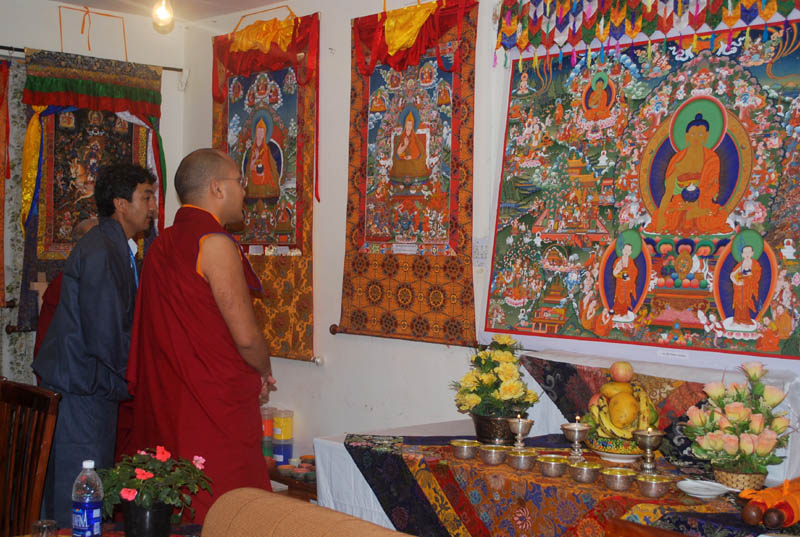
Gyalwa Karmapa inaugurates Tibetan Thangka Exhibition

Dharamshala- His Holiness Gyalwa Karmapa formally opened an exhibition of traditional Tibetan Thangka painting Monday (27th June) at the main Tibetan Temple complex, today in Dharamshala, India. He was accompanied by the minister of the Tibetan department of religion and culture; Tsering Phuntsok, to celebrate the unique paintings by the school of Tsang Menthang - of Tibetan Traditional Arts.
To highlight the beautiful work by the 8 students that graduated from this institution, the revered spiritual leader His Holiness Gyalwa Karmapa graced the presence of the rapt audience in the Temple.

He was led around the room of around 37 beautiful, hand painted deities, with the audience of students watching intently. The Karmapa unveiled the exhibition to the public, and blessed the institute.

The Thangka teacher, Buchung Nugbya, introduced Tsang Menthang and His Holiness the Karmapa to the ancient lineage of Tsang Menthang, of Tibetan Traditional Arts.

He also offered two Thangka paintings, one to the Karmapa, and one as a gift to His Holiness the 14th Dalai Lama. Tsering Phuntsok presented certificates to the 8 students of the school, who had recently graduated. The two main guests then gave speeches.

Tsering Phuntsok stated to the audience that: "It's important to keep the good lineage of the skill of Tsang Menthang traditional arts. If we stay in one place like Dharamshala, people will come to us to buy our Thangkas. If we do this only for money, and the skill and quality deteriorates, we may find ourselves going to the market in the future attempting to sell our work, and find nobody wishes to buy this. If the skill and quality remains as good as before, we can stay in one place, and people will come to us, wishing to buy our fine art".

His Holiness Gyalwa Karmapa, who celebrated his birthday yesterday, drew upon the need to retain a Tibetan culture in exile, highlighting: tt"Usually in a Thanka painting, we only paint Buddha's and other deities. I usually feel that it is important to paint the life story of Tibetan people. We can keep our culture in this manner".

Saturday, November 07, 2009

Dalai Lama sends greetings to “Tibet Festival” in Sikkim


Gangtok, Sikkim, 6 November - His Holiness the Dalai Lama sent his greetings to the first ever Tibet Festival today in the northeastern Indian state of Sikkim that has strong cultural and religious ties with Tibet. The 1989 Nobel peace laureate said it is befitting that the festival was being held to coincide with the 50 years of the Tibetan people’s life in exile.

“I too have fond memories of my several visits of Sikkim. In particular, I have been deeply moved when undertaking pilgrimage to sacred sites like Tashiding and Pemayangtse,” read the message from the Tibetan leader who is currently touring Japan. Mr. Dhondup Dorjee, Tibetan Settlement Officer of Gangtok, read out the message at the opening function of the festival today at Kanchenjunga Complex in Gangtok.

His Holiness further writes, “I am therefore pleased to send my greeting on the occasion of a Tibet Festival that is being held in Gangtok from November 6 to 10, 2009 by the Tibetan Community in Sikkim to express their gratitude to the state government and the people of Sikkim. It is befitting that this festival is being held to coincide with the 50 years of the Tibetan people’s life in exile.”

The Tibetan Community of Sikkim in association with three Tibetan NGOs from Dharamsala are hosting the event to express the Tibetan people’s gratitude to the government of India and its people for 50 years of hospitality.

T.T. Bhutia, the Minister of Transport & Public Health Engineering, presided over as the chief guest for the inaugural function, and appreciated the impressive work put up by the Tibetan community of Sikkim, and stressed on the importance of preserving Tibet’s rich cultural heritage. He also spoke on possible joint venture between the Tibetan and Sikkimese religious groups. Since Sikkimese people and Tibetans share a common religion, he urged, “the young Sikkimese lamas have much to learn and seek guidance from Tibetan lamas on the intricacies of Buddhist rituals”.

Mr. Karma Yougyal, Organising Secretary of the Tibet Festival, said, “The festival showcases the rich cultural identity of Tibet that has been conserved for the past 50 years in exile with kind assistance from the Indian government and its people. It will exhibit the spirit of Tibet in its original form.”

Mrs. Kirti Dolkar Lhamo, President of the Tibetan Women’s Association said, “We take this opportunity to convey our sincere gratitude to His Holiness the XIV Dalai Lama has provided an unwavering and visionary leadership for all Tibetan people everywhere in the world.”

“Sikkim has a special place in the hearts of Tibetan people. The hospitality extended to us is invaluable,” added Mrs. Lhamo.

Lectures and exhibits on Tibet’s environment, Buddhism, Tibetan medicine, astrology, traditional music and dance, costumes, crafts, and cuisine will be showcased at the festival.

Tibetan Women’s Association, Gu-Chu-Sum Movement for Tibet, Students for a free Tibet – India, U-Tsang Association Gangtok, Dotoe Association Gangtok, Domey Association Gangtok, Tibetan Youth Club Gangtok, Tibetan Women’s Association Gangtok and Regional Tibetan Freedom Movement Gangtok have jointly arranged the festival that is expected to draw several thousand people

Sunday, September 06, 2009

Art among Sikkim Monks

GANGTOK - An art school is preserving the oldest form of traditional and religious art of statue making, influenced by Buddhist teaching in Sikkim.

The Traditional Arts School for Thangka Painting at 5th mile, a half an hour drive from state capital Gangtok, is under the supervision of Ecclesiastical Affairs Department, Government of Sikkim. The school is exclusively for the monks (boys).
Monks from different monasteries located throughout the state come to the institute and learn the art free of cost.

The school was started as a separate branch of Enchey School, which was a monk school then in 1909 for teaching the art of statue making to monks at the time of Chogyal (King).

However during 1950s, the school came under the Ecclesiastic Affairs Department.

Ndar Lama, an instructor at the Vocational Arts School, Gangtok, revealed that the art of making the statues came from Bhutan.However, to popularise the art among local monks, the state government felt the need to set up one institute in Sikkim, Lama said.

“The art of making this mud statue came from Bhutan. Earlier, Chogyal (King) used to call the instructors from Bhutan and they used to make the statues. In fact, most of the statue in big monasteries here was made by the Bhutanese. Even I learnt the art from one Bhutanese person. But now the government of Sikkim felt the need to open one such vocational training institute even in Sikkim,” Lama added.

Students at the school said that they hope to teach the art to the future generation so as to keep the Buddhist culture alive.After learning the art of statue making, I will go to the monastery and teach the art to our future generation so as to keep our Buddhist culture and art of statue making alive,” said Dawa, a student.

Besides teaching the art, the school also helps the monks in becoming self-reliant.
(ANI)