Showing posts with label animals. Show all posts
Thursday, November 26, 2009
Another Bear Attack @Sikkim construction site
NAMCHI, November 26: A 19-year-old man working at the construction site at Rabong Buddha Park was mauled by the Himalayan Black Bear this afternoon, grievously injuring him.
John Rai, a resident from Mirik who sustained injuries on his left calf and wounds all over his body was referred to STNM Hospital, Gangtok.
This was the first bear attack in the sub-division even as the locals alerted of the sightings of two bears recently.
A team of forest officials consisting of DFO (Wildlife), Passang Dorjee Bhutia, ACF (Wildlife) Madan K Koirala, BO (Territorial), Anup Bhaniya, BO (Wildlife) Suman Basnet, BO (Wildlife) Dorjee Ongmu Bhutia surveyed the area but could not trace the animal.
Prior to the attack, forest officials had been surveying the area following reports of the wild animal eating at least five pigs from Borong-Ralong area, said forest officials. It may be mentioned here that a forest officials had last year tranquilised a black bear at the same locality.
Even at the time of filing this report, the forest officials along with members from eco development committee, joint forest management committee, Panchayats and locals have been coming through the locality. Cages have also been put at certain places around Rabong, forest officials said over the phone.
Sikkim News,News on Sikkim,News of Sikkim,
animals,
bear attack,
Himalayan Black Bear,
rabongla,
wildlife
Saturday, November 21, 2009
Bear Combing operation in Parakha
GANGTOK, November 21: The State forest department yesterday conducted a full combing operation in Parakha area of East Sikkim where bear menace had been reported recently.
A forest team consisting of wildlife and territorial staff led by DFO (Wildlife, East) Karma Legshey and ACF (Territorial, Pakyong) Rajini Bhandari along with Tekabong outpost police combed the entire area of Tekabong Parakha GPU where the bear had been sighted.
The team found signs of bear presence during the combing operation conducted in the area. The bear had also damaged some crops like squash and ginger of three local farmers - Mahananda Kharel, Suresh Gurung and Kush Narayan Sharma.
The forest team conducted an on-the-spot assessment of the damage and assured compensation to the farmers during a sensitization meeting conducted for the villagers and Panchayat members.
Sikkim News,News on Sikkim,News of Sikkim,
animals,
bear attack,
Himalayan Black Bear,
wildlife
Wednesday, November 18, 2009
Fresh sighting of bears at Gangtok
Fresh sighting of bear at Tathangchen prompts forest dept to set up a trap
GANGTOK, November 18: State forest department is maintaining strict vigil in bear wandering suspected areas even as fresh sightings continue to come from various parts of East Sikkim.
Today, bear sightings were reported from three areas of East Sikkim-Rumtek, Ban Jhakri falls and Tathangchen area of Gangtok.
The forest department received information of bear sighting from Tathangchen area, the same area where a juvenile bear had mauled a grass cutter on November 15.
A forest team led by DFO (Wildlife, East) Karma Legshey along with a team of Gangtok Sadar police rushed to the spot and immediately launched preventive measures. A cage has also been set up in the area in order to trap the sighted bear. Two armed forest guards are presently maintaining vigil on the trap.
Bear sightings were also reported from Rumtek area which was responded by the forest department. Jigmee Bhutia (Range Officer, Fhambongla wildlife sanctuary, east range) along with local territorial staff conducted enquiries at the spot but the bear was not seen again. The locals have been sensitized about the preventive bears by the forest team.
The third sighting was reported from Ban Jhakri falls where a territorial team from Gangtok range was dispatched. However, the bear could not be traced.
The forest department is planning to set up early morning hours patrolling in the area between 4 am to 6 am to trace the elusive bear.
Meanwhile, the cub which had separated from the mother bear at Rakdong Tintek yesterday has gone back to the forest areas. However, the forest personnel are still maintaining vigil in the area.
Sikkim News,News on Sikkim,News of Sikkim,
animals,
bear attack,
forest,
Himalayan Black Bear,
wildlife
Tuesday, November 17, 2009
Three goats killed by bears near Pakyong
PAKYONG, November 17: A pair of Himalayan Black Bear has been suspected to be roaming around Thekabung jungle, above Parakha BAC office, about 12 kilometres away from here.
The villagers suspect that the bears have eaten three goats, which were left in the jungle for grazing recently. These goats, the villagers said had gone missing from where they were left for grazing.
The State Forest officials and staff members of the sub-division have been in the look out of the black bears for the past two days. However, the departmental team is yet to trace the elusive animal.
Speaking to this correspondent, BK Dhamala, Range Officer, Pakyong sub-division said, the fresh waste (toilet) of bear has been sighted at Thekabung jungle this morning through which they guess that an adult animal and a cub might be there.
“Due to dense bushes and trees, we were unable to locate as where the bear was hiding,” the RO said adding that the search is still on. He further said that the bear might have eaten the three goats that went missing for the past three days.
“We have informed to the department but still no one has come to the place for tracing and capturing the bear,” Mr. Dhamala said.
On the other hand, local people fear that the animal may enter the village and cause damage.
The villagers suspect that the bears have eaten three goats, which were left in the jungle for grazing recently. These goats, the villagers said had gone missing from where they were left for grazing.
The State Forest officials and staff members of the sub-division have been in the look out of the black bears for the past two days. However, the departmental team is yet to trace the elusive animal.
Speaking to this correspondent, BK Dhamala, Range Officer, Pakyong sub-division said, the fresh waste (toilet) of bear has been sighted at Thekabung jungle this morning through which they guess that an adult animal and a cub might be there.
“Due to dense bushes and trees, we were unable to locate as where the bear was hiding,” the RO said adding that the search is still on. He further said that the bear might have eaten the three goats that went missing for the past three days.
“We have informed to the department but still no one has come to the place for tracing and capturing the bear,” Mr. Dhamala said.
On the other hand, local people fear that the animal may enter the village and cause damage.
Sikkim News,News on Sikkim,News of Sikkim,
animals,
bear attack,
Himalayan Black Bear,
wildlife
Monday, November 16, 2009
Bear mauls again in Gangtok
Gangtok, Nov. 15: A Himalayan black bear pounced on and mauled a grass cutter near the state secretariat here this morning, barely two weeks after three senior forest officials were injured in a similar attack in a residential area of the town.
Around 10.30am, 38-year-old Bimal Gurung was working on a green patch between Palace Ridge Park and the Tashiling state secretariat when the bear came up from behind him. It pounced on him, its force pushing him to the ground. It is not clear how Gurung, who is hardly able to speak, fended off the bear or why the animal left him.
On a weekday, the area on the outskirts and on a higher level than Gangtok, is fairly crowded with people queuing up to the secretariat which houses the various departments of the government.
Chutim Dorjee Lepcha, the person in whose house Gurung worked, said he heard shouts for help and rushed out. “I saw Bimal bleeding and barely able to walk up the slope towards the road. He managed to tell me that a bear had pounced on him while he was cutting grass. The animal was nowhere to be seen,” he said.
Gurung was rushed to Sir Thutob Namgyal Memorial Hospital where doctors, who attended on him, said his right arm was fractured and he suffered severe injuries on the head, chest and face.
Later, he was shifted to Central Referral Hospital at Tadong.
Forest secretary S.T. Lachungpa visited the injured man at STNM Hospital and handed him Rs 5,000 as initial payment for his treatment.
“I held a meeting with senior forest officials after the incident and it was decided that seven to eight spots in the state capital which is contiguous to forested land would be manned constantly to prevent incidents like this one. We appeal to the people to be very cautious in the morning and at nightfall when bears are mostly active, looking for food,” Lachungpa said. He added that Himalayan black bears were known to attack humans without provocation.
The bear was still at large till late this evening. A team from Himalayan Zoological Park led by deputy director Madan Shankar, senior wildlife officials and local police combed the area. The forest department also received reports today that an adult bear, most probably a female, and two cubs were sighted in Shyari, another locality in the capital.
“We combed the area around the secretariat and tried to flush out the bear using firecrackers but it could not be traced and most probably the animal must have moved to another location,” Shankar said.
Today’s incident takes the number of bear transgressions into human habitation in the state to more than 20 in the past one month, forest sources said.
The department has chalked out a plan that would entail a cost of Rs 60 lakh for better arms, darts, ambulances and other material to tackle the bear menace. However, the report is yet to be submitted.
The last sighting of the animal was on Thursday when three bears, which swam across the Teesta river at the reservoir site at Dikchu in East Sikkim, killed a goat. Forest officials said the increase in the population of bears and other wild animals in the forest areas have led to food competition forcing the animals to migrate into human settlements.
Around 10.30am, 38-year-old Bimal Gurung was working on a green patch between Palace Ridge Park and the Tashiling state secretariat when the bear came up from behind him. It pounced on him, its force pushing him to the ground. It is not clear how Gurung, who is hardly able to speak, fended off the bear or why the animal left him.
On a weekday, the area on the outskirts and on a higher level than Gangtok, is fairly crowded with people queuing up to the secretariat which houses the various departments of the government.
Chutim Dorjee Lepcha, the person in whose house Gurung worked, said he heard shouts for help and rushed out. “I saw Bimal bleeding and barely able to walk up the slope towards the road. He managed to tell me that a bear had pounced on him while he was cutting grass. The animal was nowhere to be seen,” he said.
Gurung was rushed to Sir Thutob Namgyal Memorial Hospital where doctors, who attended on him, said his right arm was fractured and he suffered severe injuries on the head, chest and face.
Later, he was shifted to Central Referral Hospital at Tadong.
Forest secretary S.T. Lachungpa visited the injured man at STNM Hospital and handed him Rs 5,000 as initial payment for his treatment.
“I held a meeting with senior forest officials after the incident and it was decided that seven to eight spots in the state capital which is contiguous to forested land would be manned constantly to prevent incidents like this one. We appeal to the people to be very cautious in the morning and at nightfall when bears are mostly active, looking for food,” Lachungpa said. He added that Himalayan black bears were known to attack humans without provocation.
The bear was still at large till late this evening. A team from Himalayan Zoological Park led by deputy director Madan Shankar, senior wildlife officials and local police combed the area. The forest department also received reports today that an adult bear, most probably a female, and two cubs were sighted in Shyari, another locality in the capital.
“We combed the area around the secretariat and tried to flush out the bear using firecrackers but it could not be traced and most probably the animal must have moved to another location,” Shankar said.
Today’s incident takes the number of bear transgressions into human habitation in the state to more than 20 in the past one month, forest sources said.
The department has chalked out a plan that would entail a cost of Rs 60 lakh for better arms, darts, ambulances and other material to tackle the bear menace. However, the report is yet to be submitted.
The last sighting of the animal was on Thursday when three bears, which swam across the Teesta river at the reservoir site at Dikchu in East Sikkim, killed a goat. Forest officials said the increase in the population of bears and other wild animals in the forest areas have led to food competition forcing the animals to migrate into human settlements.
Sikkim News,News on Sikkim,News of Sikkim,
animals,
bear attack,
gangtok,
Himalayan Black Bear,
wildlife
Thursday, November 12, 2009
Himalayan Black Bear killed in fierce infighting in West
GEYZING, November 12: A Himalayan black bear was killed during a fierce infighting among three bears at Dokeythang reserve forest near Geyzing in West Sikkim yesterday night.
The carcass was spotted by the villagers today morning who informed the forest authorities.
It is informed that the three bears had been roaming around the forest areas in and around Geyzing, the district headquarters of West Sikkim. The forest authorities said that the bears attacked each other yesterday night leading to the death one bear.
The locals of Dokathang said that they heard the roars of the bears yesterday night. They ventured out in the morning to ascertain the incident when they spotted two bears guarding the carcass.
Some parts of the carcass like had been eaten up most probably the other two bears themselves, it is informed. The incident took place where a person had been mauled recently.
The fighting could have taken over territory or over a female bear.
The forest personnel of Geyzing recovered the body and took it to a vet for autopsy where it was confirmed that some parts of the carcass had been eaten up.
Later the carcass was cremated at the forest colony, Geyzing in presence of the local people and sub-divisional authorities.
Bears have been sighted at least a dozen times in West Sikkim in the past one month. Similar sightings have taken place in other three districts of Sikkim.
Nine persons have already been mauled by the bear in West, North and East districts of Sikkim during these sightings the bears have started transgressing into human habitats.
The carcass was spotted by the villagers today morning who informed the forest authorities.
It is informed that the three bears had been roaming around the forest areas in and around Geyzing, the district headquarters of West Sikkim. The forest authorities said that the bears attacked each other yesterday night leading to the death one bear.
The locals of Dokathang said that they heard the roars of the bears yesterday night. They ventured out in the morning to ascertain the incident when they spotted two bears guarding the carcass.
Some parts of the carcass like had been eaten up most probably the other two bears themselves, it is informed. The incident took place where a person had been mauled recently.
The fighting could have taken over territory or over a female bear.
The forest personnel of Geyzing recovered the body and took it to a vet for autopsy where it was confirmed that some parts of the carcass had been eaten up.
Later the carcass was cremated at the forest colony, Geyzing in presence of the local people and sub-divisional authorities.
Bears have been sighted at least a dozen times in West Sikkim in the past one month. Similar sightings have taken place in other three districts of Sikkim.
Nine persons have already been mauled by the bear in West, North and East districts of Sikkim during these sightings the bears have started transgressing into human habitats.
Sikkim News,News on Sikkim,News of Sikkim,
animals,
bear attack,
Himalayan Black Bear,
wildlife
Wednesday, November 11, 2009
16 Bear sightings, nine injured in bear spate in Sikkim so far
Trap set up at Bulbuley to capture elusive Himalayan Black Bear
GANGTOK, November 11: Debate on forest resource conservation have been renewed with increasing conflicts between man and animals in Sikkim with nine persons injured by Himalayan black bears in various parts of the State.
At least sixteen sightings of bears have taken place in the past one month in all the four districts of the State and six of such sightings have turned into an ugly confrontation that led to mauling of nine persons including three foresters by the bears.
The most horrific mauling took place at Upper Sichey here on November 3 where three senior forest officials were seriously injured by a 90 kg adult bear.
A dozen instances of bear sightings and confrontations have been reported from West district alone, it is informed.
The first incident was reported from Tofung reserved forest, Upper Rimbi in West Sikkim where 50 year old Kuber Singh Subba was attacked by a bear. He was admitted to Geyzing hospital for treatment under the care of the doctors and wildlife staff.
The next incident took place on October 21 where Tek Nath Sharma (42) came under a bear attack at Sangku Dentam under Barsey Rhododendron Sanctuary. He suffered head and body injuries and is presently treatment at Geyzing.
Eight days later, it was the turn of 54 year old Lal Man Rai to come under the bear attack at Meli Khechoepalri. He also landed up at SNTM hospital.
Rai was soon joined by Nima Sherpa (52) at the STNM hospital following a bear attack at a private holding in Dokathang, Tikjhuk near Geyzing on November 3.
A bear was also sighted at near Geyzing, Yuksom and Dupidara, Tashiding in a private holding where livestock were attacked. Three bears were also sighted at Tharpu on November 6 and the animals were driven back into the forest areas by the forest personnel.
One report of bear sighting had come from Lower Namling busty, Ralang on October 24. The bear is reported to have killed a livestock.
The forest department has provided financial assistance and necessary support to the injured persons, said CCF (wildlife) HP Pradhan to Sikkim Express. He said that a control room has been set up to launch immediate measures whenever reports of bear sightings come.
“All wildlife and territorial officials along with front line staff are geared up to handle any situation”, said Pradhan. He also acknowledged the support provided by police, local people and Panchayats.
The bear trend drifted towards East Sikkim with a vengeance mauling three forest officials at Sateybazaar, Upper Sichey on November 3 before the animal was captured with tranquilizers and released in Kupup forest area the next day.
A lady also came under a bear attack at Raffong khola, Malling area on November 8. She is presently admitted at Mangan district hospital with injuries.
Another wild bear is presently romping around bushes of Himalayan Zoological Park, Bulbuley here since Monday morning. The forest and police authorities are taking great precaution and measures to ensure that the bear does not spill over into the human habitats at Chandmari.
As reported, the forest and police staff yesterday evening tried to push back the elusive wild animal towards to the deeper forest covers. The zoo has also been shut down till the bear threat is addressed.
ACF Ashoke Pradhan who has been since yesterday morning camped at the spot to handle the situation along with Gangtok Sadar police said that the bear is still elusive. “But we have found all the signs that the bear is in this area,” he said.
The wildlife authorities have decided not to use tranquilizers to capture the bear. “We have instead set up a trap in a cage at the spot frequently visited by the bear,” said Pradhan. “The trail leading to the cage has been littered with food items in order to lure the bear into the trap.”
“All our staff and police personnel have stood their positions since yesterday in order to prevent the transgression of the bear into human habitats,” said the ACF. He expressed his hopes that bear will be captured soon and then dispatched to higher altitude areas.
A bear is said to have also been sighted at Lower Tintek, Marchak yesterday morning but could not be located afterwards by a team of forest and police staff from Mangan. However, the people have been appealed to remain alert when they venture into forest areas to collect cattle fodder.
Meanwhile, the forest department has reiterated its appeal to the people not to retaliate or take any independent action or approach the wild animal in the event the bear is sighted in and around human habitations. The people have been appealed not to fuel or heed any rumours which may create panic in the area.
The department has already released the appeals in the local dailies requesting the people not to dispose garbage especially rice beer wastage in and around human habitations. The department has attributed collection of edible wild items from the forest areas for the increase in man-animal conflicts.
GANGTOK, November 11: Debate on forest resource conservation have been renewed with increasing conflicts between man and animals in Sikkim with nine persons injured by Himalayan black bears in various parts of the State.
At least sixteen sightings of bears have taken place in the past one month in all the four districts of the State and six of such sightings have turned into an ugly confrontation that led to mauling of nine persons including three foresters by the bears.
The most horrific mauling took place at Upper Sichey here on November 3 where three senior forest officials were seriously injured by a 90 kg adult bear.
A dozen instances of bear sightings and confrontations have been reported from West district alone, it is informed.
The first incident was reported from Tofung reserved forest, Upper Rimbi in West Sikkim where 50 year old Kuber Singh Subba was attacked by a bear. He was admitted to Geyzing hospital for treatment under the care of the doctors and wildlife staff.
The next incident took place on October 21 where Tek Nath Sharma (42) came under a bear attack at Sangku Dentam under Barsey Rhododendron Sanctuary. He suffered head and body injuries and is presently treatment at Geyzing.
Eight days later, it was the turn of 54 year old Lal Man Rai to come under the bear attack at Meli Khechoepalri. He also landed up at SNTM hospital.
Rai was soon joined by Nima Sherpa (52) at the STNM hospital following a bear attack at a private holding in Dokathang, Tikjhuk near Geyzing on November 3.
A bear was also sighted at near Geyzing, Yuksom and Dupidara, Tashiding in a private holding where livestock were attacked. Three bears were also sighted at Tharpu on November 6 and the animals were driven back into the forest areas by the forest personnel.
One report of bear sighting had come from Lower Namling busty, Ralang on October 24. The bear is reported to have killed a livestock.
The forest department has provided financial assistance and necessary support to the injured persons, said CCF (wildlife) HP Pradhan to Sikkim Express. He said that a control room has been set up to launch immediate measures whenever reports of bear sightings come.
“All wildlife and territorial officials along with front line staff are geared up to handle any situation”, said Pradhan. He also acknowledged the support provided by police, local people and Panchayats.
The bear trend drifted towards East Sikkim with a vengeance mauling three forest officials at Sateybazaar, Upper Sichey on November 3 before the animal was captured with tranquilizers and released in Kupup forest area the next day.
A lady also came under a bear attack at Raffong khola, Malling area on November 8. She is presently admitted at Mangan district hospital with injuries.
Another wild bear is presently romping around bushes of Himalayan Zoological Park, Bulbuley here since Monday morning. The forest and police authorities are taking great precaution and measures to ensure that the bear does not spill over into the human habitats at Chandmari.
As reported, the forest and police staff yesterday evening tried to push back the elusive wild animal towards to the deeper forest covers. The zoo has also been shut down till the bear threat is addressed.
ACF Ashoke Pradhan who has been since yesterday morning camped at the spot to handle the situation along with Gangtok Sadar police said that the bear is still elusive. “But we have found all the signs that the bear is in this area,” he said.
The wildlife authorities have decided not to use tranquilizers to capture the bear. “We have instead set up a trap in a cage at the spot frequently visited by the bear,” said Pradhan. “The trail leading to the cage has been littered with food items in order to lure the bear into the trap.”
“All our staff and police personnel have stood their positions since yesterday in order to prevent the transgression of the bear into human habitats,” said the ACF. He expressed his hopes that bear will be captured soon and then dispatched to higher altitude areas.
A bear is said to have also been sighted at Lower Tintek, Marchak yesterday morning but could not be located afterwards by a team of forest and police staff from Mangan. However, the people have been appealed to remain alert when they venture into forest areas to collect cattle fodder.
Meanwhile, the forest department has reiterated its appeal to the people not to retaliate or take any independent action or approach the wild animal in the event the bear is sighted in and around human habitations. The people have been appealed not to fuel or heed any rumours which may create panic in the area.
The department has already released the appeals in the local dailies requesting the people not to dispose garbage especially rice beer wastage in and around human habitations. The department has attributed collection of edible wild items from the forest areas for the increase in man-animal conflicts.
Sikkim News,News on Sikkim,News of Sikkim,
animals,
bear attack,
himalayas,
wildlife
Operation Bear to Safeguard Gangtokians
Operation launched to prevent bear from transgressing into Chandmari
Gangtok, November11: Even as people across the State are reeling under a series of bear attacks especially with the November 3 incident at Upper Sichey, another large Himalayan Black bear was sighted at Bulbuley forest cover very close to Chandmari population yesterday night.
The bear was sighted at night near the Himalayan Zoological Park periphery and was again spotted by a lady in the morning. The bear was rambling along the bushes near the zoo fence at the zoo gate with only the road separating the animal from wandering into the human settlement at Chandmari.
The bear is said to be larger than that which appeared at Upper Sichey. The bear at Upper Sichey was an adult one, weighed approximately 90 kgs and was of a height of 3.5 ft.
A team of forest officials and forest guards reached Bulbuley along with a team of Gangtok police. The area was cordoned by forest and police personnel. Forest guards were stationed in key points of the zoo and the approach roads while the local people were appealed to remain calm.
SP (East) Dr MS Tuli and Gangtok Sadar police station in-charge PI Tshering Sherpa also reached the spot to assist the forest team.
ACF Ashoke Pradhan and RO D Pradhan told media that pug marks of the bear were found in the area during the search operation.
A strategy was charted to tackle the situation and emphasis was laid on chasing the bear to the higher regions from the zoo area and not to allow the animal to cross the road and stray into the human settlements.
The bear being a nocturnal animal moves around in the night hours which the forest officials decided was the most appropriate time to chase the bear upwards. The operation was launched by the forest and police personnel in the late evening hours of Monday.
ACF Pradhan said that forest and police staff has been deployed in key areas to prevent the bear from crossing down the road while another team of forest and police personnel will be trying to chase the bear to higher locales away from the human habitats.
A clearer picture will be available only tomorrow, said Pradhan.
The Bulbuley bear is the fourth bear that had transgressed into human settlements and come in very close contact with humans, sometimes with tragic results.
At least five people have already been mauled by the stray bears in East, North and West districts of Sikkim.
Various statements have been coming up for such incidents. It is opined that with the winter setting in, bears are beefing up its food intake as the animals will soon hibernate. The bears have wandered into the human settlements in search of food, it is explained.
It is also argued that the food items of bears in the wild have dried up due to low production and also due to humans taking away wild fruits and berries for consumption and selling.
The State forest department has pointed out increase in wild animal population in the forest and wildlife protected areas, congenial conditions for breeding and shelter for wild animals, collection of edible fruit, flowers, young and tenders bamboo shoots and other non-timber forest produce from the forest by humans and change in agriculture practices in rural areas like conversion of agriculture fields into cardamom plantations as the attributing factors for increase in man-animal conflicts.
The department has appealed the people not to retaliate or take any independent action or approach the wild animal if the animal is sighted in and around human habitations. Do not fuel or heed any rumours which may create panic among the people, said the department.
The people have also been appealed not to dispose garbage especially rice beer wastage in and around human habitats.
Meanwhile, it has also appeared that the forest department is insufficiently prepared if a wild animal like bear has to be captured from non-forest areas. The department is said to have only limited resources for such scenarios.
The department has only one vet team trained to wild dart animals that have transgressed into urban areas. The team is further handicapped with insufficient equipment and only two guns to fire the tranquilizer darts.
With bears running amock in three districts, the team has been running around these areas compromising the safety of other forest personnel in areas where they cannot reach in time.
For instance, the vet and tranquilizer team could be here in Bulbuley as it had rushed to Mangan where a woman had been mauled by a bear yesterday. Before this, the team was in West Sikkim where another bear mauling had occurred.
Gangtok, November11: Even as people across the State are reeling under a series of bear attacks especially with the November 3 incident at Upper Sichey, another large Himalayan Black bear was sighted at Bulbuley forest cover very close to Chandmari population yesterday night.
The bear was sighted at night near the Himalayan Zoological Park periphery and was again spotted by a lady in the morning. The bear was rambling along the bushes near the zoo fence at the zoo gate with only the road separating the animal from wandering into the human settlement at Chandmari.
The bear is said to be larger than that which appeared at Upper Sichey. The bear at Upper Sichey was an adult one, weighed approximately 90 kgs and was of a height of 3.5 ft.
A team of forest officials and forest guards reached Bulbuley along with a team of Gangtok police. The area was cordoned by forest and police personnel. Forest guards were stationed in key points of the zoo and the approach roads while the local people were appealed to remain calm.
SP (East) Dr MS Tuli and Gangtok Sadar police station in-charge PI Tshering Sherpa also reached the spot to assist the forest team.
ACF Ashoke Pradhan and RO D Pradhan told media that pug marks of the bear were found in the area during the search operation.
A strategy was charted to tackle the situation and emphasis was laid on chasing the bear to the higher regions from the zoo area and not to allow the animal to cross the road and stray into the human settlements.
The bear being a nocturnal animal moves around in the night hours which the forest officials decided was the most appropriate time to chase the bear upwards. The operation was launched by the forest and police personnel in the late evening hours of Monday.
ACF Pradhan said that forest and police staff has been deployed in key areas to prevent the bear from crossing down the road while another team of forest and police personnel will be trying to chase the bear to higher locales away from the human habitats.
A clearer picture will be available only tomorrow, said Pradhan.
The Bulbuley bear is the fourth bear that had transgressed into human settlements and come in very close contact with humans, sometimes with tragic results.
At least five people have already been mauled by the stray bears in East, North and West districts of Sikkim.
Various statements have been coming up for such incidents. It is opined that with the winter setting in, bears are beefing up its food intake as the animals will soon hibernate. The bears have wandered into the human settlements in search of food, it is explained.
It is also argued that the food items of bears in the wild have dried up due to low production and also due to humans taking away wild fruits and berries for consumption and selling.
The State forest department has pointed out increase in wild animal population in the forest and wildlife protected areas, congenial conditions for breeding and shelter for wild animals, collection of edible fruit, flowers, young and tenders bamboo shoots and other non-timber forest produce from the forest by humans and change in agriculture practices in rural areas like conversion of agriculture fields into cardamom plantations as the attributing factors for increase in man-animal conflicts.
The department has appealed the people not to retaliate or take any independent action or approach the wild animal if the animal is sighted in and around human habitations. Do not fuel or heed any rumours which may create panic among the people, said the department.
The people have also been appealed not to dispose garbage especially rice beer wastage in and around human habitats.
Meanwhile, it has also appeared that the forest department is insufficiently prepared if a wild animal like bear has to be captured from non-forest areas. The department is said to have only limited resources for such scenarios.
The department has only one vet team trained to wild dart animals that have transgressed into urban areas. The team is further handicapped with insufficient equipment and only two guns to fire the tranquilizer darts.
With bears running amock in three districts, the team has been running around these areas compromising the safety of other forest personnel in areas where they cannot reach in time.
For instance, the vet and tranquilizer team could be here in Bulbuley as it had rushed to Mangan where a woman had been mauled by a bear yesterday. Before this, the team was in West Sikkim where another bear mauling had occurred.
Sikkim News,News on Sikkim,News of Sikkim,
animals,
bear attack,
gangtok,
wildlife
Friday, November 06, 2009
Workshop on Project Snow Leopard in Sikkim
GANGTOK, November 6: The first stakeholders’ workshop on Project Snow Leopard (PSL) for North Sikkim was conducted at the Forest Conference Hall on October 31 by State Forest, Environment and Wildlife Management Department jointly with The Mountain Institute-India (TMI-India) and Nature Conservation Foundation (NCF), Mysore under CEPF small grants project.
The workshop was chaired by the Chief Wildlife Warden cum Additional PCCF, NT Bhutia IFS along with other senior officials including Jt. Director Khangchendzonga National Park. Other participants included Chewang (Lachung Pipon), Tshering Dorjee and Norgay Lachungpa, Yaver Lachenpa, Gyambo, Lachen Dzumsa, members of Lachen Tourism Development Committee, Dr. Thinley Bhutia representing State Animal Husbandry and Veterinary Services Department Dr. Yash Veer Bhatnagar, Senior Scientist, NCF, Dr. Ghanashyam Sharma, Programme Manager, TMI-India and his team, informs a press release.
Welcoming all the participants, C. Lachungpa, IFS CCF Territorial and Land Use talked about the importance of Snow Leopard conservation. He said that mountain people have strong cultural attachment with the mountain and its wildlife. “This platform is important for all of us to build up a strong effort towards conservation of Snow Leopard in Sikkim which is as charismatic for the mountains as the tiger in the forests,” he said.
Dr. Yash Veer Bhatnagar, Senior Scientist with Nature Conservation Foundation and member of the National Steering Committee for PSL, a flagship programme of the Ministry of Environment and Forest, Government of India also gave an overview of the PSL. Informing that the project is unique in the country and being implemented in five Himalayan range states of Jammu & Kashmir, Himachal Pradesh, Uttarkhand, Sikkim and Arunachal Pradesh, Mr. Bhatnagar said PSL aims to provide the necessary framework and support to strengthen overall wildlife conservation using innovative programmes fully involving the local communities who share the snow leopard's home.
Speaking about local initiatives, the Chief Wildlife Warden said that the department has identified five potential landscapes spread over West, North and East Sikkim including West and North KNP, Lhonak Valley, Tso Lhamo-Lashar-Yumesamdong complex and Tembawa-Jelep La. State level Society, Landscape level implantation committee and Village level wildlife conservation committee are now under formation involving the participation of all levels of people including security forces. He mentioned that the department needed the support of all stakeholders and the value of flagship species like Snow Leopard and Yak whose natural home is the high altitude wilderness area of Sikkim.
Usha Lachungpa, Senior Research Officer on her part gave a presentation on the key issues pertaining to wildlife conservation in the high altitudes of Sikkim. She defined the current potential landscape for snow leopard conservation and presented the lists of stakeholders representing the state, landscape and village level committees, mentioning that all important stakeholders like the military/paramilitary, government departments, tourism industry, Dzumsa of Lachen and Lachung, and NGOs most of whom have expressed their keen interest to support the project.
Dr. Ghanashyam Sharma, Programme Manager of TMI-India presented the key findings of the collaborative TMI-I - NCF - Forest Department project. He also spoke about the value of rotational grazing practiced in the high altitudes of North Sikkim.
The last session included a fruitful discussion where Chewang, Pipon Lachung agreed to extend all necessary support of the Dzumsa. He stated that the key persons whose livelihoods are directly linked to the alpine area such as yak herders need to be involved. Representatives of Lachen Dzumsa agreed to discuss these issues with Lachen Dzumsa.
Dr. Thinlay from AHLF&VS department also spoke about ongoing SARAH project to control stray dogs in Sikkim which would have direct impact towards snow leopard and wildlife conservation in general.
While summarizing the workshop, Dr. Bhatnagar further said this is a great beginning. Sikkim has the potential to develop a model PSL programme for the country due to its relatively small size, strong local institutions, and responsive government, he added.
Sikkim News,News on Sikkim,News of Sikkim,
animals,
Project Snow Leopard,
Snow Leopard,
wildlife
Thursday, November 05, 2009
After night at zoo, Gangtok bear goes back to wild
Gangtok, Nov. 5: The Himalayan black bear that mauled two forest officers yesterday was released in the wild after spending a night at a zoo.
The animal had ambled into Setey Bazar near Gangtok early yesterday and was caught after a hide-and-seek played out for over six hours. During the confrontation, two forest officers were clawed while the third was injured when he fell while fleeing and the bear was taken to Himalayan Zoological Park in Bulbuley, 5km from here, after it was darted.
This morning, it was sent to the reserve forest at Kupup close to the Memencho lake, about 70km from here, to be released. Kupup in East Sikkim is close to the Chinese border and Nathu-la. Sources at the Bulbuley zoo said the bear had fully recovered from the effects of the tranquilliser and had been fed meat.
Chief wildlife warden N.T. Bhutia said the animal had started for the wild in a truck at 8am. “The decision (to release it) was taken since there was not enough area in the zoo to house the bear and we feared that there would be infighting in the single enclosure where a male and a female bear are presently kept,” Bhutia said. He was present yesterday when the bear was darted very close to the administrative complex of East Sikkim.
Nearly eight darts were fired. The joint director of the state forest department, J.B. Subba, divisional forest officer (territorial) East Sikkim, B.B. Gurung and the medical assistant of the Bulbuley zoo, Sonam Tshering Lepcha, were injured when they approached the bear, which they thought had fallen asleep. But proving them wrong, the animal came after them and Subba was the first person to be attacked. A witness had said Subba could have been killed had not a police sub-inspector hurled stones at the bear to distract it. But the flailing claws caught Subba on the face and Gurung on the left leg and thigh. Lepcha dislocated his arm when he fell while fleeing.
Subba and Gurung were flown by a helicopter to a nursing home in Siliguri at 3.30pm yesterday.
Senior forest officials said the bear might have come in search of food from the nearby Rateychu reserve forest. The Himalayan black bear is listed under Schedule I of the Wildlife Protection Act and is among the most endangered species.
The animal had ambled into Setey Bazar near Gangtok early yesterday and was caught after a hide-and-seek played out for over six hours. During the confrontation, two forest officers were clawed while the third was injured when he fell while fleeing and the bear was taken to Himalayan Zoological Park in Bulbuley, 5km from here, after it was darted.
This morning, it was sent to the reserve forest at Kupup close to the Memencho lake, about 70km from here, to be released. Kupup in East Sikkim is close to the Chinese border and Nathu-la. Sources at the Bulbuley zoo said the bear had fully recovered from the effects of the tranquilliser and had been fed meat.
Chief wildlife warden N.T. Bhutia said the animal had started for the wild in a truck at 8am. “The decision (to release it) was taken since there was not enough area in the zoo to house the bear and we feared that there would be infighting in the single enclosure where a male and a female bear are presently kept,” Bhutia said. He was present yesterday when the bear was darted very close to the administrative complex of East Sikkim.
Nearly eight darts were fired. The joint director of the state forest department, J.B. Subba, divisional forest officer (territorial) East Sikkim, B.B. Gurung and the medical assistant of the Bulbuley zoo, Sonam Tshering Lepcha, were injured when they approached the bear, which they thought had fallen asleep. But proving them wrong, the animal came after them and Subba was the first person to be attacked. A witness had said Subba could have been killed had not a police sub-inspector hurled stones at the bear to distract it. But the flailing claws caught Subba on the face and Gurung on the left leg and thigh. Lepcha dislocated his arm when he fell while fleeing.
Subba and Gurung were flown by a helicopter to a nursing home in Siliguri at 3.30pm yesterday.
Senior forest officials said the bear might have come in search of food from the nearby Rateychu reserve forest. The Himalayan black bear is listed under Schedule I of the Wildlife Protection Act and is among the most endangered species.
Sikkim News,News on Sikkim,News of Sikkim,
animals,
bear attack,
gangtok,
wildlife
Wednesday, November 04, 2009
Himalayan Black Bear captured @Gangtok after mauling three forest personnel
photo :SikkimExpress
GANGTOK, November 3: An unruly mob, ineffective tranquilizers and unimaginative containment measures severely handicapped the brave forest and police officials in a near disastrous mission to capture a wandering Himalayan Black Bear at Upper Sichey near East District Administrative complex today that took a senior forest official and a DFO to the brink of death before a heroic cop firmly stood his ground to save the day.
Forest joint director JB Subba, DFO (East) BB Gurung and Himalayan Zoological Park medic assistant Sonam Tshering Lepcha sustained deep injuries during the mauling by the rampaging fully grown bear at the bamboo thicket above the road near the administrative complex.
And it all happened because of around seven tranquilizers which had been rifled into the bear in regular intervals refused to sober down the bear with generous contribution of noise from the crowd which had gathered in large numbers to watch the tamasha seriously jeopardizing the containment measures that had been carefully put into place by forest and police officials with great risk to limb and life.
It is a miracle that there were no casualties not from the claws of the bear but from the stampede of the crowd on three occasions.
The whole incident began early morning when Mrs Pema Zangpo Gurung spotted the animal at around 7 am in her small field at Sateybari, Upper Sichey. It was her husband who recognized the animal as a bear and he immediately alerted the local police and forest staff.
The bear had strayed into the suburb during the night hours in search of food and apparently camped at the field.
Once informed, the local police and forest staff reached the spot led by Chief Wildlife Warden NT Bhutia and CCF (Wildlife) HP Pradhan. The area was cordoned off and a trap was laid even as the bear lay hidden in the field.
At around 10:30, the first tranquilizer was pumped into the bear through a draft fired from a rifle. By then, the whole area was surrounded by curious onlookers whose numbers grew in strength despite repeated requests them to vacate the area.
At 11: 12 am, two tranquilizers were shot into the bear from the rooftop of a nearby building.
Instead of having a debilitating effect, the shots seemed to have injected a fresh bout of energy into the bear that jumped out of the field with a roar, bypassed the trap and somehow managed to reach to the upper road and wilted away into the bamboo thicket even as the crowds went helter-skelter with terror.
By this time, additional forces from the Sadar police station led by PI Tshering Sherpa and more forest officials arrived at the scene where the bear was cornered.
SP (East) Dr MS Tuli was also present at the spot to supervise the capture mission.
Despite poor visibility, two more tranquilizers from the rifle and one from a pistol seemed to have shown its desired effect on the bear. Close observations gave a false sense of security to the people and the authorities leading to the signal given for the cage to be hauled up to the spot.
Then at 12:30, disaster struck as the bear roared back to life and in lightening speed jumped on those nearby.
Joint director JB Subba was the first victim as the bear mauled him and took him down rolling. DFO (Territorial, East) BB Gurung tried to come to the rescue and a chunk of meat from his left thigh was clawed out when the bear lashed on him.
Himalayan Zoological Park medic assistant Sonam Tshering Lepcha dislocated his left arm when pulled down by the bear. All happened in seconds and if the mauling was allowed to prolong a few seconds more, then there would have been causalities.
Fortunately, Sadar Police station SI Sameer Pradhan displayed great courage as he stood his ground and counterattacked the bear with whatever he could lay his hands on. His courage caused the bear to flee in the opposite direction giving enough time for those being mauled to scamper to safety.
Blood tearing down his face, Subba was immediately rushed to the STNM hospital followed by the other two victims.
The horrific incident shook all with questions abounding over the effectiveness of the tranquilizers. A couple of more tranquilizers were shot into the bear that finally slumbered into a state of unconsciousness even as a standing order to terminate the bear had been issued by the Chief Wildlife Warden.
The bear was hauled into the cage and into the forest vehicle at 1:20 am ending a six hour long standoff. The bear was whisked away to the Himalayan Zoological Park where it will put under observation for some time, forest officials said.
The bear could have probably slipped into the urban areas in search of food from the nearby Rateychu Reserve Forest, it is suspected.
Despite the threat posed by the huge bear to the human lives, the forest and police officials took great precaution and risked their lives to safely capture the Himalayan Black Bear, a highly endangered wildlife species listed in the Schedule I of the Protection of Wildlife Act.
Meanwhile, the injured Subba has been airlifted to Siliguri for further medical treatment while the DFO and the medic assistant are being treated here in Gangtok.
At the same time, questions have crept over the reasons for the increasing wanderings of wild animals into human habitats. The Upper Sichey bear is reported to have been wandering in and around the area up to Arithang for the past one week. The animal was in search of food and as forest officials point out, the increasing loss of their food items from the jungles have forced these animals to come into conflict with humans.
Recently, a bear had jumped on a group of farmers and clawed away a chunk of meat from the leg of a 42 year headmaster at Sangshu, Dentam in West Sikkim yesterday.
GANGTOK, November 3: An unruly mob, ineffective tranquilizers and unimaginative containment measures severely handicapped the brave forest and police officials in a near disastrous mission to capture a wandering Himalayan Black Bear at Upper Sichey near East District Administrative complex today that took a senior forest official and a DFO to the brink of death before a heroic cop firmly stood his ground to save the day.
Forest joint director JB Subba, DFO (East) BB Gurung and Himalayan Zoological Park medic assistant Sonam Tshering Lepcha sustained deep injuries during the mauling by the rampaging fully grown bear at the bamboo thicket above the road near the administrative complex.
And it all happened because of around seven tranquilizers which had been rifled into the bear in regular intervals refused to sober down the bear with generous contribution of noise from the crowd which had gathered in large numbers to watch the tamasha seriously jeopardizing the containment measures that had been carefully put into place by forest and police officials with great risk to limb and life.
It is a miracle that there were no casualties not from the claws of the bear but from the stampede of the crowd on three occasions.
The whole incident began early morning when Mrs Pema Zangpo Gurung spotted the animal at around 7 am in her small field at Sateybari, Upper Sichey. It was her husband who recognized the animal as a bear and he immediately alerted the local police and forest staff.
The bear had strayed into the suburb during the night hours in search of food and apparently camped at the field.
Once informed, the local police and forest staff reached the spot led by Chief Wildlife Warden NT Bhutia and CCF (Wildlife) HP Pradhan. The area was cordoned off and a trap was laid even as the bear lay hidden in the field.
At around 10:30, the first tranquilizer was pumped into the bear through a draft fired from a rifle. By then, the whole area was surrounded by curious onlookers whose numbers grew in strength despite repeated requests them to vacate the area.
At 11: 12 am, two tranquilizers were shot into the bear from the rooftop of a nearby building.
Instead of having a debilitating effect, the shots seemed to have injected a fresh bout of energy into the bear that jumped out of the field with a roar, bypassed the trap and somehow managed to reach to the upper road and wilted away into the bamboo thicket even as the crowds went helter-skelter with terror.
By this time, additional forces from the Sadar police station led by PI Tshering Sherpa and more forest officials arrived at the scene where the bear was cornered.
SP (East) Dr MS Tuli was also present at the spot to supervise the capture mission.
Despite poor visibility, two more tranquilizers from the rifle and one from a pistol seemed to have shown its desired effect on the bear. Close observations gave a false sense of security to the people and the authorities leading to the signal given for the cage to be hauled up to the spot.
Then at 12:30, disaster struck as the bear roared back to life and in lightening speed jumped on those nearby.
Joint director JB Subba was the first victim as the bear mauled him and took him down rolling. DFO (Territorial, East) BB Gurung tried to come to the rescue and a chunk of meat from his left thigh was clawed out when the bear lashed on him.
Himalayan Zoological Park medic assistant Sonam Tshering Lepcha dislocated his left arm when pulled down by the bear. All happened in seconds and if the mauling was allowed to prolong a few seconds more, then there would have been causalities.
Fortunately, Sadar Police station SI Sameer Pradhan displayed great courage as he stood his ground and counterattacked the bear with whatever he could lay his hands on. His courage caused the bear to flee in the opposite direction giving enough time for those being mauled to scamper to safety.
Blood tearing down his face, Subba was immediately rushed to the STNM hospital followed by the other two victims.
The horrific incident shook all with questions abounding over the effectiveness of the tranquilizers. A couple of more tranquilizers were shot into the bear that finally slumbered into a state of unconsciousness even as a standing order to terminate the bear had been issued by the Chief Wildlife Warden.
The bear was hauled into the cage and into the forest vehicle at 1:20 am ending a six hour long standoff. The bear was whisked away to the Himalayan Zoological Park where it will put under observation for some time, forest officials said.
The bear could have probably slipped into the urban areas in search of food from the nearby Rateychu Reserve Forest, it is suspected.
Despite the threat posed by the huge bear to the human lives, the forest and police officials took great precaution and risked their lives to safely capture the Himalayan Black Bear, a highly endangered wildlife species listed in the Schedule I of the Protection of Wildlife Act.
Meanwhile, the injured Subba has been airlifted to Siliguri for further medical treatment while the DFO and the medic assistant are being treated here in Gangtok.
At the same time, questions have crept over the reasons for the increasing wanderings of wild animals into human habitats. The Upper Sichey bear is reported to have been wandering in and around the area up to Arithang for the past one week. The animal was in search of food and as forest officials point out, the increasing loss of their food items from the jungles have forced these animals to come into conflict with humans.
Recently, a bear had jumped on a group of farmers and clawed away a chunk of meat from the leg of a 42 year headmaster at Sangshu, Dentam in West Sikkim yesterday.
Sikkim News,News on Sikkim,News of Sikkim,
animals,
bear attack,
forest,
gangtok,
wildlife
Bear Attack in Gangtok Video
Here is Bear Attack in Gangtok Video as telecasted on Nayuma Television"
Sikkim News,News on Sikkim,News of Sikkim,
animals,
bear attack,
gangtok,
youtube
Wednesday, October 17, 2007
Students urged to protect wildlife in Sikkim
GANGTOK, Oct. 16: The World Wide Fund today organised a daylong awareness camp for students in association with the state forest department. The programme, aimed at protecting wildlife and discouraging poaching, was held at Palzor Namgyal Girls Senior Secondary School here. Named Kids for Tiger, the awareness camp was a part of Complan Sanctuary Tiger programme. "Animal grazing in the state has been banned in reserve forest areas. Only fodder collection is allowed on sustainable basis," said Mr Karma Legshay Dhondup, divisional forest officer, wildlife. "In case anyone tries to flout the order, they would be fined by the forest department under the Wildlife Protection Act," he added. The programme was held to educate the students about wildlife and to ensure that the next generation gears up to save wildlife, forest and natural resources. Dr Dipankar Ghose, programme coordinator of WWF, India, spoke about conservation of wildlife. He announced that the WWF would conduct red panda census in Sikkim soon. Several pictures on killing of animals by poachers were shown through presentation by the organisers. "To aware the rural people, the state government recently launched "Smriti Van" programme in all the," said a senior forest official. There are eight sanctuaries in Sikkim, including Rhododendron Sanctuary at Lachung in North Sikkim and Kanchanzonga National Park which covers the area of 1,784 sq km from West to North Sikkim. Animals, including red pandas, Himalayan black bear, Tragopan pheasant, Kaleej pheasant and butterflies are found in all state sanctuaries.The state government, meanwhile, is planning to organise similar awareness programmes in all the schools to boost preservation of wildlife.
Saturday, July 28, 2007
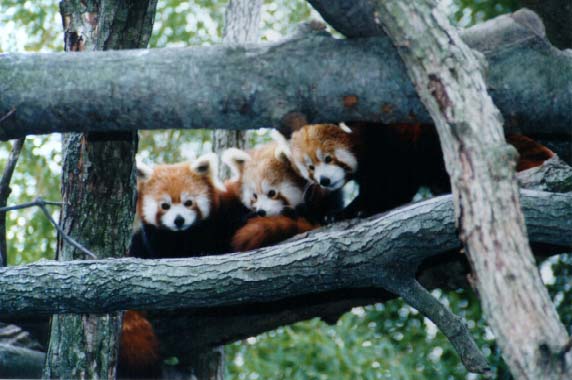
The secret world of Red Pandas

Mumbai: Screening steamy videos to encourage endangered pandas to breed is the latest technique in China’s zoos, but not in Darjeeling.
“We do not use any artificial breeding techniques," says Sunita Pradhan, one of the world’s few biologists who can track the endangered red panda to its secretive habitat. “But the young ones have a high mortality rate and need care."Her bond with the 14 red pandas at the Darjeeling Zoo is strong, but with minimum human contact. So that rules out gimmicks like those at Berlin Zoo, where Knut the polar bear drew over one million visitors this year for twice a day shows with his human keeper. The red pandas prefer to doze the day off, bushy tails curled around their tiny heads.In 1994, this shy scientist from Darjeeling had reported a rare sighting of the red panda in the wild, by a stream in a silver fir forest in Phalut, West Bengal .“When I started work in 1993 in the Singhalila National Park, the place didn’t have electricity. I cooked on firewood,’’ recalls Pradhan, scientific officer, Padmaja Naidu Himalayan Zoological Park, Darjeeling. “That was initially a problem for me, an urban girl. Few vehicles came to the Park, so it was difficult to get rations, vegetables or mail. I was extremely lonely, disconnected with the world.”Intrepid researchers like Pradhan hike on remote Himalayan terrain in almost impenetrable bamboo forests, looking for red panda pellets, pugmarks on snow or signs of bamboo feeding. “Fieldwork is a big challenge, especially in monsoon and winter,’’ says Pradhan. “Trying to draw attention to the red panda’s plight is so difficult.’’ Estimates of surviving red
panda numbers in India, Bhutan, Mayanmar, Nepal and China are unconfirmed.But saving the animal, a sign of a healthy Himalayan forest, is critical. The red panda has unusually adapted from being a carnivore to a bamboo-feeder. “It has a niche relationship with its ecosystem, we cannot afford to lose it,’’ emphasises Pradhan. She was drawn into their world after post-graduation as she noticed a changing environment. “The ponds where we used to watch tadpoles vanished. Deer, porcupines, flying squirrels stopped coming to our backyard.”In 2003, Pradhan released Sweety, a captive red panda, in the Singhalila National Park, West Bengal. “Sweety took the trouble to establish herself in the wild, mate, and give birth to a cub.’’ After a year, the battery of Sweety’s radio collar died and Pradhan did not spot her again. She now focuses on conservation problems of red pandas in protected areas, to build a captive population. “More releases are subject to studying the status of red pandas in the wild. I still feel I haven’t done much for them."
“We do not use any artificial breeding techniques," says Sunita Pradhan, one of the world’s few biologists who can track the endangered red panda to its secretive habitat. “But the young ones have a high mortality rate and need care."Her bond with the 14 red pandas at the Darjeeling Zoo is strong, but with minimum human contact. So that rules out gimmicks like those at Berlin Zoo, where Knut the polar bear drew over one million visitors this year for twice a day shows with his human keeper. The red pandas prefer to doze the day off, bushy tails curled around their tiny heads.In 1994, this shy scientist from Darjeeling had reported a rare sighting of the red panda in the wild, by a stream in a silver fir forest in Phalut, West Bengal .“When I started work in 1993 in the Singhalila National Park, the place didn’t have electricity. I cooked on firewood,’’ recalls Pradhan, scientific officer, Padmaja Naidu Himalayan Zoological Park, Darjeeling. “That was initially a problem for me, an urban girl. Few vehicles came to the Park, so it was difficult to get rations, vegetables or mail. I was extremely lonely, disconnected with the world.”Intrepid researchers like Pradhan hike on remote Himalayan terrain in almost impenetrable bamboo forests, looking for red panda pellets, pugmarks on snow or signs of bamboo feeding. “Fieldwork is a big challenge, especially in monsoon and winter,’’ says Pradhan. “Trying to draw attention to the red panda’s plight is so difficult.’’ Estimates of surviving red
(Reshma Patil, Hindustan Times)
Subscribe to:
Posts (Atom)