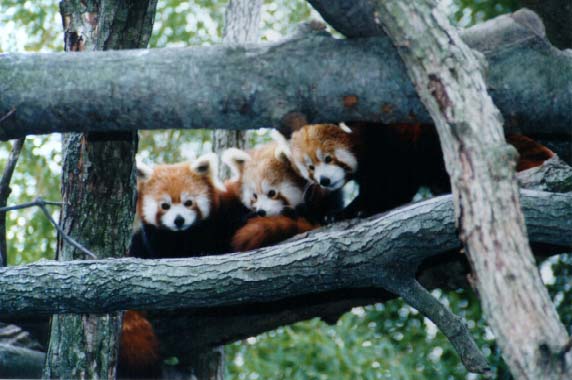
Showing posts with label red panda. Show all posts

Thursday, June 09, 2011

First Survey Reports On Red Panda in Sikkim Confirms 300 Red Pandas

Gangtok, June 9: A recent survey conducted by the Sikkim forest department and the World Wildlife Fund has revealed that there are around 300 red pandas in the state.

The project, that started in 2008, was conducted in Pangolakha wildlife sanctuary in East Sikkim and Barsey rhododendron sanctuary in the West district and is the first census on the animals.

Red panda, the state animal of Sikkim and one of the endangered species categorised in the Schedule I of the Wildlife Protection Act, 1972, is found in six protected areas of the state.

The first phase of the project — Long Term Survival of Red Pandas in Sikkim — that began in Pangolakha was completed recently.

A preliminary survey has started at the Barsey sanctuary this year to find out the number of pandas in the forest.

“By combining our findings at Pangolakha and Barsey we have estimated the population of red pandas in Sikkim to be around 300. This is just a rough and conservative estimate and more surveys are needed to come up with the correct number,” said WWF-India’s senior project officer Parthasarathi Ghosh.

He added that around 20-25 red pandas had been spotted at Pangolakha during the survey and two animals were seen at Barsey.

“We will also start our survey along with the forest department in the Kanchenjungha Biosphere Reserve and Kanchenjungha National Park, which covers West and North districts of Sikkim, from next year. The population estimation exercise will help us map out the habitat areas of the red panda in Sikkim and go a long way in conservation and forest management policies,” said forest secretary and principle chief conservator S.T. Lachungpa. He said the census reports would be published after 5-10 years.

“When the new figures come up we will be able to understand whether this is the result growth or a decrease in the population of red pandas in Sikkim. We will also understand the factors responsible for the growth or decline. It will help us in the scientific management of red panda habitats,” said Lachungpa.

The official said the findings would also help foresters take measures to protect the animals.

“Once we get proper findings we can regulate human activities in the red panda habitats and give proper training to our field staff. We can also plant bamboo and wild fruit trees which are food for the red pandas in these areas,” said Lachungpa.

He added that during the survey the foresters have also collected important data on other animals like the Himalayan pheasants, musk deer and ghoral that are found in the two areas.

Friday, August 07, 2009

Raising Awareness of Sikkim's Red Pandas


Raising Awareness of Sikkim's Red Pandas


Saturday, August 01, 2009

New attractions @ Himalayan Zoological Park,Gangtok


GANGTOK, July 31: Heralding a success story for the captive breeding programme of the Red Pandas in the Himalayan Zoological Park located at Bulbuley above Gangtok town, the naming formality of the two newly born Red Pandas were done today at the park.State Forest minister Bhim Dungel named the first Red Randa cub as ‘Nidhi’ (resource in English) while the visiting Red Panda researcher from Germany, Dr. Axel Gebauer named the second Red Panda cub as ‘Sonam’ (Fortunate One in English). Both the cubs had been born one month ago in the Park as part of the captive breeding programme. Both the cubs are healthy.The zoo authorities informed that they have not been able to find out the sex of the two cubs. They added that it will be possible only after a few months.The latest addition in the Park takes the Red Panda family to eight now.The State run Himalayan Zoological Park had started the captive breeding programme from 1997 of the Red Pandas with the support from the Central government. The Park is located at an altitude of 5840 ft (1780m) at Bulbuley at a distance of 3 km (approx.) from Gangtok, the capital of Sikkim and is spread over an area of 205 hectares of mountainous land with terrain suitable for high altitude animals and birds. Red Panda, the State animal of Sikkim, figures in the schedule one of the Wildlife Protection Act because of its dwindling population both in wild and in captive. Sikkim government is trying to conserve the animal in a natural enclosure or habitat at Himalayan Zoological Park. The captive breeding programme was started in the Park with a female Red Panda from Holland and a male Red Panda from Darjeeling of West Bengal.Meanwhile, a one day exhibition of the rare pictures of Red Panda taken by Dr. Gebauer in Darjeeling and Sikkim zoos during his research was also organized at the Park. The photos had been taken by Dr. Gebuer during his research on Red Pandas and were viewed by State forest minister Bhim Dhungel with enthusiasm.During the exhibit, the German researcher raised serious issues concerning the protection of the Red Pandas and the projects he had prepared in the conservation and promotion of the Red Pandas.Dr. Gebuer said that Sikkim provides natural habitat to the Red Pandas and called upon the Sikkimese people to come ahead in the protection and conservation of the Red Pandas instead of leaving the responsibility to the State forest department alone.

Sunday, September 30, 2007

"PRECIOUS" :The Gangtok's Red Panda Baby

Himalayan Zoological Park of Gangtok,Sikkim is also known as Bulbuley, this is a recently established Zoo of Sikkim's native fauna species. Situated 8 kilometers above Gangtok and spread over a sprawling expanse of 205 hectares, its inmates can roam around almost freely in a semi-natural habitat. Species in captivity include the Red Panda, Himalayan Black Bears, Spotted Deer and Barking Deer.

A lovely 3 months old Red Panda Cub made its public debut at the Himalyan Zoological Garden or Bulbuley in Gangtok. The cub is christian ed ‘Rigsel’ meaning ‘Precious’ in Bhutia language. Zookeepers cuddled and showed off the 3 months old Red Panda male cub as they tried to weigh him on scale.
The proud parents ,Rahul and Lucky,completely ignored the visitors around the enclosure and continued their morning Snooze.
The name was given by Additional Chief Secretary T.T.Dorjee in a programme organized at Park premises. He was accompanied by the ST Lachungpa, Principal Chief Conservators of the Forests, Addl. PCCF- N.T.Bhutia,Chief Wildlife Warden-Guth Lepcha,and Joint Director,Parks & Zoos division-Dr.Madan Shankar and other Forest officials.
Earlier,Mr.Dorjee also released a pair of the Golden Pheasant inside the aviary and also planted a rhododendron sapling at the premises of the Aviary Complex of Park.
The Red Panda is the State animal of the Sikkim and is the world’s most endangered animals and is a Schedule I species under Wildlife Protection Act of 1972.

Tuesday, September 04, 2007

Holiday with red pandas


Darjeeling, Sept. 3: Get ready to hit the forest trail in pursuit of the elusive red panda.
Two Siliguri-based organisations — Help Tourism and Association for Conservation and Tourism — are developing a red panda circuit, which they promise will be open to tourists after the Pujas.
The trail will take tourists to Megma, a village on the fringes of Singalila National Park in Darjeeling, Kolakham, a virtually unexplored entry point to Neora Valley National Park in Kalimpong, and Hee-Bermiok, along the Barsey Rhododendron sanctuary in Sikkim.
All these places are home to the red panda, an endangered species. The project aims for sustainable development of the area through eco-tourism.
For the moment, the brains behind the circuit are focusing on Kolakham, in many ways a virgin territory for tourists.
“We plan to set up a jungle camp at Kolakham, located around 10km from Lava. The residents of the area are getting in place the required infrastructure like cottages and we have already started training them on the nitty-gritty of the hospitality industry,” said Raj Basu, the vice-president of the conservation and tourism association.
From Kolakham, the visitors can choose from a number of trekking trails. Those looking for a stress-free walk can embark on an 8km trek to Changa Falls, while serious trekkers can explore the Rachela forest over three days. One can even stay an overnight camp at the Pankasari area or try to trek to Lava and Reshop, a distance of 6km.
Along with jungle camps, there are also plans to start home-stays at Kolakham (Hee-Bermiok already has the facility and Megma, too, will have home-stays soon). For this, a group of 12 residents from the three areas came to Darjeeling recently and were trained at a hotel here.
Bharati Rai, a villager from Kholakham, was one of the twelve who attended the week-long course.
“Back home, everyone is excited,” she said. “It might take some time to develop home-stays at Kolakham, but we will succeed.”
“We have decided to adopt two red pandas in Darjeeling zoo (which allows individuals and organisations to pay for the upkeep of animals at the zoo) to start the new circuit,” said Paras Dahal, project manager, Help Tourism.

Saturday, July 28, 2007

The secret world of Red Pandas


Mumbai: Screening steamy videos to encourage endangered pandas to breed is the latest technique in China’s zoos, but not in Darjeeling.

“We do not use any artificial breeding techniques," says Sunita Pradhan, one of the world’s few biologists who can track the endangered red panda to its secretive habitat. “But the young ones have a high mortality rate and need care."Her bond with the 14 red pandas at the Darjeeling Zoo is strong, but with minimum human contact. So that rules out gimmicks like those at Berlin Zoo, where Knut the polar bear drew over one million visitors this year for twice a day shows with his human keeper. The red pandas prefer to doze the day off, bushy tails curled around their tiny heads.In 1994, this shy scientist from Darjeeling had reported a rare sighting of the red panda in the wild, by a stream in a silver fir forest in Phalut, West Bengal .“When I started work in 1993 in the Singhalila National Park, the place didn’t have electricity. I cooked on firewood,’’ recalls Pradhan, scientific officer, Padmaja Naidu Himalayan Zoological Park, Darjeeling. “That was initially a problem for me, an urban girl. Few vehicles came to the Park, so it was difficult to get rations, vegetables or mail. I was extremely lonely, disconnected with the world.”Intrepid researchers like Pradhan hike on remote Himalayan terrain in almost impenetrable bamboo forests, looking for red panda pellets, pugmarks on snow or signs of bamboo feeding. “Fieldwork is a big challenge, especially in monsoon and winter,’’ says Pradhan. “Trying to draw attention to the red panda’s plight is so difficult.’’ Estimates of surviving red panda numbers in India, Bhutan, Mayanmar, Nepal and China are unconfirmed.But saving the animal, a sign of a healthy Himalayan forest, is critical. The red panda has unusually adapted from being a carnivore to a bamboo-feeder. “It has a niche relationship with its ecosystem, we cannot afford to lose it,’’ emphasises Pradhan. She was drawn into their world after post-graduation as she noticed a changing environment. “The ponds where we used to watch tadpoles vanished. Deer, porcupines, flying squirrels stopped coming to our backyard.”In 2003, Pradhan released Sweety, a captive red panda, in the Singhalila National Park, West Bengal. “Sweety took the trouble to establish herself in the wild, mate, and give birth to a cub.’’ After a year, the battery of Sweety’s radio collar died and Pradhan did not spot her again. She now focuses on conservation problems of red pandas in protected areas, to build a captive population. “More releases are subject to studying the status of red pandas in the wild. I still feel I haven’t done much for them."

(Reshma Patil, Hindustan Times)