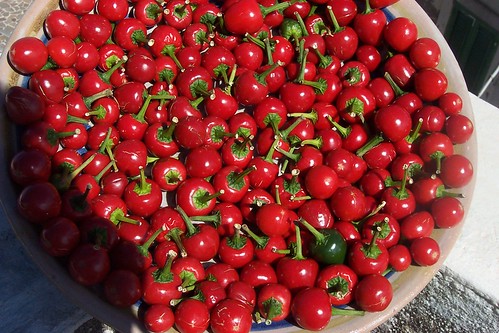
Pakyong,Nov10: Villagers here are dismayed at the falling of price of Round Chilli (Dallae). Last year, the price of Dallae was more than Rupees 100 and reached upto 150 per kilogram but this time the price has declined to Rupees 60 and some villagers are even selling it at Rs.40 a kg.
One of the villagers Mr. Purna Bahadur Khatiwara of Tareythang who sells his vegetables here at weekly haat said that due to increase in production of Dallae by all the farmers, the price of Round Chilli (Dallae) is low this year. “We had grown Dallae thinking this year too we will earn good profit at a higher price but the hope is dashed”, he rued.
Sikkim Co-operative Supply and Marketing Federation Ltd. (SIMFED) Deputy General Manager (Marketing) Mr. PK Mukhia said, “At present we do not have any cold storage facility so that we may buy the farmers items and store. The market of Dallae is best only in hilly and cold climatic places and there is not much demand in the plain areas so we could not supply it to other parts of India”.
Showing posts with label dallae khursani. Show all posts
Tuesday, November 10, 2009
High Production crashes price of Cherry pepper
Sikkim News,News on Sikkim,News of Sikkim,
cherry pepper,
dallae khursani
Wednesday, October 07, 2009
Floriculture business blooms in Sikkim
Gangtok, Oct 6- ANI: The climatic advantage coupled with highly educated workforce gives Sikkim a definite advantage in floriculture, and realizing the potential the State Government is assisting farmers through various training programs and facilities.
Sikkim is famous for its lush green plantations, and it is reaping good profits in the floriculture business.
Home to over 26 per cent of the country's biodiversity with exquisite species in flora and fauna, the State has been successful in promoting floriculture.
We provide training to the farmers. After the training we provide them with planting materials such as seeds and we also provide them with the infrastructure required to farm flowers in a large scales basis by providing them green house facilities and the required demonstration is also given to them, said K. K Singh, Special Director of Department of Horticulture.
Realizing the potential and investment opportunities in this sector, the department has also given subsidies for marketing and transport facilities to local farmers.
The Government has given us encouragement, as the weather here is suitable. The Government initially gave us 500 saplings for trial basis. It was first given to 10 families, now we have 62 families in this plot. They have even helped us technically, said Laxmi Rai, a farmer.
To promote Sikkim at the international level, an international show is also held in the state.
At present, Sikkim is producing cut flowers, which includes roses, Lilium and Anthurium on a commercial scale.
Sikkim is the only state in the country which produces high value cymbidium orchids. It has also been designated as the agriculture export zone with particular emphasis on production and export of large cardamom, ginger and cherry pepper.
- ANI
Sikkim is famous for its lush green plantations, and it is reaping good profits in the floriculture business.
Home to over 26 per cent of the country's biodiversity with exquisite species in flora and fauna, the State has been successful in promoting floriculture.
We provide training to the farmers. After the training we provide them with planting materials such as seeds and we also provide them with the infrastructure required to farm flowers in a large scales basis by providing them green house facilities and the required demonstration is also given to them, said K. K Singh, Special Director of Department of Horticulture.
Realizing the potential and investment opportunities in this sector, the department has also given subsidies for marketing and transport facilities to local farmers.
The Government has given us encouragement, as the weather here is suitable. The Government initially gave us 500 saplings for trial basis. It was first given to 10 families, now we have 62 families in this plot. They have even helped us technically, said Laxmi Rai, a farmer.
To promote Sikkim at the international level, an international show is also held in the state.
At present, Sikkim is producing cut flowers, which includes roses, Lilium and Anthurium on a commercial scale.
Sikkim is the only state in the country which produces high value cymbidium orchids. It has also been designated as the agriculture export zone with particular emphasis on production and export of large cardamom, ginger and cherry pepper.
- ANI
Sikkim News,News on Sikkim,News of Sikkim,
cherry pepper,
dallae khursani,
floricuture,
flowers
Wednesday, August 12, 2009
Sikkim ICAR training on scientific cherry pepper cultivation
Gangtok,August12 : A day long hands on training programme on scientific cherry pepper (Dalle Khorsani) cultivation was organized on 10th August, 2009 at ICAR Sikkim Centre, Tadong, Gangtok where more than fifteen participants of three different villages of South and East district participated.
The programme held under Technology Mission, MM-I Project of ICAR was inaugurated by the institute’s Joint Director, Dr. H. Rahman who highlighted importance of cherry pepper in present day scenario and gave some valuable information. Welcoming the guests and participants Dr. Rahman in his address also informed that ICAR Research Complex for NEH Region, Sikkim Centre is working on various aspects of agricultural, horticultural and animal husbandry.
Regarding spices, he mentioned that India leads in many spices like chilli, ginger, large cardamom, black pepper, turmeric, etc. Chillies are important cash crop and grown for their pungency. It is rich in Vit A & D, minerals and proteins. They have many medicinal values also.
Northeast India has special varieties of chillies like Naga chilli, King chilli, Tezpur chilli, Cherry pepper, etc. Cherry pepper (Dalle Khorsani) is the favourite chilli of Sikkim and Darjeeling hills because of its moderate pungency and good aroma. Because of its higher demand and low availability, the farmers can fetch very good return of about Rs.10 lakhs/ ha by proper management and precautionary measures in cherry pepper cultivation, Dr. Rahman said.Dr R. K. Avasthe, Principal Scientist of ICAR highlighted problems of horticultural crops with reference to dalle cultivation and processing. Dr. (Mrs.) Saroj Toppo, Sr. Scientist and In-charge of Women Empowerment Cell, ICAR, Sikkim Centre, mentioned that the institute has been engaged in imparting trainings in fruit and vegetable processing, mushroom production, backyard poultry production, machine knitting and sewing for women empowerment.
Scientist Dr. Ashok Kumar gave the training on how to cultivate and process cherry pepper avoiding disease and insect pest problems under organic regime
Sikkim News,News on Sikkim,News of Sikkim,
cherry pepper,
dallae khursani,
sikkim
Monday, July 27, 2009
The Secrets of Sikkim
It’s my pet theory that you have never really explored a new destination till you’ve seen its market. It was with this in mind that I set off to the floor above the local taxi stand in Gangtok. Extreme pressure on real estate and not much in the way of flat land means that Gangtok has many examples of unlikely business “tie-ups”: The loan-disbursing department of the state government shares space with a popular restaurant; an upmarket curio store doubles up as a cyber café and every cigarette stall does roaring business in car-mirror danglers.
Fiery: The dallae khursani is consumed fresh, not dried.
So it was no surprise that the city’s vegetable market was located at the shared taxi stand (as distinct from the outstation taxi terminus). And what a treasure trove the market was! The flaming scarlet cherry-like objects were the tear-inducing cherry peppers, one of the hottest chillies of the region, though they pale in comparison to the bhut jholokia of Nagaland. Dallae khursani, as the fiery devils are called, are only sold and consumed fresh — never dried. If you don’t think you’ll be able to make it to the market again soon, you can buy dallae chutney, sold in plastic containers in multiples of 100g.
There are mushrooms on sale that look like enoki but are not, a vegetable that resembles asparagus spears but is not, ferns, nettles, dried and fresh yak cheese, bamboo shoots and fermented soya beans and an intriguing vegetable that the vegetable seller assures me is “sweet karela”.
There are three varieties of tiny dried fish, though God knows that Sikkim is far off from any sea; loads of common vegetables such as gourd, okra and tomato, even spices such as cumin, coriander seeds and panchphoran in deference to the tourists, many of whom are from West Bengal.
The strangest thing is that in spite of a thriving local cuisine, all you get in restaurants (besides shahi paneer and mutton korma) are momos and thukpa. Had I not buttonholed a near stranger and begged him to host me for a Sikkimese dinner, I would never have stumbled upon the delicacy of sliced, steamed bamboo shoot with crumbled chhurpi, the locally made paneer.
Cooked minimally, it was accompanied by thick slices of steamed pork; Sisnu, a subtly flavoured soup of nettle leaves; and an intriguing vegetable dish made of mustard and other leaves collectively called gundruk and only eaten fermented. If gundruk was surprisingly close to Korean kimchi, Sikkim’s kinema or fermented soy beans is very similar to a popular Japanese cold starter.
There’s a curious reluctance on the part of hoteliers and restaurateurs to serve tourists the food of the state: It seems almost like a conspiracy to keep it a well-guarded secret and to unleash one culinary cliché after another on visitors. You cannot even call Sikkimese food bland: not with fresh dallae khursani and the pounded version to eat with your rice.
Chhurpe with Chillies
Sikkimese food does not take long to cook. There are no spices to speak of — only fresh red chillies. The only similarity with Indian cooking is the other ingredients added along the way: ginger, garlic and onions. Although Sikkimese chhurpe (which means curdled milk and usually refers to fresh paneer or to the dried version, which is a hard rock-like substance — an acquired taste) is often made of cow’s milk, as opposed to yak’s milk, it has a completely different taste from regular paneer, having more of a fresh, milky flavour.
Ingredients:
250g paneer, mashed with the back of a fork
3 fresh red chillies or
3 dried whole red chillies soaked for an hour in water and then chopped coarsely
1 small knob of butter
1 tsp ginger, finely minced
1 tsp garlic, finely minced
1 small onion, chopped
Method:
Heat the butter in a kadhai or wok, add the onion and sauté till translucent. Add the ginger and garlic and stir continuously to avoid sticking to the wok. Then add the mashed paneer and salt. After the water content of the paneer has evaporated, add the chillies, stir to mix thoroughly and serve.
Write to travellingtiffin@livemint.com
So it was no surprise that the city’s vegetable market was located at the shared taxi stand (as distinct from the outstation taxi terminus). And what a treasure trove the market was! The flaming scarlet cherry-like objects were the tear-inducing cherry peppers, one of the hottest chillies of the region, though they pale in comparison to the bhut jholokia of Nagaland. Dallae khursani, as the fiery devils are called, are only sold and consumed fresh — never dried. If you don’t think you’ll be able to make it to the market again soon, you can buy dallae chutney, sold in plastic containers in multiples of 100g.
There are mushrooms on sale that look like enoki but are not, a vegetable that resembles asparagus spears but is not, ferns, nettles, dried and fresh yak cheese, bamboo shoots and fermented soya beans and an intriguing vegetable that the vegetable seller assures me is “sweet karela”.
There are three varieties of tiny dried fish, though God knows that Sikkim is far off from any sea; loads of common vegetables such as gourd, okra and tomato, even spices such as cumin, coriander seeds and panchphoran in deference to the tourists, many of whom are from West Bengal.
The strangest thing is that in spite of a thriving local cuisine, all you get in restaurants (besides shahi paneer and mutton korma) are momos and thukpa. Had I not buttonholed a near stranger and begged him to host me for a Sikkimese dinner, I would never have stumbled upon the delicacy of sliced, steamed bamboo shoot with crumbled chhurpi, the locally made paneer.
Cooked minimally, it was accompanied by thick slices of steamed pork; Sisnu, a subtly flavoured soup of nettle leaves; and an intriguing vegetable dish made of mustard and other leaves collectively called gundruk and only eaten fermented. If gundruk was surprisingly close to Korean kimchi, Sikkim’s kinema or fermented soy beans is very similar to a popular Japanese cold starter.
There’s a curious reluctance on the part of hoteliers and restaurateurs to serve tourists the food of the state: It seems almost like a conspiracy to keep it a well-guarded secret and to unleash one culinary cliché after another on visitors. You cannot even call Sikkimese food bland: not with fresh dallae khursani and the pounded version to eat with your rice.
Chhurpe with Chillies
Sikkimese food does not take long to cook. There are no spices to speak of — only fresh red chillies. The only similarity with Indian cooking is the other ingredients added along the way: ginger, garlic and onions. Although Sikkimese chhurpe (which means curdled milk and usually refers to fresh paneer or to the dried version, which is a hard rock-like substance — an acquired taste) is often made of cow’s milk, as opposed to yak’s milk, it has a completely different taste from regular paneer, having more of a fresh, milky flavour.
Ingredients:
250g paneer, mashed with the back of a fork
3 fresh red chillies or
3 dried whole red chillies soaked for an hour in water and then chopped coarsely
1 small knob of butter
1 tsp ginger, finely minced
1 tsp garlic, finely minced
1 small onion, chopped
Method:
Heat the butter in a kadhai or wok, add the onion and sauté till translucent. Add the ginger and garlic and stir continuously to avoid sticking to the wok. Then add the mashed paneer and salt. After the water content of the paneer has evaporated, add the chillies, stir to mix thoroughly and serve.
Write to travellingtiffin@livemint.com
Sikkim News,News on Sikkim,News of Sikkim,
dallae khursani,
sikkim
Subscribe to:
Posts (Atom)