Showing posts with label bhutan. Show all posts

Friday, June 17, 2011

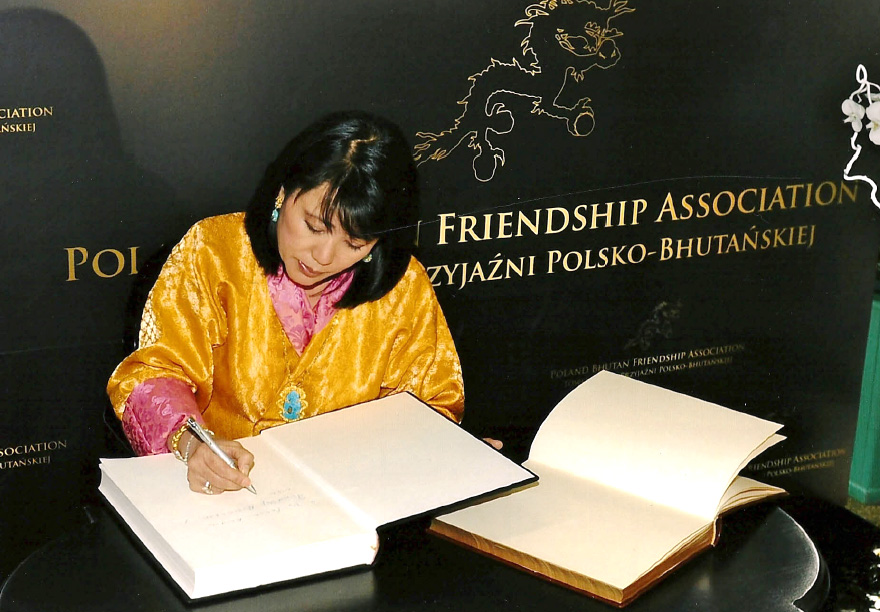
Meet Bhutan's Queen Mother Ashi Dorji Wangmo Wangchuck

M eet Queen Mother Ashi Dorji Wangmo Wangchuck.
Bhutan Queen Dorji Wangmo Wangchuck is a real conservationist when it comes to her country's Himalayan culture and Buddhist heritage. But she is also well-traveled, a literary enthusiast and loves Elvis Presley.

Queen Dorji Wangmo Wangchuck is one of four sisters who married Jigme Singye Wangchuck, Bhutan's former king, who abdicated in favor of his eldest son a few years ago.

Today, the queen mother, a youthful 55-year old, embodies her country's efforts to reap the benefits of modernity while protecting its traditions.

Queen Dorji Wangmo Wangchuck, who was schooled in India's region of Darjeeling, is the patron of Thimphu's Mountain Echoes literary festival that brings together Indian and Bhutanese writers.

An accomplished author herself, in "Treasures of the Thunder Dragon: A Portrait of Bhutan" she retraces the country's recent history and offers vivid accounts of travels that took her to the mountain kingdom's most far-flung areas. During the festival's second edition last month, she announced plans to start writing again after a five-year break.

Over tea and steamed dumplings in her palace in Thimphu, Queen Dorji Wangmo Wangchuck recently spoke about the perils of television, her pilgrimage to Memphis and Gross National Happiness, the country's guiding philosophy.
One of my fondest memories of my time in boarding school in India is watching Elvis Presley movies. We used to have screenings in school, I remember watching "It Happened at the World's Fair" and "Viva Las Vegas." And I just fell in love with this gentleman—ever since I was in second grade. I am still a fan.

Elvis has always been one of my all-time favorites. I saw him in concert in Madison Square Garden in the 1970s. When he died I was here in Bhutan and I remember wearing black for one week. And in the mornings I would offer butter lamps for his soul, which is something we do here in Bhutan.

I also had the great opportunity of going to Memphis, where I stayed at the Heartbreak Hotel. I went there with my daughter, right after her graduation from Harvard Law School in 2007. Graceland appeared much, much smaller than I had expected it to be as a child. Nevertheless, Elvis loomed large. I also saw the jumpsuits he looked so wonderful in when he went on stage. On his bookshelf I also noticed a copy of Hermann Hesse's "Siddhartha," which is about the Buddha. I liked that.

I have walked the length and breadth of this entire nation, from its plains to some of its most inaccessible mountain areas. If I had to choose my single favorite place in Bhutan, it would have to be the Jigme Dorji National Park, named after the third king. This park is home to the national animal, the takin, the national flower, the blue poppy, and is home to our most pristine lakes and virgin peaks. In the park I also went on the Snowman trek, one of the toughest treks in the world.

It's important to have festivals like Mountain Echoes that bring together Bhutanese and Indian authors and that give us the opportunity to celebrate our shared culture.

It is possible to speak of a pan-Himalayan culture, especially from a religious perspective. We have to remember Buddha's Indian origins. Here in Bhutan we have thousands of pilgrims going to India's Bodh Gaya every year.

Bhutan was never really forbidden. We were just isolated, by choice. That's one of the reasons we have so much of our culture and heritage still intact. We began being "unforbidden" when we started building motorways in the early 1960s. That's when we opened up physically. It was around then that I saw my first motor vehicle. Until then the only mode of transport was horseback, for those who were lucky enough to have horses. Others had to walk.
I think the Internet and mobile phones are wonderful innovations. Now, television is another story altogether. It has its benefits but it has even more negative side-effects. Families spend less time together and our youth sometimes pick up bad habits. We have over 100 channels and there is so much out there. We have one main Bhutanese channel, BBS, the national broadcaster, and, besides a few small private channels, the rest are all international. You have the good channels, like CNN and BBC, but then you have others, too.

The outlook of our youth is changing and I'm worried we'll just become part of the global culture and pay less attention to our own. We are very small, very fragile and we need to pay the biggest attention to the preservation of our culture and heritage, which is very unique.

We can preserve our culture through Gross National Happiness, which is enshrined in our constitution. One of the principles of GNH is to protect our culture, our heritage and our environment—something the government is doing in so many ways. For instance, through the promotion of our own movies, and our own songs and dances. We also have to wear our traditional clothes when visiting government offices, among other things.

I don't think there will ever come to a point when we have to restrict our country's exposure to global media. I don't see this as something our country would ever do. Putting restrictions on something like that would be fundamentally wrong. But what we can do is keep our culture alive within our country and make young people proud of their heritage. I was a young person once upon a time, and we all go through phases of fascination and experimentation. Then what happens is that you get older and come closer to home. We are trying to keep that home intact

Thursday, June 09, 2011

Bhutan Delegates visits Central Agricultural University, Ranipool, Gangtok


Gangtok 8 June Twelve member team headed by DNR-RDC (PRO) Government of Bhutan, Mr. Sengay Phub lead by Deputy Project Manager, ATMA, FS&ADD, Government of Sikkim Dr. Narendra K. Gautama, visited the College of Agricultural Engineering and Post Harvest Technology (Central Agricultural University) Ranipool, Gangtok on June 8, 2011. With a brief welcome by In Charge Dean Dr. P.C. Senapati appraised the delegates about the teaching, research and extension education activities of the College. The faculty members introduced themselves with their areas of specialization too. Whereas the Head of the Department of Farm Power and Machinery Dr. SK Rautaray, briefed the research and development programmes of the College covering the Intramural Research Projects (IRPs), All India Coordinated Research Projects (AICRPs) on APA, ESA, FIM, PHT, RES and UAE and Value chain on Aromatic Crops under National Agricultural Innovation Project (NAIP).

Furthermore Dr. Rautaray impressed upon the engineering interventions considering the site specific limitations those have been taken up to develop improved equipment and technology for mechanization of hill agriculture including soil and water engineering, post harvest engineering and technology and renewable energy gadgets to be energy efficient and cost effective. Dr. Rautaray adding more informed that the basic approach is to equip the human, animal, mechanical and electrical power sources and renewable energy gadgets to enhance the output per unit.Furthermore the delegates even visited different laboratories, workshop, research projects, experimental farm, library, computer laboratory and agricultural technology information centre (ATIC). Many useful interactions and discussion emerged out of the visit and those were attended by the scientists of the College.Whereas the feed back from the visitors showed that agricultural practices in Bhutan closely relate to the practices followed in Sikkim agriculture and it therefore indicated the possibility of link-up research and development and extension education programmes to be useful by sharing and exchange of knowledge and information

Saturday, May 21, 2011

2011 edition of mountain echoes @ Bhutan


M ountain Echoes is a unique literary and cultural festival set in the pristine beauty of Bhutan. An initiative of the India-Bhutan Foundation in association with Siyahi, it aims to provide a platform for authors to engage in cultural dialogue and celebrate tales of a shared landscape in the Himalayan region. The festival enjoys the patronage of Her Majesty, the Queen Mother Ashi Dorji Wangmo Wangchuck.
Man has forever been haunted by the idea of echo. Sometimes in the form of retribution but often for the plain joy of hearing your voice resound on the other side – echoes are both, far-reaching and beautiful. Inspired by this poetic phenomenon, Mountain Echoes is making a comeback following the overwhelming response received by the literati in both Bhutan and India last year. In its second year, Mountain Echoes is bigger and better. There is no other way to grow but to learn to see the world from another perspective. –Mountain Echoes gives this opportunity to one and all by allowing them to enter in an almost parallel universe for four days this year between 20th to 23rd May. Bask in the beautiful weather of Thimphu, Bhutan and avail the opportunity to view theatrics, literary discussions and workshops against the striking, mountainous backdrop.

Monday, July 26, 2010

Sikkim Teachers promote buddhist culture through songs in Bhutan

Bhutan stamp on Sikkim CD
July 25: A music album by two teachers in Sikkim to promote Yuksom and Tashiding has paid rich dividends with the Bhutan government releasing two postal stamps recognising the duo’s efforts to showcase Buddhist culture and heritage.

The songs in the video album, made to promote Yuksom and Tashiding as pilgrimage centres, were recorded in Bhutan capital Thimpu.
While one stamp features the cover of the album, the other shows the coronation site of the first monarch of Sikkim at Norbugang in Yuksom. The two stamps were released by the Bhutan Postal Corporation Ltd in the second week of June. Nima Lhamu Bhutia and Phurba Tshering Bhutia, the two behind the CD, Yuksam Drayang (Melody from Yuksom), could not initially believe that their creation had won recognition in Bhutan.

“Then, we received a letter on July 20 posted by a friend in Thimpu containing the two stamps. We were told that the stamps had been released in the second week of June,” Phurba Tshering told journalists here today.
The 28-year-old Phurba Tshering is an assistant professor of political science at Namchi Government College, while Nima Lhamu, 32, is a teacher at Yuksom Secondary School in West Sikkim.

The stamps are available in Bhutan currency Ngultrum (Nu) 15, Nu 10 and Nu 5 each.The first stamp contains the cover of the CD which shows Phurba Tshering and Nima Lhamu between an image of the Eight Lucky Signs of Buddhism.

Yuksam Drayang has five songs in Bhutia language on the historical and cultural legacy of Yuksom and Tashiding. The album has also a six-minute narration on the two places with English subtitles.
Pic:The envelope with the two stamps sent to Nima. 

The second stamp shows Yuksom, the coronation site of the first monarch of Sikkim. The place is the first capital of ancient Sikkim and is known as “throne of Norbugang” too.

In a certificate from the Bhutan Postal Corporation Ltd faxed to the duo here, the government said the album had been well appreciated by all the Bhutanese people in terms of its contents and quality. .
“Such a product has brought in tremendous effect on cultural unity among the peoples of Bhutan and Sikkim. The CD is distributed to schools, community centres and even foreign tourist as the contents purely portray cultural aspects of Sikkim,” said Tseten Geltsen, the managing director-cum chief executive officer of the postal corporation, in the certificate.

While Nima Lhamu has written the lyrics and produced the album at a cost of Rs 3 lakh, the CD was directed by Phurba Tshering. The album was shot extensively at Yuksom and Tashiding and the CD was released on December 9.
Highlighting the importance of Yuksom in the history of Sikkim, the duo said the place was not only the first capital of Sikkim in the 17th Century but was also a holy place as it had been blessed by Guru Rimpoche in the 8th Century. “We have also focused on Tashiding, a holy place and a centre of Buddhist pilgrimage,” said Phurba Tshering.
He said the album had done well in Bhutan and a lot of people from the country had started coming to Yuksom and Tashiding. “The album has promoted the pilgrimage potential of Yuksom and Tashiding.”

Tuesday, November 17, 2009

Bhutanese students in dress code dilemma


Darjeeling, Nov 17: Bhutanese students across the Darjeeling hills have been caught in a crossfire between the Gorkha Janmukti Morcha and police on wearing of their national dress.

The Morcha has asked all students and teachers to wear their traditional dresses for three days a week from October 26 till further notice.

Bhutan government officials, along with senior police officers of Bengal, have appealed to Bhutanese students to stop wearing their national dress, which incidentally is mandatory in their country, while attending colleges in the hills.

The Gorkha Janmukti Vidyarthi Morcha, the hill party’s student wing, however, described the appeal as a move to derail the agitation for Gorkhaland. “It is the conspiracy of K.L. Tamta (inspector-general of police, north Bengal) to derail the cultural movement by using the Bhutanese government. The conspiracy is being hatched to create problems before the next tripartite meeting,” said Keshav Raj Pokhrel, the general secretary of the Vidyarthi Morcha.

The Morcha student wing has decided to “be more vigilant” from tomorrow to ensure the strict compliance of the dress code. “If the police want to use their power to ensure that the dress code is not followed, we, too, will use all our means to ensure that the dress code is adhered to by all students,” Pokhrel said.

Tamta, who held a meeting with Bhutanese officials in Darjeeling and Kalimpong, said: “They (the Bhutanese officials) were of the opinion that as foreigners they should not be forced to wear the dress.”

The Bhutanese government also felt that the dress code could pose serious problems for the safety and security of the Bhutanese students in a foreign country, Tamta said.

“After the people of Nepali origin were pushed back to Nepal from Bhutan in 1993, there are apprehensions that Bhutanese citizens could be attacked. Wearing the dress would make them soft targets especially after some members of the Bhutan Tiger Force were arrested in Siliguri a year ago. Their intention is to attack Bhutanese citizens and the government has strong views on this issue,” the police chief of the region said.

Tamta called upon the Morcha to consider the appeal from the Bhutanese officials.

Over a lakh of people of Nepali origin who had been pushed out of Bhutan have been living in refugee camps in eastern Nepal, close to the border with Darjeeling district.

Pokhrel, however, argued that the dress would not make the Bhutanese students “soft targets”. “If anyone is bent on doing something to Bhutanese students, they can easily be identified by their language. Moreover, the refugees were pushed back almost 15 years ago and till now the Bhutanese have never been attacked in the Darjeeling hills,” he said. “Even last year, the Bhutanese students wore their dress for a month without any problem.”

The 700-odd Bhutanese students who mostly study in various Darjeeling and Kalimpong colleges are now in a dilemma. Many of them refused comment when asked about their reaction.

Bhutanese men wear gho, while the women’s dress is called kira. Gho is a knee-length robe, which is tightly wrapped around the body to form a pouch above the waist. The kira is a floor-length cloth wrapped over a wonju or blouse. It is held from the shoulders by komas or hooks. The dress is complete with a short toego or jacket.

Wednesday, August 01, 2007

RBI : Bhutan Currency Cannot be Used In India


Bhutan, July 31: The ngultrum is like any other foreign currency and cannot be used as a medium of payment in India, the Reserve Bank has said.
The use of the ngultrum along with the rupee — both currencies are on a par — in towns like Jaigaon in Jalpaiguri district bordering the Himalayan kingdom has been going on for several years. The absence of foreign exchange counters is the main reason for this practice.
In a letter dated July 26, 2007, the Reserve Bank of India (RBI) makes it clear that the Bhutanese currency is not a “legal tender” (accepted by law) on this side of the border, prompting the business community of the region to renew their cry for a forex counter at Jaigaon, 250km from here. The nearest is in Calcutta. The traders also want the appointment of private authorised dealers, who can exchange currency, for those who are in Siliguri deal with dollars and pounds only.
“Recently, security agencies had seized some Bhutanese currency and arrested a businessman who has had transactions in ngultrums over years,” said Biswajit Das, secretary of the Federation of Chambers of Commerce and Industries, North Bengal (Focin). “We wrote to the RBI to know about the norms. They told us that we cannot do business in ngultrums.”
The letter addressed to Das — signed by Saurabh Nath, an assistant general manager of the RBI posted in Calcutta — also clarifies that though under the Foreign Exchange Management Act, 1999, a resident can acquire and accept ngultrums for business purposes, amounts in excess of $2,000 must be surrendered to an authorised dealer.
“We will send circulars to our member associations and at the same time write to the RBI to appoint authorised dealers,” Das said.
To some traders, the letter has come as a big blow. “Many of us in the Dooars have to accept ngultrums from our customers in Bhutan as there is no forex counter. If the norms are strictly followed, we will have to close down our business,” said Bijoy Barua, the secretary of Banarhat Merchants’ Association