Showing posts with label Hydroelectric. Show all posts

Saturday, July 23, 2011

Sikkim boycotts NHPC Stage-IV Hydro Project

The affected people of Teesta Stage-IV and their representatives boycott the public hearing scheduled for 22 July at Namprikdang.
North Sikkim, 22 July: The affected people of Dzongu carried through their resolve to boycott the public hearing called for Teesta Stage-IV hydel project with complete unanimity today. When all of them, including their panchayats and MLA, remained no-shows at the venue of the public hearing, the Namprikdang Ground, even till noon, the DC [North], who chairs the public hearing panel, postponed the public hearing till further notice since not even a single person had shown up, save the concerned officials and NHPC representatives.
The venue was hit by a minor case of arson last night when some banners and decorations at the stage were burned by miscreants. No substantial damage was caused.

The affected people, along with their panchayats, it may be recalled, had resolved that even though they were not opposed to the project per se, they could not trust NHPC anymore since they had seen the denials and ignored promises suffered by the affected people of Teesta Stage-V developed slightly downstream from where NHPC proposes to develop the Rs. 3,594.74 crore Stage-IV. They had drafted an 11-point list of queries and clarifications [see NOW! issue dated 22 July 2011 for details], which was submitted to the DC earlier in the morning.
The joint representation of the panchayat and public details that they want a written reply from NHPC to all the queries before they reconsider their decision.
Announcing the postponement of the public hearing, the DC directed NHPC to carry out thorough public consultation before the public hearing whenever it is called for next so that such a boycott was not repeated.
As per the Environment Impact Assessment and Management Plan prepare for the project, a total of 14 villages/ blocks will be “directly affected” due to various project activities. The total population of these villages is 14,291 divided among 2,793 households. As of now, none of them has any faith in assurances that NHPC would have made at the public hearing.
The hearing was scheduled to begin at Namprikdang Ground in Upper Dzongu at 11 a.m. this morning, but no official business could be conducted in light of the zero turn-out of people or their representatives.
Speaking with media-persons here, the NHPC Executive Director [Siliguri], Dhiman Parija, sought to alleviate the feeling of hurt expressed loud and clear today, by insisting that if the corporation has missed out something, it will make amends.
He added that NHPC will now approach the affected people, understand their grievances in more detail and fulfil their demands. He also stated that the people should express their demands and commented that today’s boycott came as a surprise, insisting that “everything was normal till the day before”.
AK Choudhary, Chief Engineer, NHPC Teesta Stage-IV, explained the project details. NHPC plans to generate 2,372 million units of power from Teesta Stage IV, 13% of which will be the State’s share. He also stated that the corporation was “always open to discuss as per the memorandum”.
The Teesta Stage-IV hydroelectric project is located on the Teesta in North Sikkim and 327.07 hectare will be acquired for it- 143.49 ha Government and Forest land and 180.58 private land.
The proposed dam site is located downstream of the confluence of Run Chhu with Teesta near Chandey village.
The major components of the project are located on the right bank (Dzongu area) while other infrastructure (project headquarters, store, workshop and labour colony) will be created on the left bank to minimize the land requirement in Dzongu. The dam is to be located at Zimchung and Hee-Gyathang villages, while the adit works will be confined to the Gnon Sangdong GPU. The labourers and officers colonies are proposed in Tingchim-Mangshilla GPU.

(NowDaily)

Tuesday, May 03, 2011

Flashflood washes away equipments from Dikchu Hydro Power Site in Sikkim

DIKCHU, 02 May: Equipment worth Rs. 1.50 crore was washed away from a hydel project site on the Dikchu khola here on Sunday when the hill stream broke its banks following heavy rainfall in its catchment area on the higher reaches. Water level at Dikchu khola [which starts from the confluence of Baghca and Ratey Chu higher up] surged late in the afternoon and washed away the temporary bridge thrown across it to the Dickhu Hydro-Electric Project site. It started raining at around 3 p.m., and was at its most destructive at 6 p.m. Apart from the washed away bridge, the raging river also swept away equipment from the site and trapped one person on the far bank. He was rescued from his predicament early Monday morning.
Nar Bahadur Pradhan of Lower Rakdong was stranded to the far bank of the river on the northern side all of last night after the bridge was washed away at around 6 in the evening.
AS word spread of Dikchu khola in spate, people who rushed to the spot witnessed heavy equipment being carried away by the khola, which this morning, after the flood waters had subsided, appeared misleadingly tame. Only the wreckage of a truck, stuck in the shallow waters, standing evidence of the fury with which the stream had broken out last evening.
As for Nar Bahadur Pradhan, who had crossed over to collect fodder for his cattle, he was struck throughout the night with a sheer cliff behind him and a raging Dikchu khola in front. There was no alternate escape for him, and after the waters had subsided a bit towards nightfall, his relatives and fellow villagers used ropes to reach him some refreshments.

“This could have ended in a tragedy for me. I was relieved when stars shone through the clear night sky. If it had continued raining, my situation would have been much worse,” he said, after reaching to the safety of the left bank at around 9 a.m. on Monday.
The timing of the suspected cloud-burst which caused Sunday evening’s damage is propitious for the project developers, coming as it did on Labour Day, when no work was underway at the project site and no workers on duty. Had work been underway full-swing at the site, the toll would have been much worse than just the equipment lost.
That said, even the equipment loss has been substantial. The list goes something like this: one Aliva short kit machine, three Jackhammers, several hume pipes, connected air pipes, and water pipes. Excavator machines and a boomer machine were also washed away but are stuck in the river bed and can be recovered. The flood-waters also swept away the retaining wall in front of Cable Access Tunnel (CAT).
The equipment belongs to Drillcon Infrastructure Pvt Ltd, a sub-contractor of Sneha Kinetic Power Project Ltd. which is developing the 96MW Dikchu HEP.
Upon hearing of the flash-flood, ward panchayat, Lower Rakdong, BB Gurung, police personnel from Dikchu Out-Post and Phidang Check Post from North Sikkim rushed to the spot along with representatives from the SKPPL and Drillcon.
The Drillcon Project Manager, while speaking to NOW! informed that it will take at least one week, weather permitting, before work can resume at the project site.

Tuesday, September 21, 2010

Sikkim Monks seeks scrapping of hydel project

GANGTOK, Sept 20 A joint meeting of National Sikkimese Bhutia-Lepcha Organization with the Denjong Chyarig Chogpo (Buddhist religious outfit) has deliberated on the threat posed by the proposed 96 MW Lethang hydel power project in Yuksam.
The proposal to construct the mega power project in the Rathong Chu in Yuksam, West Sikkim is the most undesired project which has ignited immense threat to the sanctity of the Buddhist tradition of Sikkim, mentioned a release issued by the organisation. “We appreciate the Chief Minister’s scrapping of the earlier Rathong Chu project respecting the Buddhist tradition and its sanctity of Sikkim, the release added.
The release thanked SIBLAC for attending public hearing of September 16, 2010 to protest against the Lethang hydel project.

The release further requested the Chief Minister to take another decision of scrapping any such projects and activities in and around the sacred Rathong Chu which falls under Places of Worship (Special provision) Act 1991.

The organisations also reiterated their stand for a proportionate increase in the total number of the Bhutia-Lepcha seat in the Sikkim Assembly.

Monday, November 23, 2009

Sikkim to have highest mini-hydro power station in India


GANGTOK, November 23: Sikkim would soon acquire the distinction of having a hydro power station at an altitude of around 13,000 ft, the highest in the entire country.
The work on this proposed mini-hydel power project in Thangu in North Sikkim would start soon with active intervention from the State department of science & technology, said the department’s advisor Mr. GJ Samadhanam.
Mr. Samadhanam who was in Gangtok on Friday, said that the proposed mini-hydel project which is sponsored by his department had earlier been entrusted to a local NGO. However, the NGO could not complete the project in the scheduled time due to some unavoidable reasons and the resulting delay has resulted in cost escalation, he said.
After a meeting on Friday with the State chief secretary and officials from power department along with science & technology departments, Samadhanam said that it was decided during the meeting that the project will be handed over to the power department while the local NGO too would remain involved in undertaking non-technical and other jobs.
Samadhanam said that a fresh DPR will be submitted by the department soon and the Rs. 5 crore worth project is expected to be completed in the next two years.

Wednesday, November 11, 2009

Power developer LANCO starts scholarships in Sikkim School


Majhitar (Rangpo)Nov11: In compliance of its Corporate Social responsibility, LANCO Energy Private Limited in a social welfare programme held at Majhitar Primary School Ground, East Sikkim, distributed scholarship to 18 meritorious students of different schools of South Sikkim where the company is working.
Building and Housing Department Minister Mrs. Tilu Gurung was chief guest and Mr. BS Panth, MLA, Temi-Namphing and Chairman, Power Department, was guest of honour of the programme which was attended by SDPO Mr. Hari Tewari, General Manager LANCO, Mr. SK Sarkar, Advisor Mr. RK Pradhan and Unit Head Mr. BK Ojha. Teachers, students and panchayat members of Namthang-Rateypani and Temi- Namphing constituencies were present in large number.
Mrs. Gurung appreciated LANCO for its involvement in social activities. “Many big companies are currently operating in the state as a result of Chief Minister Dr. Pawan Chamling’s visionary schemes”, she said, adding, “he had the idea of converting unused barren land and ever flowing water of Sikkim into main revenue generator”.
Chief Guest Mrs. Gurung said, 75% of LANCO’s total project is in Namthang-Rateypani constituency. She called upon company officials to have a coordination meeting in near future with her and panchayats of the constituency. More and more locals should be benefited by the company so that they will have full faith in them, she said. She urged the company to come forward in spreading education among people. She asked for total transparency in every project and emphasized on better coordination with locals. She called upon the company to construct a community hall at Namthang.
Guest of Honour Mr. Panth said, every policy of the company should be people-friendly and pro-people. He also praised LANCO for its social activities. He said, “Our people are very innocent, even our youths”, and urged the company officials “to keep a human touch with locals”. “Every company has socio-corporate responsibilities”, he underlined. No hatred or humiliation should be mated to the locals, he emphasized. He congratulated LANCO for encouraging local students with scholarship.
Mentioning dinking water scarcity of Namphing area, Mr. Panth asked LANCO to extend its helping hand in the matter. The company, while doing its construction work, should also maintain greenery and care for conservation of forest, he noted. He advised that the proposed construction of a barrage at Sirwani should be tourism-centric. Manpari-Samardung road should be completed shortly, he told the company.
“Our unskilled youths should be provided skill development training by the company and then employed”, Mr. Panth emphasized. He said the State government will provide every possible legal help to the company. Panchayats also addressed the meeting.
Company officials informed, total 409 locals are employed so far. Every year the State will be paid a revenue of Rs.1.50 crore. On the day, scholarship was given to students of Namthang, Kabrey , Bermiok Tokal and other schools of Temi Namphing and Namthang Rateypani constituency. Fire Fighting pump was handed over to Manpari Busty by LANCO.
On the occasion, a health camp was also organized by the company for handicapped people of the two constituencies. Another camp will organized shortly at Namthang, it is informed. Students of Majhitar School presented a cultural programme on the occasion.

Tuesday, November 10, 2009

Hydropower will make Sikkim richest state


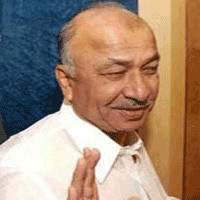
Gangtok,Nov10: Union Power Minister Sushil Kumar Shinde has praised the Pawan Chamling government for going ahead with optimum utilisation of the hydropower resources of the state. The Himalayan state was on course to become the richest state in India upon commissioning of the ongoing hydel projects in a few years’ time, he said. The revenues from the hydropower projects will not only boost the coffers of the state exchequer, but also bring about an overall socio-economic development in Sikkim, he added.
Mr. Shinde came to Sikkim on Saturday on a three-day visit within four months of his taking charge of power ministry for second consecutive terms in the UPA government led by Prime Minister Manmohan Singh. On the day he chaired the 16th Power Finance Corporation Ltd (PFC) meeting held in Sikkim. Later in the evening he was talking to reporters.
Asked about the status of the six hydel projects which were put on hold by the ministry of environmengt four months ago, the Union Minister said, “I have taken up the matter at the higher level for grant of clearances to the six hydel projects.” He however maintained that the environmental issues must be taken due care of in conceiving hydropower projects. Even his ministry has made necessary changes in its hydropower policy in view of the environment-related concerns being raised by various quarters, he said.
He mentioned that a broad range of issues like the local area development, compensation to the project-affected people, jobs to the local people and setting up of training institutes for developing skills of local youths and their absorption in the power projects, etc, have been committed by the power developers engaged in the state.

Monday, November 09, 2009

Hydel Projects will bring socio-economic development in Sikkim: Shinde


Gangtok,Nov09: Union power minister Sushil Kumar Shinde said that he has taken up with Ministry of Environment and Forest (MOEF) over stalling the work of six hydel project in Sikkim earlier this year over environmental concerns.

"I have taken up the matter at the higher level for grant of various clearances to the six hydel projects," he told reporters here last night in reply to a question on the status of the six hydel projects which was put on hold by the MOEF four months ago.

Shinde, however, said that the environment-related concerns raised by the MOEF must be addressed appropriately by the stake holders in view of the buzz over the climate change.

The environmental issues must be taken due care of in conceiving hydro power projects, he said, adding even his ministry has made necessary changes in its hydro power policy in view of the environment-related concerns being raised by various quarters.

The MOEF had directed the Sikkim government in July this year bring all construction activities at Teesta Stage I (280 MW), Teesta Stage II (330 MW), Lachen (210 MW), Lachung (99MW), Bimyong (99 MW) and Bop (99 MW), all located in the ecologically sensitive Chungthang Valley in the upstream of Teesta River citing a report by the Centre for Inter-Disciplinary Studies of Hills and Mountain Environment (CISME) saying that these power projects endangered bio-diversity and rare wildlife of the region.

Shinde praised the Pawan Kumar Chamling government for going ahead with optimum utilization of its hydro power resources in Sikkim and said that the Himalayan State was on course to become the richest state in India upon commissioning of various ongoing hydel projects in a few years' time.

With the Chamling government having gone ahead with award of over two dozen hydro power projects in recent years with a proposed generation capacity of 5200 MW, the revenues generated from these projects will make Sikkim the richest state in the country, he said.

The revenues from the hydro power projects will not not only boost the coffers of the state exchequer, but bring in an overall socio-economic development in Sikkim, he said.

A broad range of issues like the local area development, compensation to the project-affected people, jobs to the local people and setting up of training institutes for local youths to honing skills and their absorption in the power projects, have been committed by the developers, Shinde said.

Tuesday, November 03, 2009

Affected Citizens of Teesta (ACT) held its annual meeting at Namprikdang


Gangtok,Nov02:  A group of Lepcha children at a picnic organised by the Affected Citizens of Teesta (ACT) to mark its annual meeting at Namprikdang in North Sikkim on Sunday. The organisation, which was opposing the setting up of hydel projects in Dzongu, a Lepcha reserve, felicitated those who have been supporting its cause since it came into being on July 19, 2004.
Recently, the ACT called off its indefinite and relay hunger strikes that began in June 2007 after the state government invited them for talks. Welcoming the initiative of the government, Atup Lepcha, who has been re-elected its president, said: “We are hopeful of getting a positive response from the government.” Sikkim Citizen Forum convener Thukchuk Lachungpa, ACT general secretaries Dawa Lepcha and Tenzing Lepcha and other youths who had participated in the relay hunger strike were felicitated.

Sunday, September 27, 2009

Centre seeks additional data on six hydel projects in Sikkim

Complete technical data from a resource should be furnished for further consideration of its decision to stall six proposed hydel projects in the Chungthang Valley in North Sikkim


Gangtok,Sep26: In a glimmer of hope for six hydel projects in North Sikkim with a projected generation capacity of 1047 MW, the union ministry of environment and forests (MOEF) has sought complete technical data for consideration of its earlier decision to put them on hold.


Complete technical data from a competent resource should be furnished for further consideration of its decision to stall six proposed hydel projects in the Chungthang Valley in North Sikkim, MOEF additional secretary J M Mauskar has demanded in a letter to the state government, official sources said.
The state government had written to the MOEF last month urging it to review its decision to withhold the six hydel projects.

It had stated that the developers would take utmost care of the concerns raised by the Centre for the Inter-disciplinary Studies of Mountain and Hill Environment (CISME) report on the carrying capacity of the Teesta river.
The state government urged the MOEF to grant permission to the developers to go ahead with investigation into the detailed project-specific information for critical examination by the state and the Centre to assess environmental impact of the hydel projects.

The state government had said that the authorities had the option to take a decision on the hydel projects at any stage after investigation.Only those projects found to be viable from geo-technical and hydrological angles and were environmentally sustainable should be allowed to be developed, the state government had said in its plea to the MOEF.

The state government had assured that it would provide concrete measures and pragmatic strategy to preserve the environmental sensitivity of Chungthang Valley and put in place adequate environmental protection measures.

Making a case for the viability of the six hydel projects, the state government also questioned the contention of the CISME report about the availability of ‘little geological information from the area and the region being prone to landslides´.

It said the report did not substantiate the arguments.

The Chungthang valley represents a stable geological domain, the state government claimed while seeking to nullify the contention of the CISME report that it was geologically sensitive located in a young Himalayan mountain range.

The MOEF had directed the state government two months ago to stall construction at the six proposed hydel projects (Teesta Stage I - 280 MW), Teesta Stage II (330 MW), Lachen (280 MW), Lachung (99 MW), BOP (99 MW) and Bimkyong (99 MW) citing the CISME report which had questioned the viability of these projects.

Sunday, August 30, 2009

Another apolitical outfit takes cudgel against hydro projects

Gangtok, Aug 29 Yet another apolitical outfit - Affected People's Forum (Teesta Stage V & VI) - has questioned the viability of hydel projects in North Sikkim claiming that the water sources in that region has dried up due to construction works at the 1200 MW hydel project at Chungthang.

In a memorandum submitted to the Governor B P Singh, the outfit has demanded immediate suspension of the construction works by the private development, Lanco Energy Company, saying that the natural sources of water in North Sikkim have dried up due to drilling, blasting and tunnelling activities for the construction of the mega hydel project in question.

Apart from the natural water sources drying up, the residential buildings have developed cracks to jeopardise the safety of the local people due to the unmitigated disaster being caused to the pristine landscape of North Sikkim due to the construction works at the hydel project site, it alleged in its eight-point memorandum to the Governor.

The APF further accused the developer with hurting the cultural and religious sensibilities of the tribal people by acquiring the land which they have been using for nearly 70-80 years for cremation purposes, the memorandum claimed, adding the developer has failed to provide an alternative site to enable the people to perform the last rites of their dead relatives.

Tuesday, August 18, 2009

The Affected Citizens of Teesta (ACT) condems arrests of Lepchas

GANGTOK, August 17: The Affected Citizens of Teesta (ACT) issued a press statement today condemning the ‘arbitrary arrest of innocent Primitive Lepchas’ of Dzongu by ‘Indian Reserve Battalion/Sikkim Police’ allegedly on the behest of Teesta Urja Pvt Ltd at Raman, Upper Dzongu.

“A fact finding team of the grievance cell of ACT after interacting with the victims have found out that contrary to the media report that these youths had trespassed in the office of the Teesta Urja Ltd, at Ramam, the company had in fact trespassed on the ancestral land of the Lepchas and they were extracting building material and wood, even though no compensation has been paid to the land owner of the particular plot”, stated Tseten Lepcha, ACT vice president in the press statement.

According to ACT, the minor altercation that took place on July 21 between the land owner, Tenzing Lepcha and the non-local driver of the company was used as pretext by the company people who then ‘physically abused the youths and then misused the IRB Personnel stationed there to further beat the indigenous Lepchas in their own land, arrested them and assaulted them even after they were put in the cell at Chungthang police station’. These innocent members of tribes were kept without food or water in the cell and no information were given to their families, said ACT.

The ACT termed the above incident as an attempt to ‘subjugate the voices of the Sikkimese public who have been very seriously affected by the destructive hydro projects’. The private company is misusing the presence of the IRB to further harass and intimidate all those who have been suffering silently, alleged ACT.

The ACT in its press statement have demanded immediate withdrawal of the baseless cases against the members of the tribes, provide immediate compensation to all those who had been physically harmed and ensure that all labour camps area removed from the Dzongu area, as per the directions of Ministry of Environment and Forests. The body further said that it will seek the intervention of the Ministry to implement this clause in the Dzongu Region of Teesta Stage III hydro electric project.

The ACT has also demanded the withdrawal of IRB from the remote and peaceful Dzongu region so that the ‘force is not misused by the project developers to suppress the people of North Sikkim’.

Monday, August 10, 2009

Sikkim’s SOS to Union Power Minister Shinde


To remove CISME redflag on six hydel projects of North Sikkim
GANGTOK, August 9: The State Government has sought the intervention of Union Power Minister Sushil Kumar Shinde regarding the six hydel power projects proposed in North Sikkim that has been withheld by the Union Ministry of Forest and Environment (MoEF).
It is informed that the State Government had approached Mr. Shinde for permission to go ahead with the ‘red flagged’ power projects whose total projected capacity is 1047 MW. The private developers of the six power projects are also putting pressure on the State Government to approach the Centre for go ahead with the construction of the projects.
Sources informed that the State government has explained the facts of the six hydel projects in North Sikkim to the Union Power Minister during a recent video conference with him. The State Government has urged the Union Power Minister to take up the matter with the MoEF to remove the bottleneck for the construction projects to begin, the sources said.
It is informed that the Mr. Shinde has assured to look into the matter.
Meanwhile, the State Government will also separately take up the case with the MoEF over the six hydel power projects and seek review of the report of the Centre for Inter-Disciplinary Studies of Mountains and Hill Environment (CISME) about the carrying capacity of Teesta River.
It may be recalled that the MoEF had on July asked the State Government to defer the six hydel power projects in upstream of Teesta River on the basis of CISME report which had concluded that these projects will endanger the fragile economy and bio-diversity of the mountain range in North Sikkim.
The MoEF had taken the CISME report seriously and derailed six proposed hydel power projects in North Sikkim giving the State Government no option but to put the proposed projects in hold following the Centre’s directions to the State Government not to proceed with the construction of the six projects.
The projects affected by the Centre's directive include Teesta Stage I (280 MW), Teesta Stage II (330 MW), Lachen (120 MW), BOP (99 MW) and Bimkyong (99 MW) and Lachung (99MW).
Various formalities like land acquisition and survey works by the developers at the six projects have been stopped after the MoEF wrote a terse letter last month suggesting that these projects were unviable citing a study report by CISME which effectively derailed the projects.
Apart from approaching the Union Power Minister over the derailed hdyel power projects in North Sikkim, the State Government had earlier taken out a white paper on hydel power development in Sikkim which had been tabled in the Sikkim Legislative Assembly during the recent budget session.
The white paper has recommended the State Government to reinvestigate the Chungthang region in North Sikkim where the Ministry of Environment and Forests have asked the State Government that projects above Chungthang region should not be considered for construction of dams due to its vast biodiversity. The State Government cannot abandon projects with 1050 MW capacity that have been awarded to the developers without a proper examination of the issues.
The State Government should, therefore reinvestigate the region to find the factual position and arrive at the final decision with regard of the development of these projects, the white paper had recommended

Hydro-Power projects a boon or bane for Sikkim?


The 510 MW Teesta Stage V hydel power station commissioned by National Hydro Power Corporation (NHPC) was dedicated to the nation recently by Union Power Minster Sushil Kumar Shinde in a formal ceremony at Baluwatar located in East Sikkim along the Teesta river, some 40 kms away from the Gangtok, the capital of Sikkim.

Built at a cost of Rs. 2619 crores and completed in a span of eight years, the Teesta Stage V mega power project had been fully commissioned in March last year and is one of the largest hydel power plants in the Northeast region.

The electricity being generated at Teesta Stage V plant is being supplied to power the deficit States of West Bengal, Orissa, Jharkhand and Bihar which had previously entered into a purchase agreement with NHPC.

Mr. Shinde said that the Teesta Stage V plant would go a long way to tide over the power shortage in West Bengal, Orissa, Jharkhand and Bihar. The Union Minister also added that the commissioning of the hydel plant has also helped the Himalayan state of Sikkim financially as it has been getting 12 per cent free power of its installed capacity which fetches it about 125 crores annually. This has emerged as a permanent source of revenue which could be utilized for various development works. The Union Minister lavishly praised Chief Minister Pawan Chamling for his commitment to the state’s development. Mr. Shinde said that it was due to Mr. Chamling’s leadership that the border state of Sikkim will become financially self-reliant in years to come, once all the ongoing power project construction works are completed and get commissioned.Chief Minister Chamling termed the inauguration of the project as an exemplary act of development done by Sikkim.

However, ACT, an NGO based on North Sikkim, is in no mood to say that the hydro power projects being set up in the state are completely for the prosperity of the Sikkimese people. It is demanding that the heavy hydro power projects being set up in Dzongu, the place of origin of the Lepcha community, the primitive tribe of India, should be stopped. The organization has been staging a continuous relay hunger strike since 20th June, 2007.

Protestors voice their grievances to deaf ears
Mr. Dawa Lepcha and Tenzing Lecpha had even staged a continuous month long hunger strike without even drinking water. Later on, they withdrew their strike on the assurance from the government that some of their demands would be taken into consideration. However, the state government did not stick to this promise.

Despite all this, ACT was the talk of the state till the period before the general elections of 2009. The political observers were also of the view that Lepcha votes would go against the SDF, the ruling party. And the movement was also able to earn the sympathy not only from Lepchas but also from other communitys, so much that some political parties had even tried to fight the election, riding on ACT.

However, with the announcement of the election results, the ACT movement took a back seat as the SDF won the election with a thumping majority of all 32 seats in the Assembly and also the Lok Sabha seat. Mr. Sonam Gyathso Lepcha, MLA of Dzongu constituency, also won by a huge margin from the constituency. These election results speak of the popularity of the SDF and the people’s support of the mega hydle power projects. SDF chief Mr. Chamling rewarded the Dzongu MLA Mr. Lepcha by promoting him to the post of Power minister from a mere MLA.

ACT holds the view that besides the threat to the Lepcha community, the power projects have affected the environment too. Mr. Tseten Lepcha, coordinator of the organization said that the Panan project one of the hydro power projects in Dzongu is being developed by encroaching into the Khangchendzonga National Park as the developers are undertaking catchments area treatment there.

On the other hand, the state as well as the developers contended that this was not a project component and would be returned after completion of the catchments area treatment. This is in violation of Supreme Court orders. Other grievances of ACT are influx of outsiders into the Lepcha reserve of Dzongu and the resultant dilution of Lepcha culture and heritage..

Are hydro power projects really dangerous for the environment?
ONe of the tunnels at the Teesta River

Experts are of the view that hydro power is more reliable and efficient and a less expensive energy source than geothermal, biomass, wind, and solar energy. It is a clean source of power as it produces no carbon dioxide, sulfurdioxide, nitrous oxides, or any other air emissions. In addition, it produces no solid or liquid waste. Hydro power is also one of the least expensive sources of electricity.

Mr. S. K. Garg, Chairman & Managing Director, NHPC Ltd, also adds that while developing hydropower projects, NHPC is very sensitive and concerned about R&R and environmental issues and adopts a very balanced approach.

He says NHPC obtains site, environment and forest clearances as per the statutory requirements and also tries to utilize minimum forest area. Environment impact assessment is conducted and based on that, an environment management plan (EMP) is framed to properly address the environmental issues. Close monitoring is done to ensure effective implementation of EMPs. Post-construction EIA to evaluate pre- and post-construction scenario to ascertain the efficacy of environment management plan is also undertaken.


What is left of our Children?
According to him, NHPC has formulated detailed compensation packages based on various approved relief and rehabilitation guidelines. Compensation package includes various allowances for shifting, subsistence allowances until a family member finds employment, special grants for SC/ST families, and rehabilitation sites for affected families with adequate infrastructure, sanitation, educational and other amenities. NHPC also ensures a public hearing process and tribunals for redressing public grievances on these issues.

But it is also a fact that most hydroelectric projects have dams whereby a river habitat is often replaced by a lake habitat. Thus, habitats for wildlife on land and for organisms in the water are destroyed or altered by impoundments of rivers. Examples in Tennessee are the Little Tennessee River and Tellico Lake. The biggest issue in the Northwest has been blocking upstream and downstream movement of fish. Salmon must be able to migrate upstream from the ocean to reproduce in fresh water. Even with the use of fish ladders to help salmon go up over dams and enter upstream spawning areas, the presence of hydroelectric dams essentially has changed the migration pattern of fish. The coho, chinook, and sockeye salmon populations of the Northwest, which once were abundant, are either on or will soon be on the endangered species list. They are headed for extinction, in part, because of hydropower. However, federal dams, not nonfederal dams, are primarily responsible for the reduction of the Pacific Northwest salmon population from about 16 million to 300,000 wild fish each year. The bottom line is that hydropower production is decreasing as new environmental protection is enforced. Another big problem now is getting the young fish back downstream and into the ocean. On the way they can be killed as they pass through the turbines. Development of hydroelectric dams can have adverse effects on water quality in several different ways. Tree clearing can result in soil erosion and landslides, causing a buildup of sediments that can clog up streams. Spilling of water over spillways can result in super saturation of the water with gases from the air. The gas bubbles, which are absorbed into fish tissue, may cause damage and ultimately kill the fish.

Another problem with dams is that, even if the water quality is not degraded, major habitat changes can occur if the natural hydrology of the river is changed. This issue is normally lumped under the term “in stream flow” problems. If the amount of water released downstream changes, either on a seasonal basis or, in the short term, say, on an hourly basis, that can have adverse effects on fish and other organisms

Friday, August 07, 2009

Huge revenue and prosperity from hydro project in Sikkim not realistic - ACT


GANGTOK, August 6: Basing on the White Paper on hydel projects, the Affected Citizens of Teesta has said that the State Government’s contribution of 26 percent equity share in the hydel projects through loans taken from project developers and the subsequent repayment with interest from 12 percent free power that the state is to get from the projects has dazzled the public with promises of huge revenue and prosperity.
Quoting the White Paper that taking a loan for equity contribution might not be very attractive proposition, ACT general secretary Dawa Lepcha has questioned the reasons for the random implementation of numerous projects in such haste “if the future prospect of revenue generation on which the hydel projects are being justified and glorified is in serious doubt”.
He has further raised concerns whether projects would function as being projected before the loans are paid back given the volatile nature of rivers, landscapes and the receding glaciers.
He added that the paragraph from the White Paper surely does not give a promising picture.

Monday, August 03, 2009

Dzongu protests against national security: Govt.white paper


Dzongu protests may not go well with primary parameters of national security : Sikkim Hydro White Paper


GANGTOK, August 2: The white paper tabled by the State Government on ‘development of hydropower resources of Sikkim’ has opined that the visible protest observed in Dzongu against the hydel power projects may not go well with the primary parameters of national security.
“A section of Lepchas of Dzongu in North district (under ACT) have raised vital issues related to the likely adverse impacts of hydro power projects on the conservation of their land, livelihood and environment. Their concerns need to be need to be examined from a very local perspective”, the white paper states.
The New Delhi based research agency, Entecsol International which had prepared the white paper for Sikkim government further highlights danger signs for the Lepchas in their last bastion, the protected reserve of Dzongu.
Dzongu area is a declared reserve area exclusively for the Lepchas with restrictions on other communities and tribes to settle in this area.
However, a survey conducted in 13 revenue blocks way back in 1981 showed out of total 1306 households (7745 population), the Lepcha households were only 737 (4331 population-56%), the white paper mentions.
“In today’s context this also meant that in the reserve area exclusively for the Lepchas also, the revenue blocks were swamped by other communities. This is a danger sign of shrinking demographic and topographic trend to this primitive tribe of Sikkim”, the white paper states.
“Since North district is surrounded by international borders, such kind of protest with strong undercurrent of ethnicity and socio-political deprivation may not go well with the primary parameters of national security. This definitely needs the attention of the government”, the white paper suggests.

Friday, July 31, 2009

Government White Paper on Hydro Power in Sikkim


‘8000 MW, ONLY WAY OUT’


Sikkim Government White paper recommends expeditious harnessing of 8000 MW hydro potential of Sikkim


GANGTOK, July 30: A voluminous white paper on hydropower resources of Sikkim tabled by the State Government in the State Assembly today has opined that Sikkim must expedite the development of its 8000 MW hydropower resources as the ‘only way out’ to meet the Millennium Developmental Goals set forth.“The considered opinion emerging from the analysis of this report is that Sikkim must expedite the development of its hydropower resources at a faster pace. Utilize the hydropower revenue for the social, educational, economic and other developmental aspects of its people. That is the only way out, if Sikkim wants to lead other States in the country in speedy development and meeting the Millennium Developmental Goals set forth”, states the white paper tabled by State power minister Sonam Gyasto Lepcha on the concluding day of the budget session today in the Sikkim Legislative Assembly.Prepared by Entecsol International, the 209 pages white paper in its executive summary said that the white paper on the development of hydropower resources of Sikkim is aimed at examining the State of economy, hydropower resources and the status of their development in Sikkim.The white paper claims that it also examines the steps taken by the government for facilitating and expediting the development of its hydropower resources and the constraints, issues and challenges faced by the government in exploiting this resource. It evaluates the potential financial and economic benefits that Sikkim can harness from the development of its hydropower resources and exporting the surplus energy to other parts of the country.Out of the total hydropower potential of Sikkim of 8000 MW, the total installed capacity as on March 31 this year is only 610.7 MW.The State government has awarded 24 hydropower projects at a total estimated installed capacity of around 4,694 MW to various developers out of which, 2,081 MW is expected to be commissioned within the 11th Plan and remaining within the 12th Plan.All the projects are run of the river schemes.In its recommendations, the white paper called for immediate structural changes in the State power sector for efficient management of the Sikkim power sector coupled with the need to manage a quantum jump in the development of hydropower resources from the existing level of about 200 MW to 8000 MW. The white paper has recommended that the State government should establish two corporate bodies fully owned by the State government-Sikkim Hydro Power Corporation Ltd (SHPC) and Sikkim Transmission and Distribution Corporation Ltd (SPDCL). It has also recommended that Sikkim Power Development Corporation Ltd which has not met the objectives for which it was set up should be wound up by transferring its assets to SHPC.The SHPC will manage all the existing generation stations in the State and also handle the entire power allocation, sale and purchase of electricity presently handled by the State power department, the white paper recommends.On the other hand, the proposed SPDCL will manage the existing and the proposed transmission and distribution systems in the State.“The State should also come out with its Hydro Power Policy as suggested in the conclusions and recommendations chapters of this report”, states the white paper. It has also recommended that a State level Rehabilitation and Resettlement Policy that matches the provisions in the Central government’s concerned policy should also be formulated.“An Independent Monitoring and Evaluation Team (IMET) as detailed in the report should be constituted immediately to provide the government with an independent assessment about the project execution and to work as an impartial link between various stakeholders and the government”.Regarding the harnessing of the balance potential of about 2736 MW which is yet to be awarded, the white paper has suggested that creating of shell companies by SHPC which will then award the projects after international competitive bidding. The white paper has stressed on the immediate need to set up a Project Review Committee to review the review the projects made by the developers in the establishing the projects already awarded.“Projects where the progress is not matching with the targeted milestones as envisaged in the MoUs/project award agreements should be cancelled”.The white paper has also recommended the State Government to reinvestigate the Chungthang region in North Sikkim where the Ministry of Environment and Forests have asked the State Government that projects above Chungthang region should not be considered for construction of dams due to its vast biodiversity. The State Government cannot abandon projects with 1050 MW capacity that have been awarded to the developers without a proper examination of the issues, the white paper said.The State Government should, therefore reinvestigate the region to find the factual position and arrive at the final decision with regard of the development of these projects, the white paper recommends.The State Government has also been suggested to give priority to development of wind and solar energy projects for serving the rural masses living in the deep mountainous region.The white paper in its genesis of protests against hydropower development in Sikkim has attributed it non-involvement of the locals in the identification of proposed projects.“For many of the local stakeholders who are affected (or likely to be) by these projects, the entire issue of power projects came like a bolt from the blue as they are clueless about, who was doing it and why and what will they get. The communication gap and absence of participation of local stakeholders was a major institutional failure, which could have been avoided through a massive awareness campaign before launching these projects”, the white paper said pointing to the protracted hunger strike carried out by anti-hydel body Affected Citizens of Teesta as a blatant example of this institutional failure.One upfront challenge that needs to be met head-on by the State Government is to strike a fine balance in the developmental needs of the State, the natural resource need and biodiversity management, conservation of socio-cultural ethos and sustainability of ecological balance. The confidence in the minds of the people must also be instilled by adopting a fair-handed approach in developing the hydropower resource by issuing a State level Hydropower Policy.Regarding the major issue of land procurement for the hydro projects, the white paper states the total land required for projects in North Sikkim is just 0.29 percent of the available land in North Sikkim.The white paper also states that Sikkim will be getting annual revenue of Rs. 1337.79 crores during the first 15 years after the projects of current 4694 MW which is being developed is commissioned. In addition, the State government will earn about Rs. 22.3 crores as cess annually and Rs. 178.368 crores per annum as sale proceeds of 1 percent free power for local area development, the white paper adds.These projects in Sikkim would provide employment to 3000-5000 skilled persons, 6500-10000 semi-skilled persons and 6500 to 10000 un-skilled persons.The report has concluded that despite enormous advantages appreciated by all, there are undercurrents of dissatisfaction, misplaced apprehensions and misunderstandings created by lack of effective information flows. While genuine concerns need to be addressed immediately, the wrong apprehensions should be warded off by proper briefings, public hearings and disseminating the information and the steps taken by the government to address the issues, it is suggested.In the backdrop of the national need for growth of electricity sector to 12 percent per annum, the white paper has concluded that Sikkim has to expedite the development of its 8000 MW hydropower potential so that then nation, state and locals benefit.

Saturday, November 17, 2007

PUBLIC HEARING ON 96 MW DIKCHU HYDEL PROJECT HELD IN NORTH SIKKIM


Affected families want total safeguard of local interests


GANGTOK, November 16: The public hearing for the 96 megawatt Hydel Power Project at River Dikchu was held today at Dikchu Bazaar.
Organized by the State Pollution Control Board, Forest and Wildlife Department the hearing was attended by all project affected families and the landowners from Lingdok and Dikchu.
M/s Sneha Kinetic Power Project limited, a Hyderbad based company has proposed to construct a 96 MW Hydroelectric Project by utilizing the water of River Dikchu, a tributary of Teesta River in East Sikkim.
Placing the technical details, the Managing Director of Sneha Kinetic Power Project Limited Raghunathan Reddy informed that the hydel project would have an installed capacity of 99 MW at the cost of Rs. 49 Crore
He added that an Environmental Impact Assessment (EIA) and Environment Management Assessment (EMA) have been drafted keeping in view the environmental, cultural, and traditional conservation. He also informed that as per the Memorandum of Understanding (MoU) signed with the State Government, the local people will be employed in the project and also given ample opportunities. Mr. Raghunathan also assured that all the contractual works would be given to the local youths only. “We commit to bring more infrastructure development such as schools, roads, community centers in Dikchu, he added.
However, after acquiring the land for the said project, a total of 75 families will be affected, it is learnt.
Queries were also raised by the affected landowners during the interactive session of the meet.
An affected landowner from Lingdok, Vishnu Neopaney said that more than four hundred species of medicinal plants would be uprooted with the implementation of the said project. He also added that Dharma tam, a cave of historical importance where Thekong Tek and Neykong Nyal after signing the brotherhood treaty stayed will be submerged into the water.
Stating that the State government and the company have signed a MoU for the generation of only 54 MW electricity earlier, Mr. Neopaney has questioned about the remaining 42 MW, which would total up to the present figure of 99 MW. He further questioned about the non-amendment of the MoU after the increase in the power generation.
Responding to Mr. Neopaney’s query, the concerned officials informed that a detailed survey has been carried out before preparing the EIA and it has been made clear that none of the biodiversities gets affected with the commissioning of the hydel project.
Nar Bahadhur Pradhan of 12th Mile, Lower Lingdok also placed a demand to the company stressing that only the public of Lingdok Namphong Block should be given site to run businesses near the project site. He also said the company should pay a compensation of Rs 50 per square feet for the acquired land. All the laborers from outside Sikkim after the completion of the project should go out of Sikkim, he demanded. He also demanded for the preservation of the religious, social, cultural aspects of the people and their place.
It was also demanded that the chairman of the contractors’ association, which will be involved in the said project should be nominated and appointed amongst the affected families.
The President of Dikchu Youth Welfare Association, Chung Chung Bhutia emphasized on the point that the supply and the transportation works should be given to the unemployed youth of Dikchu. He also demanded to include one of the members of Dikchu Youth Welfare Association in the Steering Committee formed for the project.
The public hearing for the People of North District for the concerned Project will be held on November 17 at Phodong.
The area MLA Norzang Lepcha, MLA Kabi Tingda TT Bhutia along with Chairman State Pollution Control Board CC Sangderpa also attended the public hearing. Also present were the officials from various government departments.

Tuesday, October 30, 2007

Arunachal Pradesh to pitch for equity in hydro power projects

The state has bet big on hydro power development in the region and has attracted private players

The government of Arunachal Pradesh is discussing with financial institutions ways in which it can acquire equity stakes in hydroelectric power projects being developed by Central public sector units in the state.
“We plan to either convert the 12% (of the generated power) free power that has been given to us into an equity share or put in our own money into the projects. We are presently in discussions with the financial institutions to work out a strategy about which of these options are more beneficial to us,” said T. Norbu, Arunachal Pradesh power secretary.
Free power is given to states where such projects are based, because these projects entail large-scale relief and rehabilitation efforts and costs to the local environment.
The quantum of free power given to the states may be increased following demands by Arunachal Pradesh, Uttarakhand, Himachal Pradesh and Sikkim for the same, as reported by Mint on 12 June.
“It (Arunachal thinking of an equity stake in projects based in the state) is a good thing and will help the state government get a sense of ownership. If the state puts in its own money, the contribution from the developer (PSU) will come down which in turn will help it (the state) to earn more from the project. Having an equity stake in the project will also allow the state to leverage things in terms of employment among others to its advantage,” said K. Ramanathan, distinguished fellow at The Energy and Research Institute.
Some of the big ticket hydro projects being developed in the state include NTPC Ltd’s Etalin (4,000MW), and Attunli (500MW), National Hydroelectric Power Corp. Ltd., or NHPC’s 4,500MW one and North-Eastern Electric Power Corp.’s 1,230MW project.
“The percentage of our stake in the projects will depend on our ability to take such stakes which in turn will depend on our financial health,” said a senior official in the state government who did not wish to be identified.
The state’s gross fiscal deficit is 12% taken as an average over 2001-04.
The total hydropower generation potential of India’s North-Eastern states, and Bhutan, is about 58,000MW. Of this Arunachal Pradesh alone accounts for 50,328MW, the highest in India.
The state has bet big on the hydro power development in the region and has attracted a lot of private sector developers.
At present, India has an installed power-generation capacity of 130,000 MW, of which around 32,325.77MW is generated through hydroelectric power projects.
The 11th Plan (2007-12) has projected that the country will add 78,577MW of power generation capacity, of which around 16,000MW is expected to come from hydroelectric power projects.

Monday, October 15, 2007

CPM’s central committee member Nilotpal Basu Supports Sikkim Hydel Protests for Dzongu


CPI(M) CENTRAL SECRETARIAT MEMBER SUPPORTS DZONGU PROTEST

Religious, cultural significance of Dzongu will be lost if hydel projects go ahead: Basu
GANGTOK, October 14: Central Secretariat member of the CPI (M) and former MP Nilotpal Basu today said that development projects should be sustainable and address all the concerns of a society or else the projects will be “destructive”.
Development projects should not necessarily move forward with the sole motive of benefiting a handful of people, the Left Front leader said while addressing a gathering of the Lepcha community, political leaders and social organizations here at BL House.
He further said that “religious, cultural & anthropological significance of Dzongu will be destroyed if all hydel projects are not scrapped.”
Reiterating the party’s support to the protests against the proposed mega hydel power projects in a Lepcha tribal reserve, Mr Basu said the Dzongu issue was about protecting primitive tribes and their cultural and religious significance.
“There are some issues where the State government has absolute power, as far as the protection of primitive tribe, their cultural and religious significance are concerned,” he stated.
Appealing all other communities to come forward in support of the Lepchas, the leader said the CPI(M) would support the Lepcha movement terming the demand as justified, secular and relevant.
Earlier, the ACT today submitted a memorandum to Mr Basu, appealing for his party’s intervention to scrap the proposed projects in Dzongu.
He also said that the Constitution empowers the Centre to intervene for the protection of minority communities, including the Lepchas.
“Our Constitution provides for preservation of different cultural and ethnic identities,” he remarked adding “Besides Dzongu, issues from the Northeast as a whole were not considered properly by the Centre, no matter which ever party came to power.”
Lepchas from Dzongu at North Sikkim, under the banner of Affected Citizens of Teesta (ACT) have attained 116 days of relay hunger strike to protest the proposed implementation of mega power projects in Dzongu.
Six mega projects were being planned in Dzongu, which is inhabited by the last few members of the indigenous Lepcha community, who consider the area as sacred.
The protests had spread to the Lepcha community living in the neighbouring Kalimpong Darjeeling regions also.
Maintaining that the left party has the prime agenda for the upliftment of the tribal worldwide, the CPI(M) MP from Darjeeling Saman Pathak told the gathering that he had already raised the Dzongu issue twice in the Parliament and urged the local representatives of national political parties, especially Congress and Bharatiya Janata Party to exercise their power in this issue.

Monday, October 08, 2007

National Tribal leader on Dzongu recce


Gangtok, Oct. 7: The president of the Akhil Bharatiya Adivasi Vikas Parishad, Somjibhai Damor, will arrive in Sikkim on Tuesday for a first-hand idea of the on-going Lepcha agitation against hydel power projects at Dzongu in North Sikkim.
“He will first go to Gangtok and then to Dzongu,” said Dorjee Lepcha, the president of Rong-Ong-Prongzum (Lepcha Youth Association).
The visit follows a presentation on Dzongu made by L.S. Tamsang, the president of Indigenous Lepcha Tribal Association, at the 14th National Conference of the All India Tribal Development Council in Jaipur, Rajasthan earlier this month.