Showing posts with label orchids. Show all posts

Monday, July 04, 2011

Sikkim Forester Awarded Veitch Memorial Medal

KC Pradhan
Gangtok, July 4 (PTI) Sikkim Forester K C Pradhan, who has also served Sikkim as its chief secretary, will be the first Indian and the third Asian to receive the prestigious Veitch Memorial Medal of the Royal Horticulture Society of the United Kingdom.The name of Pradhan for this year's VMM along with three others was announced at the annual general meeting of the RHS on July one.Pradhan is being awarded "for his important role in developing the flower growing industry in India," a RHS release said here.The award, which will be presented by Princess Alexandra today at the Hampton Court Palace Premiere Flower Show, the largest flower show in the world, it said.The VMM is a prestigious prize issued annually by the Royal Horticulture Society to persons of any nationality who have made an outstanding contribution to the advancement and improvement of science and practice of horticulture.Pradhan will, however, not be able to travel to England and the Medal will be received on his behalf by a nominee of the president of the RHS, it said.The VMM was instituted in 1870 in memory of James Veitch of Chelsea in UK.The Royal Horticultural Society is the UK's foremost gardening charity and is more than two centuries old. PTI

Wednesday, September 15, 2010

Scented Orchids Project in Sikkim

Gangtok, Sept. 15: Two institutes here are working on a three-year project for commercial exploitation of scented orchids in Sikkim, an endeavour that could be the first in the world.

The Sikkim Himalayan region, comprising the hills of Sikkim and Darjeeling, has about 450 species of orchids, of which 70 are scented, said the National Research Centre (NRC) that is working on “a value chain on selected aromatic plants of Northeast India”.

Established in 1996, the NRC is based in Pakyong subdivision of East Sikkim and conducts research on high-altitude orchids. In this project that started in March, the NRC is working jointly with the College of Agricultural Engineering and Post Harvest Technology which comes under the Central Agriculture University based in Ranipool, East district.

NRC director R.P. Medhi said most people are familiar with orchids only as cut-flowers. They are little aware of scents like lemon, jasmine, hyacinth, orange, chocolate, coconut and vanilla emanating from orchids. “Our role is to conduct research and develop planting material (of the scented orchids) through tissue culture. We have to first develop production protocols and methods for a large scale of cultivation of scented orchids,” said Medhi.

The NRC is currently working on five scented species found in Sikkim — Aerides odoratum, Dendrobium crysotoxum, Coelogyne cristata, C. flacida and Zygopatalum intermedium.
In response to a query, the NRC director said no information about any research conducted on scented orchids is available so far, suggesting that the project in Sikkim is probably the first of its kind in the world.

“World demand for aromatic plants and their products is increasing and India’s prospects depend on focusing on value added products, consistent drive and quality, and ensuring competition through enhanced productivity. The aromatic orchids have to be brought under large-scale cultivation to maintain their continuous supply. The small and marginal farmers in Sikkim need to be encouraged to grow the aromatic species,” said Medhi.

He, however, said the quantity of fragrant essence, which can be extracted as well as the market value of the product, is still to be worked out. But the fact that a scent of an orchid is on sale itself is enough to attract a lot of attention, Medhi said.

NRC principle scientist D. Barman said progress had been made in tissue culture of the scented orchids. “We have so far generated around 5,000 plants (by tissue culture). However, we have not achieved significantly in extraction of essential oils from the orchids. We are still conducting analysis,” he said.
P.K. Srivastava, the dean of the College of Agricultural Engineering and Post Harvest Technology, said his institute would provide engineering support on how to harvest and extract essential oils from the orchids.

“We have already set up a pilot extraction plant at the institute. Even after the extraction of essential oils from the orchids, some fragrance will be left on the plants which we are planning to use for incense sticks,” said Srivastava. He said his institute would train farmers who take up the cultivation of scented orchid species.

“Once the farmers take up the cultivation of scented orchid species, we will allow them to use our extraction plant. We can also develop a portable extraction plant for self-help groups,” said the dean. He added that the cost of an extraction plant starts at Rs 1.5 lakh.

Sunday, November 15, 2009

Orchid house at Gangtok Raj Bhavan


GANGTOK, November 15: An orchid house has been added at the Raj Bhavan on the initiative of the first lady of Sikkim, Karuna Singh today on the occasion of Children’s Day for the children of Raj Bhavan complex.
A press note from Raj Bhavan informs that the rich flora on the Raj Bhavan areas comprises more than 200 varieties of trees and plants concentrated on an area not more than two hectares.
The successive Governors have contributed to the preservation of the rich flora of Raj Bhavan while during last one and half years under the guidance of the present Governor BP Singh and Karuna Singh, several hundred more trees, bamboos and shrubs have been added.
A beautifully landscaped garden has also been developed to make the Raj Bhavan a model environmental sanctuary, it is informed.

Saturday, November 14, 2009

Do You Love Orchids?

Add a little colour to your living spaces with fresh orchids ordered from around the world.
If you want to have a little bit of nature in your living room, there’s nothing better than colourful and supremely gorgeous orchids. Among the more exotic flowers put out by the plant life on terra firma, orchids have remained a popular choice when it comes to lending a special floral touch to any space. They often trace their origin to some truly amazing locale — dark rainforest or wind-swept hillside — and are luxuriously distinct in colour and appearance too.

Orchids have always been a florist’s favourite and today, with commercial orchid production, they have become more affordable. Pawan Gadia, vice president of Ferns and Petals, one of India’s largest florist chains, says the market for orchids in India is about Rs 30 crore, but pales in comparison with the sort of demand it has in the West. Not surprisingly, in view of this demand, several floriculture promotion agencies have been trying to encourage orchid cultivation. One area making leaps in this field is the state of Sikkim, often regarded as the orchid capital of India.

Which type of orchid should you bring back home for the festive season?


Cymbidium
This is the most popular orchid family in the world. The Cymbidium family is found distributed all over tropical and subtropical Asia and, because it grows easily in the wild, it is considered very attractive for commercial cultivation. Cymbidium is the most produced and sold orchid in India. Each flower can have a diameter of up to 10 cm and these orchids come in a fantastic range of colours — white, green, yellowish-green, cream, yellow, brown, pink and red. What’s more, many cultivators even grow them in such a manner that there’s a fascinating intermingling of shades. So, there will be shades of ink blue teamed with a brilliant pink, or, for that matter, a burnt yellow in ash red. Cymbidium, however, never comes in blue or black — shades of blue can only be injected. A stem of this orchid at your local florist ranges from Rs 90 to 150.


Dendrobium
In addition to being beautiful, this is one of the most diverse families of orchids. There is a stunning variety of dendrobium — over 1,200, to be precise — and this orchid can be found all over South, East and South-east Asia. What’s more, it has been an inspiration of sorts for floral emblems, also featured in a series of currency notes printed by the mint authorities in Singapore. Dendrobium is mostly a summer orchid and is also popular with cultivators in India. Price: Rs 30 per stem.

Imported orchids
Some of the more exotic orchids are imported from farms in Thailand, Holland and China. Phalaenopsis is the most popular orchid that is imported. With 60 varieties, it has the unique distinction of being among the few orchids that have artificial hybrids. Not surprisingly, these orchids are expensive and cost as much as Rs 200.

Speaking of imported orchids, Tiger orchids are a popular import. A native of the Americas, these often come from farms in Europe. These orchids are famous for the exquisite patterns on their petals, which can feature multiple colours. The flower size here can go up to 10 cm. Price: Rs 60.


Most expensive...
Though there are plenty of orchids that are advertised as the most expensive, there is one that catches the eye. Deep inside Kinabalu National Park in Sabah, Malaysia, grows the Rothschild’s Slipper. It is known popularly as the Gold of Kinabalu and is said to take up to 15 years to flower. It can be identified by its petals, which it holds horizontally in up to six large flowers. It grows in a fenced area of the park and its peak flowering season is April and May. A single stem can cost Rs 2.5 lakh!

Orchids at home
Orchids are said to be among the simplest plants to grow in your home. They have three basic requirements. All orchids only grow within a specific range of temperature, humidity and light. All you need to do is select your plants within the ranges that you can provide. The easiest types to grow are said to be the dendrobium and phalaenopsis hybrids. Any florist or gardening store can help you in acquiring these. It is said that most bathrooms are ideal for orchids, as they have a window for light and heat, and are naturally humid. You can also keep the plants in a tray full of wet gravel.

If nothing works, head to your local flower mandi or order the orchids on the Net and watch them bloom.

Thursday, October 29, 2009

VIce President Visits Orchids Farm


Shri M. Hamid Ansari, Vice President of India visiting Orchid Farm at Sikkim Orchid Ltd. Assam Lingzey in Sikkim on October 29, 2009. The Governor of Sikkim, Shri Balmiki Prasad Singh is also seen

Friday, September 04, 2009

19 new species of flora and fauna discovered in Sikkim


Gangtok, Sept 4 (PTI) Sikkim continued to maintain its pole position as the country's richest state in terms of bio-diversity with 19 new species of flora and fauna being found in the state in last 10 years, World Wildlife Foundation (WWF) said in a report.

Of the 353 species of flora and fauna discovered in the eastern Himalayan range between 1998 and 2008, Sikkim has generated 19 species comprising plants and fish, the WWF said in its report.

The WWF surveyors also discovered 21 new species of orchids in the range of which five have been found in Sikkim, the report said.

The new variety orchid - coelogune pantlingii (pure white) - has been found in several parts of Sikkim, it said adding of 14 fish varieties found Sikkim has contributed three varieties - Pseudopoda abnormis, Pseudopoda hingstoni and Pseudopoda minor.

Tuesday, August 11, 2009

The Eastern Himalayas — Where Worlds Collide :The WWF report


353 wildlife species found in 10 years in N-E India .
Snow white orchid among 353 new species
Gangtok , Aug. 10: The eastern Himalayas is one of the last biological frontiers of Asia with 35 new species being discovered on an average annually for the past 10 years, according to a report of the World Wildlife Fund.

The WWF report titled The Eastern Himalayas — Where Worlds Collide and released today says between 1998 and 2008, at least 353 new species have been discovered in the region.

“The Eastern Himalayas is certainly one of the last biological frontiers of Asia and, without doubt, there are still many new discoveries waiting to be made,” the report said.

The eastern Himalayas is spread across north Bengal, Bhutan, Arunachal Pradesh, Assam, and Sikkim besides the far north of Myanmar, Nepal and the southern parts of Tibet.

The report says the cache, quality and diversity of species newly discovered between 1998 and 2008 make the mountainous region one of the world’s most important biological hotspots. “The extent of the new species finds place the eastern Himalayas on a par with more well known biological hotspots such as Borneo,” it says.

The WWF has asked the governments of Bhutan, India and Nepal to commit to cooperate in conservation efforts in the geographic region that transcends the borders of the three countries to protect the landscape and the livelihoods of people living in the eastern Himalayas.

The rugged and largely inaccessible landscape of the eastern Himalayas has made biological surveys in the region extremely difficult, resulting in poor wildlife survey and large areas still remaining unexplored.

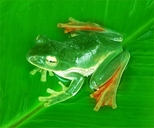
One of the discoveries in 2007 highlighted by the report is the bright green, red-footed tree frog Rhacophorus suffry called “flying frog” because its long-webbed feet allow the species to glide when falling.

The species is mainly found in swampy areas and is known only from five specific sites, including the Suffry tea estate in Assam where it was originally found and in neighbouring areas. Other new species from Assam include Amolops assamensis, a green and brown species which is also called the Assamese cascade frog. The report also mentions the “miniature muntjac”, also called the leaf deer (Muntiacus putaoensis) the world’s oldest and smallest deer species. It also highlights growing pressures on the ecosystems and species as a consequence of unsustainable development in the region.

“Despite protection efforts, in the last half-century, this area of South Asia has faced a wave of pressure as a result of population growth and the increasing demand for commodities by global and regional markets. The host of threats include forest destruction as a result of unsustainable and illegal logging, agriculture, unsustainable fuel wood collection, overgrazing by domestic livestock, illegal poaching and wildlife trade, mining,” the report says.

Wednesday, July 18, 2007

FLOWER POWER

Flower power


You have to visit Sikkim just to see the variety of orchids on display at a show


Be dazzled By the orchids


Make your travel plans now, for it is springtime in Sikkim, one of the most scenic States of the country. The highlight of the season is the orchids that are on display at the Flower Show in the capital Gangtok.

The show is extremely popular with tourists as one can see the various species of these exotic blooms that grow in the tiny State under one roof.
The mighty Mount Kanchenjunga at 8,586 m, the third highest peak in the world, towers over the land.

Conducive terrain

The Himalayan terrain is said to be extremely conducive to the growth of orchids, and some 600 species grow in the State. In fact, they can be seen flowering on the hillsides till August.
The Gangtok orchid show is held in a glasshouse made of plexiglass. The orchids are grown under controlled conditions in a specially designed orchidariums. The plants are temperature-sensitive.
Thus the display area is well ventilated, and efforts are made to recreate conditions akin to tree shade as orchids in Nature grow protected from direct sunlight.

Warmth and light

The plants enjoy humid and warm climes, and burst into life when there is even a light rainfall. To keep the humidity levels high, there is a small water body in the middle of the display area.
The flowers are prized for their ornamental value. The Indian Council For Agricultural Research (ICAR) has set up a National Research Centre for Orchids at Pakyong, Sikkim.

One of the most important species, Cymbidium goeringii, is native to the State. Popularly called Noble Orchid, this small white blossom is the State flower. The research centre also protects endangered species. Walking through the orchid show is an experience by itself. Understandably, it is a paradise for shutterbugs. At every turn, you are bound to find different colours and mind-boggling variety.

Some of the irresistible species are the Pure Choice Susan, Abacus Pure Love, Splatters Spotted Velvet, Valley Splash, Green Spectacle and Porter’s Dream. There is also an exhibition of flowers throughout the year, and the highlight is the rhododendron, of which 36 species can be found here.

Orchid Sancturies
The show is on near the White House Complex at Gangtok. Entry fee is Rs. 10, and visiting hours are between 9 a.m. and 5 p.m. There are also two established orchid sanctuaries at Singtam and Deorali.